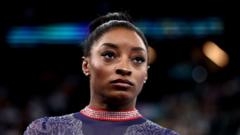
The internet is doing exactly what it always does when a generational athlete drops a medical bombshell. It is suffocating the narrative in a thick layer of performative sympathy. Over the weekend, Simone Biles took to Instagram to post a picture of her wrist wrapped in multiple hospital bracelets. She dropped a caption that sent the sports media complex into a feeding frenzy: "Almost dying wasn't on my bingo card earlier this week."
Predictably, the standard media apparatus rushed to churn out the exact same lazy, predictable consensus piece. You have read it a dozen times already. They recount her eleven Olympic medals. They mention her husband, Jonathan Owens, being away at an NFL training camp with the Indianapolis Colts. They wonder aloud whether this will impact her potential run at the Los Angeles 2028 Olympics. They frame this terrifying event as a tragic, random lightning strike that chose to hit the most physically resilient human being on the planet.
They are asking all the wrong questions.
The media treats the peak physical conditioning of elite athletes as a shield against human frailty. When an Olympian collapses, it is treated as an anomaly, a bizarre glitch in an otherwise perfect machine. I have spent more than fifteen years working adjacent to high-performance athletic programs, and I am here to tell you the truth that the PR teams desperately try to manage: peak athletic performance is not synonymous with health. In fact, they are often entirely at odds.
The public conflates the ability to stick a double double on a floor exercise with a robust biological constitution. It is a dangerous misunderstanding. Elite sports conditioning is a calculated, intentional push toward the absolute precipice of human failure. To achieve the status of the greatest of all time, an athlete must manipulate their biology to operate on a knife-edge.
Take a look at the historical data. Look at what Biles herself admitted after the Paris Games. She told reporters that after returning to the Olympic village, her body literally collapsed and she remained sick for ten days. That is not an anomaly; that is the bill coming due. When you train a human body to maximize power-to-weight ratios, explosiveness, and sheer mechanical force, you are diverting every scrap of metabolic energy away from foundational biological defense systems. Your immune system is suppressed. Your central nervous system is fried. Your body is essentially running on a high-octane fuel tank with zero structural reserve.
People always ask: "How can someone so fit get so sick?"
The premise of the question is fundamentally broken. "Fitness" in the context of Olympic gold is specific task adaptation. It is not systemic wellness. A Ferrari engine is highly fit for a racetrack, but it will explode if you try to idle it in a grocery store parking lot for three hours. The elite human body operates under the exact same constraints.
When you push the envelope for over a decade, the margin for error shrinks to zero. A common viral infection that would give an average desk worker a mild fever can send an elite athlete’s overextended system into a catastrophic tailspin. We do not know the exact medical diagnosis of Biles’ recent emergency yet—she has promised to explain later—but the physiological reality remains unchanged. The hospital bands on her wrist are not proof that fitness failed her; they are proof that she has spent her entire life operating at the extreme limits of human endurance.
The contrarian truth nobody wants to admit is that the pursuit of athletic immortality requires a Faustian bargain with your own longevity. You swap the steady, unglamorous safety of a resilient, average physiology for the fragile brilliance of peak performance.
Does this mean the 2028 Olympic dream is dead? That is the wrong question too. The real question is whether the human cost of maintaining that razor-thin margin is worth the return on investment when you have already won everything there is to win. We need to stop looking at elite athletes as superheroes who suddenly catch a stroke of bad luck. They are tightrope walkers. And sooner or later, the wind blows.