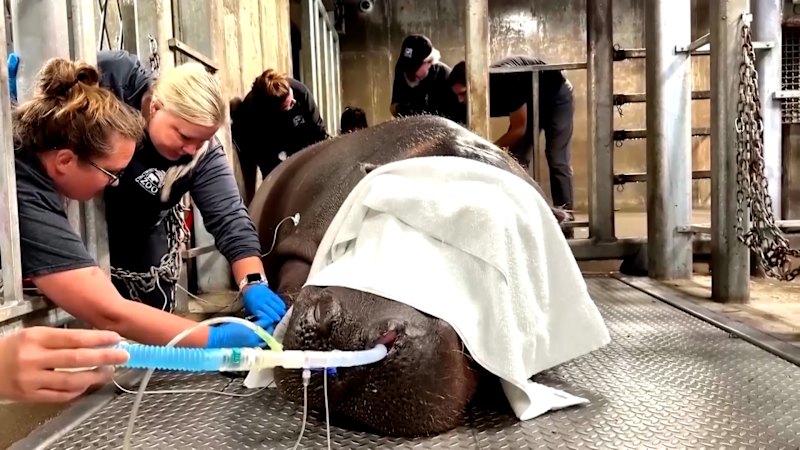
On November 19, 2026, Fiona, the world-famous nine-year-old Nile hippopotamus at the Cincinnati Zoo & Botanical Garden, died from severe gastrointestinal complications after swallowing a visitor's knit hat. The incident began roughly eleven days earlier when a guest tossed the hat into the air, where it struck a ceiling fan and deflected through a narrow gap above the exhibit's viewing glass into the hippo habitat. Despite round-the-clock intensive veterinary care, sedation, ultrasound monitoring, and a desperate attempt to dislodge the obstruction using a borrowed equine vibration plate, the synthetic fibers lodged twenty-five feet past her final stomach compartment, fifty feet shy of the end of her digestive tract, leading to fatal organ failure during recovery from an exploratory procedure.
Most news outlets covered the tragedy as a freak accident—a heartbreaking quirk of bad physics and bad luck. That framing misses the real story. When you look closely at the engineering of modern zoological exhibits, the physiology of megafauna, and the history of foreign-body ingestion in captivity, Fiona's death was not an unforeseeable anomaly. It was the predictable collision of open-air architectural trends and the unforgiving anatomy of a 3,000-pound herbivore. Expanding on this theme, you can also read: When the Shield Breaks in Rome.
The Architecture of Vulnerability
Modern zoo design has spent the last three decades tearing down barriers. The Victorian-era menagerie—defined by heavy iron bars, thick concrete moats, and sterile cages—was rightfully abandoned in favor of immersive, naturalistic habitats. The goal was twofold: improve animal welfare by mimicking wild environments, and deepen public empathy by bringing visitors closer to the animals than ever before.
At the Cincinnati Zoo's Hippo Cove, which opened in 2016, that philosophy translated into soaring glass viewing walls, open-air upper clearances, and ceiling fans designed to circulate air through the public viewing pavilion. Visitors stood mere inches from the water, separated from massive Nile hippos by thick acrylic panels. Above those panels, however, remained an open gap to allow airflow and acoustic connection between the crowd and the habitat. Experts at Associated Press have also weighed in on this matter.
In the zoological industry, this is known as the containment-immersion paradox. Every inch of physical barrier you remove to enhance the guest experience introduces a new vector for contamination. When millions of visitors pass through an exhibit every year, human error stops being a rare edge case and becomes a statistical certainty. People drop phones. Children throw toys. Hats blow off in the wind, or get tossed in moments of thoughtless play.
Industry safety audits traditionally focus on keeping dangerous animals inside their enclosures—a lesson the Cincinnati Zoo learned under intense global scrutiny in May 2016, when a three-year-old boy climbed into the Gorilla World habitat, leading to the fatal shooting of the silverback gorilla Harambe. Following that incident, barriers across North American zoos were raised, reinforced, and redesigned to prevent humans from falling in.
What those post-2016 engineering reviews largely overlooked was the reverse threat: small, seemingly harmless personal items crossing the threshold from the public gallery into the animal zone. A ceiling fan positioned near an open-top viewing wall turns any lightweight object tossed upward into a projectile. Once that knit hat cleared the top of the glass, no physical mesh, netting, or baffle existed to intercept it before it hit the water.
Why Hippo Anatomy Turns Cloth Into a Death Sentence
To the average observer, a hippopotamus eating a knit hat sounds minor. These are animals capable of crushing whole watermelons and pumpkins in a single bite, with jaws that exert nearly 2,000 pounds of force and stomachs built to ferment tough, fibrous grasses. If a hippo can digest woody reeds, why couldn't Fiona pass a soft winter beanie?
The answer lies in the fundamental chemistry of pseudoruminant digestion versus modern textile manufacturing.
Nile hippos possess a complex, four-chambered stomach designed to break down cellulose through microbial fermentation. Over millions of years of evolution, their digestive tracts adapted to process organic plant matter. What their gut bacteria cannot break down—and what stomach acids cannot dissolve—are synthetic polymers like acrylic, polyester, and nylon, which make up the vast majority of modern knitwear.
Unlike organic fiber, which softens and breaks apart under bacterial fermentation, synthetic yarn retains its tensile strength in the digestive tract. As the muscular walls of the small intestine contract in waves—a process called peristalsis—to push food forward, the fabric does not compress into a neat, passable ball. Instead, it unravels, tangles, and bunches.
According to Dr. Mike Wenninger, the Cincinnati Zoo's director of animal health, an ultrasound revealed that the hat had caused severe intestinal bunching. In veterinary medicine, this is one of the most lethal forms of gastrointestinal obstruction. As the intestine tries to push the anchored fabric forward, the bowel telescopes onto itself, cutting off blood supply to the intestinal wall, causing tissue necrosis, and eventually triggering systemic shock.
The Surgical Impossibility
When a dog or a human swallows a foreign object, a surgeon makes an abdominal incision, locates the blockage, opens the bowel, removes the item, and sutures the tissue closed. With an adult Nile hippopotamus, that standard protocol is virtually impossible.
Hippos present three distinct anatomical barriers to abdominal surgery:
- Dermal armor: A hippo's skin is up to two inches thick, dense, and poorly vascularized, making initial incisions grueling and post-operative wound closure prone to catastrophic dehiscence—where sutures tear open under the sheer weight of the animal's internal organs.
- Anesthetic fragility: Hippos exhibit an unusual physiological response to general anesthesia. Under heavy sedation, their respiratory drive drops precipitously, and the immense weight of their torso compresses their lungs when lying on their side or back. Furthermore, hippos possess a specialized dive reflex that alters blood flow and heart rate under stress, making anesthetic depth notoriously difficult to calibrate.
- Sheer scale: Fiona's gastrointestinal tract stretched well over seventy-five feet. The post-mortem necropsy revealed the hat was lodged twenty-five feet beyond her final stomach compartment and fifty feet from the exit. Reaching that specific loop of small intestine through layers of thick fat, muscle, and heavy viscera without causing fatal internal trauma is a feat veterinary surgery has rarely, if ever, successfully performed on a full-grown hippo.
Forced into non-invasive options, the Cincinnati veterinary team tried everything available in modern zoological medicine. They sedated Fiona twice, deployed a nine-foot colonoscope that could not reach deep enough into the convoluted tract, increased her feed intake to stimulate gut motility, monitored her hydration, and brought in a vibration plate from a local horse farm to mechanically shake the blockage loose. None of it could overcome the mechanical physics of synthetic yarn tangled seventy-five feet inside a three-thousand-pound body.
A Silent Pattern Across Global Zoos
Fiona's death captured global headlines because of her celebrity status. Born six weeks premature in January 2017 at just twenty-nine pounds—roughly half the normal birth weight for a Nile hippo—she survived only through unprecedented intervention by zoo keepers and neonatal specialists from Cincinnati Children's Hospital. She became a civic icon, boosted zoo attendance by twenty percent in her first year, doubled donations, and served as a living symbol of resilience for a city still bruised by the Harambe controversy.
Yet within the zoological profession, Fiona's cause of death belongs to a troubling, recurring pattern that rarely generates international outrage unless a star animal is involved.
Foreign-body ingestion is a persistent killer in accredited facilities worldwide. At a zoo in Tennessee, a rare antelope choked to death on the plastic cap of a visitor's snack pouch. At a German zoo, a polar bear died after swallowing a jacket dropped by a guest. Sea lions, penguins, big cats, and primates have all undergone emergency procedures—or died on the operating table—after ingesting coins, plastic wrappers, hair ties, and cell phones.
The uncomfortable truth that the Association of Zoos and Aquariums (AZA) and its member institutions must confront is that public education campaigns do not stop foreign-body fatalities. Signage asking guests not to throw items into habitats is ubiquitous, yet items continue to cross the line. In Fiona's case, the visitor did not even intend to throw the hat into the exhibit; they tossed it playfully in the air inside the viewing building, and a ceiling fan did the rest.
Good intentions do not protect an animal from poor environmental controls. If an object can physically enter an enclosure through an unscreened opening, an air gap, or an unbaffled ceiling fixture, eventually it will.
The Animal Welfare Counter-Argument
In the immediate aftermath of the announcement, animal rights organizations seized on Fiona's death to renew their foundational critique of captivity. Their argument is straightforward: in the wild rivers of sub-Saharan Africa, a hippopotamus never encounters acrylic knit hats, ceiling fans, or crowds of selfie-taking tourists.
That argument carries emotional weight, particularly when a beloved animal dies nine years into a forty-to-fifty-year captive lifespan. However, it ignores the harsh reality facing Nile hippos outside zoo walls.
Wild hippopotamus populations have declined sharply due to habitat loss, agricultural encroachment, drought, and poaching for meat and ivory teeth. In the wild, infant mortality is staggering; a premature calf born at twenty-nine pounds would have died within hours of birth, either from inability to nurse or predation by crocodiles and lions. Captivity gave Fiona nearly a decade of life, funded millions of dollars in conservation initiatives, and educated tens of millions of people about a vulnerable species.
The real debate is not whether zoos should exist. It is whether zoos are willing to sacrifice a fraction of their aesthetic openness to guarantee physical containment.
What Needs to Change Immediately
The Cincinnati Zoo's veterinary staff exhausted every medical option to save Fiona. Dr. Wenninger's candid admission following the necropsy—that no amount of supportive care or surgical intervention could have saved her once the hat lodged deep in her small intestine—underscores a stark reality. Once a foreign object enters a megaherbivore's digestive tract, medicine is largely powerless. Prevention is the only functional cure.
Accrediting bodies like the AZA and zoo architects must treat foreign-object intrusion with the same engineering rigor applied to perimeter security after 2016. Relying on visitor compliance is a failed strategy.
- Eliminate unscreened air gaps: Any viewing gallery featuring tall glass panels must install fine, high-tensile stainless steel mesh or transparent polycarbonate baffles extending all the way to the ceiling. Airflow can be maintained through perforated metal grilles without leaving open voids large enough for clothing, phones, or food containers to pass through.
- Audit mechanical fixtures near exhibits: Ceiling fans, overhead vents, and lighting rigs inside public viewing areas must be positioned and caged so they cannot deflect airborne objects toward animal habitats.
- Mandate pre-opening hazard sweeps: While keepers routinely inspect habitats each morning, facilities with high foot traffic require continuous visual monitoring of upper ledges, water skimmers, and perimeter gutters where dropped items accumulate before animals investigate them.
- Enforce strict loose-item protocols in high-risk zones: Just as amusement parks ban loose hats, phones, and bags on roller coasters, zoos should require visitors entering indoor viewing pavilions with open-top enclosures to secure loose headwear and handheld items.
Fiona's survival story in 2017 proved what human ingenuity and veterinary dedication could achieve when an animal's life hung in the balance. Her death in 2026 proves that all the medical brilliance in the world cannot compensate for an unguarded gap above a glass wall. Until zoos engineer human carelessness out of their exhibits, the animals inside will continue to pay the ultimate price for the objects we leave behind.


