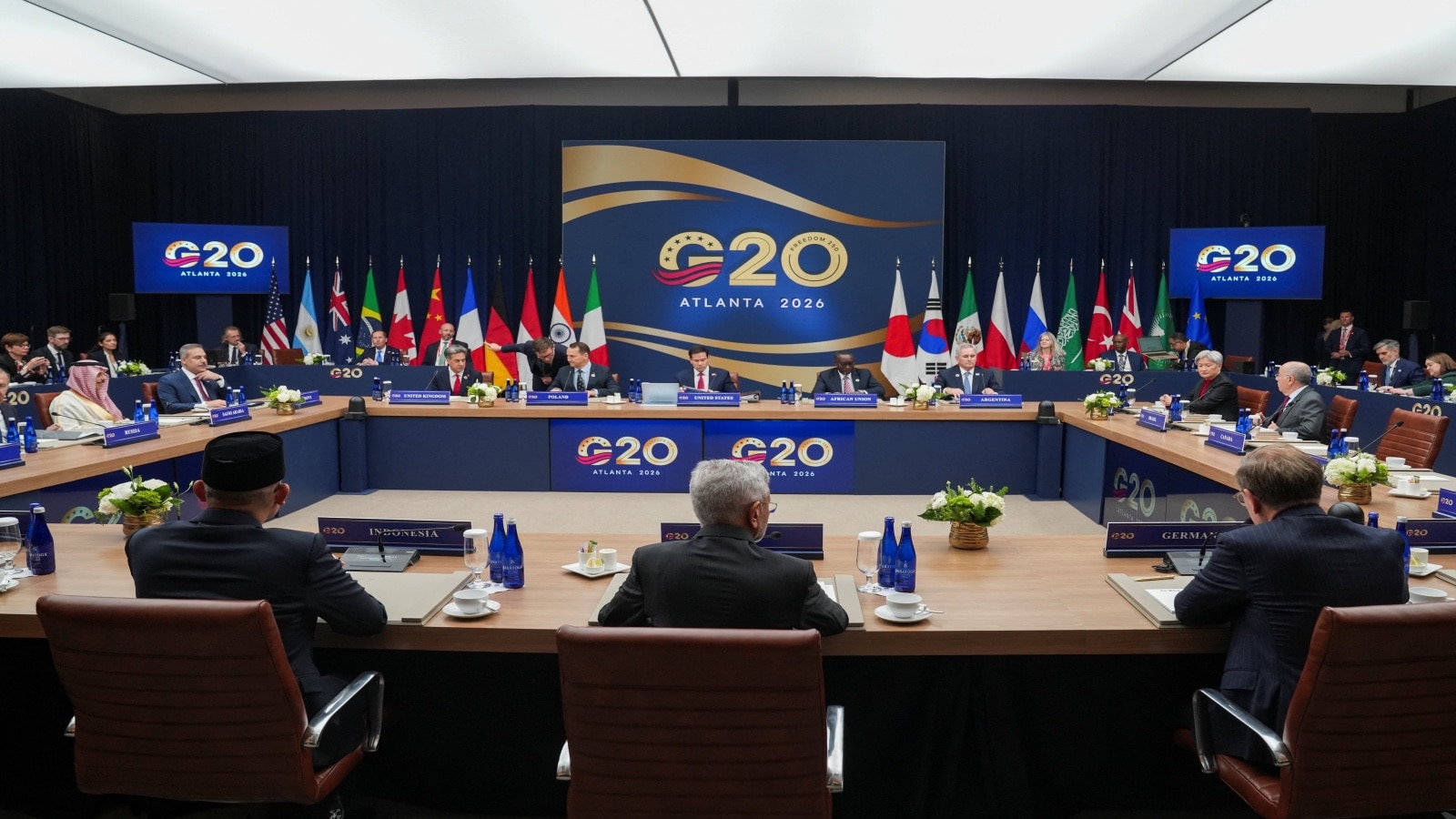
Mainstream foreign policy pundits are hyperventilating over a missing photograph.
When G20 foreign ministers quietly abandoned the traditional "family photo" to avoid standing shoulder-to-shoulder with Russian Foreign Minister Sergey Lavrov, the establishment press immediately declared the summit broken. The lazy consensus rolled off the presses right on schedule: multilateralism is dead, diplomacy is failing, and petty optics are ruining global governance.
They are completely wrong.
Obsessing over a missing grip-and-grin misses the actual mechanics of high-stakes diplomacy. Skipping the photo-op was not a sign of institutional collapse. It was a calculated, ruthless act of political preservation that saved the actual working sessions from imploding before the coffee even cooled.
The Tyranny of the "Family Photo"
To understand why the cable news crowd got this backwards, you have to understand what a summit photo-op actually is. It is not a diplomatic instrument. It is a domestic propaganda weapon.
When twenty foreign ministers stand on a riser smiling beneath a banner, that image does not go into a vault at the United Nations. It gets beamed straight to state-controlled television networks in Moscow, Beijing, and every other capital in the room. For a sanctioned regime isolated by Western financial systems, standing next to the U.S. Secretary of State or the German Foreign Minister isn't a polite formality. It is proof of legitimacy. It tells a domestic audience that the isolation is fake, the sanctions are theater, and the great powers are still doing business as usual.
I have watched corporate boards and trade delegations blow millions of dollars in negotiation capital because they didn't grasp this basic rule of optics. Once you give an adversary the visual of parity, you lose your asymmetric advantage before a single policy memo gets read.
By killing the photo-op, Western ministers denied Lavrov the single asset he flew thousands of miles to collect. They stripped him of the visual validation of normalcy without firing a shot or walking out of the building.
What Actually Happens Behind Closed Doors
The conventional wisdom assumes that if ministers won't stand together for thirty seconds in front of the press pool, they aren't talking at all. That is pure fiction.
Diplomacy operates on two completely separate tracks:
- The Public Theater: Press conferences, communiqués, flag ceremonies, and photo-ops designed entirely for domestic voters and media consumption.
- The Plumbing: Bilateral pull-asides, working-group drafts, debt restructuring frameworks, and central bank coordination that keep the global economy from seizing up.
When the cameras are banished, the performance anxiety vanishes. Ministers stop reading scripted talking points meant for evening news soundbites and start dealing with hard numbers. During the exact summits where pundits lamented the lack of a group photo, G20 finance tracks and sherpas were quietly hammering out sovereign debt restructuring mechanisms for distressed economies and aligning on cross-border payment regulations.
George Kennan, the architect of Cold War containment, understood this distinction better than anyone. In his famous "Long Telegram" and subsequent diplomatic postings, Kennan repeatedly warned against mistaking public gestures of goodwill for substantive agreement—and conversely, mistaking public friction for the end of communication. Real statecraft happens in the margins, precisely when the press corps isn't watching.
Dismantling the "Broken Multilateralism" Myth
Whenever a G20 meeting ends without a unanimous joint communiqué—or without a smiling group portrait—critics trot out the same tired autopsy. They claim the G20 has outlived its usefulness. They argue that the divide between the G7 and the BRICS nations has rendered the forum obsolete.
Let’s look at the actual premise of that argument. Why was the G20 elevated to the leaders' level during the 2008 financial crisis in the first place?
It was never designed to be a love-in of like-minded democracies. That is what the G7 is for. The G20 was built specifically because you cannot solve systemic global crises—financial contagion, supply chain shocks, pandemic responses, or sovereign defaults—without the messy, adversarial economies in the room. If everyone in the G20 agreed on human rights, territorial sovereignty, and geopolitical order, the organization wouldn't need to exist.
Expecting harmony at a G20 meeting is like complaining that a boxing ring has too much conflict. Friction is the entire point of the venue.
When ministers skip a photo-op, they are acknowledging reality rather than paper-macheing over it. Pretending that business is normal while a permanent member of the UN Security Council wages a land war in Europe would destroy the credibility of the other nineteen nations at home. If Western leaders stood grinning next to Lavrov, their own parliaments and voters would revolt, stripping those leaders of the political mandate required to ratify whatever economic agreements the G20 actually produces.
The Hidden Cost of Performative Unity
Imagine a scenario where the host nation forced the photo-op through anyway.
What happens next? Half the foreign ministers boycott the entire summit rather than risk the front-page headline back home. The chairs sit empty. The deputy ministers sent in their place lack the authority to make binding concessions. Suddenly, an optic meant to project "unity" guarantees total operational paralysis.
We saw this exact dynamic play out in smaller regional blocs throughout the late 2010s. Summits obsessed with producing unanimous, watered-down communiqués spent 90 percent of their floor time arguing over adjectives and commas, leaving zero bandwidth for actual crisis management.
By sacrificing the photo-op early, the G20 organizers acted as a pressure release valve. They gave Western ministers the domestic cover they needed to stay in the room, look their counterparts in the eye, and get through the agenda.
Where the Contrarian Playbook Breaks Down
Does this mean diplomatic optics don't matter at all? No. Pretending visuals are irrelevant is just as naive as thinking they are everything.
There is a real, measurable downside to normalizing the death of summit rituals. Every time a traditional diplomatic norm is quietly dropped to accommodate an impasse, it lowers the bar for the next crisis. Today it is the group photo. Tomorrow it is the formal bilateral meeting. Eventually, the connective tissue of protocol erodes to the point where states lose the muscle memory of how to de-escalate when a genuine nuclear or financial flashpoint hits.
Furthermore, for middle-power host nations—countries like India, Indonesia, or Brazil—the G20 presidency is a massive geopolitical coming-out party. Hosting the world's largest economies is supposed to showcase their arrival as indispensable global brokers. When major powers refuse to stand on the stage together, it dims the spotlight the host nation paid billions in infrastructure and security to build.
Host countries hate skipped photo-ops because they steal the visual proof of their own diplomatic clout. That friction between the host's desire for prestige and the guests' need for domestic political survival is a permanent structural flaw in modern summits.
How to Read the Next Summit Like an Insider
If you are an executive, investor, or policy analyst trying to figure out whether a major international summit actually succeeded, stop looking at the press pool. Follow the money and the technical working groups instead.
- Ignore the Communiqué: Whether a summit produces a "Chair's Summary" or a "Joint Declaration" is 99 percent linguistic gymnastics. Markets rarely move on summit adjectives anymore.
- Watch the Sherpa Track: Look at who showed up to the pre-summit technical meetings. If central bank governors, treasury deputies, and trade negotiators are still sitting across from each other for six hours a day, the plumbing is intact.
- Track the Bilateral Pull-Asides: The most important meetings at any G20 never appear on the official schedule. They happen in hotel hallways and unannounced 20-minute blocks between sessions. Look at the readout logs from foreign ministries 48 hours after the summit ends—that is where the real deals are buried.
- Separate Posture from Policy: When a foreign minister delivers a blistering speech condemning an adversary in the plenary session, check whether their treasury department issued any new sanctions the same week. If the rhetoric is loud and the regulatory register is quiet, nothing has changed.
The next time a major summit cancels its group photo, don't buy the breathless headlines about the collapse of the global order. The diplomats didn't fail to do their jobs. They simply refused to give their enemies a free billboard—and then went back to work.