The air tasted like dry concrete and crushed stone. For forty-eight hours, the sky above Indonesia did not belong to the living. It belonged to Mount Lewotobi Laki-Laki, a volatile architect of fire standing thousands of miles away in East Flores, whose sudden, violent cough sent millions of tons of pulverized rock and glass hurtling into the upper atmosphere. High-altitude winds carried that invisible, lethal shroud westward, directly into the flight corridors of Jakarta, a city of eleven million souls breathing through cloth masks and wondering when the ground beneath them would stop trembling.
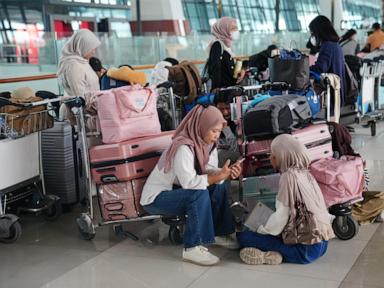
Consider Dewi, a twenty-eight-year-old software coordinator whose wedding dress was currently hanging in a garment bag inside a suitcase she could not check. Her flight out of Soekarno-Hatta International Airport had been scratched on Tuesday without warning. The departure board flickered with an unyielding parade of red cancellations, transforming an orderly terminal into a vast, anxious waiting room where thousands of travelers sat on the linoleum floors, charging phones against pillars and staring at blue screens that offered no guarantees. For an alternative look, consider: this related article.
Volcanic ash is not like normal weather. Rain passes; fog lifts with the morning sun. But volcanic glass is a quiet saboteur. When ingested into a jet turbine operating at thirty thousand feet, the microscopic shards melt at high temperatures, coat the turbine blades, and resolidify into a solid glaze. Engines choke. Power dies. Aviation authorities do not negotiate with silica. They ground everything.
For two days, the closure of flights to and from Indonesia’s capital severed arteries that kept families, commerce, and tourism alive. The economic cost ticked upward with every grounded Airbus and Boeing, but the true currency spent was human patience. Stranded tourists watched their holiday countdowns evaporate in airport cafes. Business travelers missed vital contracts. Families separated by island chains waited in limbo, listening to distant weather reports and checking radar maps that showed gray plumes swirling over the Java Sea like bruised ink in water. Similar reporting on this trend has been shared by Travel + Leisure.
Behind the locked gates, however, an invisible machinery was turning.
Meteorologists tracked the wind vectors hour by hour, feeding atmospheric data to the Indonesian Ministry of Transportation and AirNav Indonesia. Test flights—utilizing specialized aircraft equipped to measure particulate density—punched through the thinning haze at dawn on the third day. They measured the suspension index of the ash, flying loops through corridors that had been silent zones just hours prior.
The sensors came back clean. Or clean enough.
By Thursday morning, the ban lifted. The announcement did not come with fanfare; it arrived as a quiet ripple of updates on mobile applications and gate screens.
Dewi heard the shift before she saw it. The low, rhythmic thrum of a wide-body engine spooling up on the tarmac pierced the terminal glass. It was a sound of immense mechanical violence, but to the thousands waiting below, it was the sweetest music on earth. Security shutters rolled upward with a metallic screech. Lines reformed instantly, organic and self-organizing, driven by a collective, desperate momentum to reclaim their lives.
When Dewi finally handed her passport to the agent at Gate 14, her hands were shaking slightly. The agent did not smile—there was no time for pleasantries with a hundred people breathing down the queue—but she stamped the boarding pass with a sharp, definitive thud.
The plane taxied past grey-dusted perimeter fences, lifting off into a sky that was miraculously blue once more. Below them, the sprawling concrete expanse of Jakarta shrank into a hazy grid, resilient and breathing, having survived another reminder of the restless earth beneath its foundations.