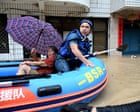
Rain does not always begin as a roar. Sometimes, it starts as a whisper against the tin roof, a gentle tapping that feels less like a threat and more like an old acquaintance returning for an evening visit. But when Typhoon Saudel gathered its breath over the warm, restless waters of the Pacific and set its sights on the southeastern coast of China, the whisper lasted only an hour before the sky simply gave way.
Picture Lin Zhao on a Tuesday afternoon in his ground-floor storefront in Guangdong. He was sixty-two, with hands calloused from decades of mending fishing nets and a quiet disposition that suggested he had seen enough weather to know arguing with the horizon was a fool's errand. Outside his window, the air had turned a bruised, metallic shade of violet. The humidity was so thick it felt like breathing warm soup. You might also find this connected article insightful: Why Jamaica Asking King Charles for Reparations is a Complete Waste of Leverage.
Lin did not panic when the local loudspeaker crackled to life, broadcasting the mandatory evacuation order. He simply sighed, looked at his stack of dry-goods ledgers, and reached for the heavy plastic sheeting he kept tucked behind the counter. He knew the numbers. When a storm of Saudel's magnitude—churning with sustained winds exceeding one hundred kilometers per hour—collides with a densely populated coastline, human stubbornness is the most fragile thing in the room.
Over two hundred thousand people were moved out of harm's way in those frantic, orchestrated hours. Behind that cold statistical abstraction lie hundreds of thousands of individual decisions to leave behind lifetimes. How do you pack forty years of existence into a single canvas rucksack? Do you grab the family photo albums or the spare shoes? Do you lock the front door of a house you might never see upright again, knowing full well that locks only keep honest people out, and water respects no boundaries? As extensively documented in recent reports by The Washington Post, the implications are significant.
The mechanics of mass evacuation are staggering. They require an invisible army of local officials, meteorologists, and bus drivers who do not sleep for days. They rely on the quiet obedience of citizens who trust that the radar sweeps and satellite data flashing across the television screens are not crying wolf. In an age where skepticism is practically a civic duty, there is something profoundly moving about a city of millions packing their bags simply because someone told them the sky was falling.
And the sky did fall.
By Wednesday night, the storm made landfall. The wind became a physical entity, a giant shoulder shoving against concrete walls and tearing corrugated iron from rooftops like paper. Power grids flickered and died, plunging entire neighborhoods into a howling darkness punctuated only by the strobe-like flash of shorting transformers. In the temporary shelters—gymnasiums, school auditoriums, municipal community centers—the air smelled of damp wool, instant noodles, and collective anxiety.
Children played tag between rows of cot beds, oblivious to the fact that their living rooms were currently swimming in three feet of brackish storm surge. The elderly sat on metal folding chairs, staring blankly at the gymnasium floor, lost in memories of older, harsher typhoons that carved notches into local folklore.
We often talk about natural disasters as if they are punctuation marks in history—isolated incidents with a beginning, a middle, and an aftermath. But for the people living through them, a typhoon is a lens that magnifies the fault lines of modern civilization. It exposes the fragility of our asphalt and glass, the terrifying power of rising tides, and the quiet heroism of neighbors carrying an invalid down three flights of dark stairs.
When the winds finally subsided and the gray, exhausted dawn broke over Guangdong, the damage was measured in billions of dollars and countless ruined possessions. Mud choked the streets. Uprooted banyan trees leaned drunkenly against shattered storefronts.
Yet, as Lin Zhao walked back down the blocked, debris-strewn alleyway toward his shop, he did not look down at the ruined inventory or the mud staining his ankles. He looked up at the jagged edge of his roof, still miraculously attached to the rafters, and then across the street to where his neighbor was already sweeping standing water out of a doorway.
The storm took the signs, the power, and the harvest. It did not take the morning.