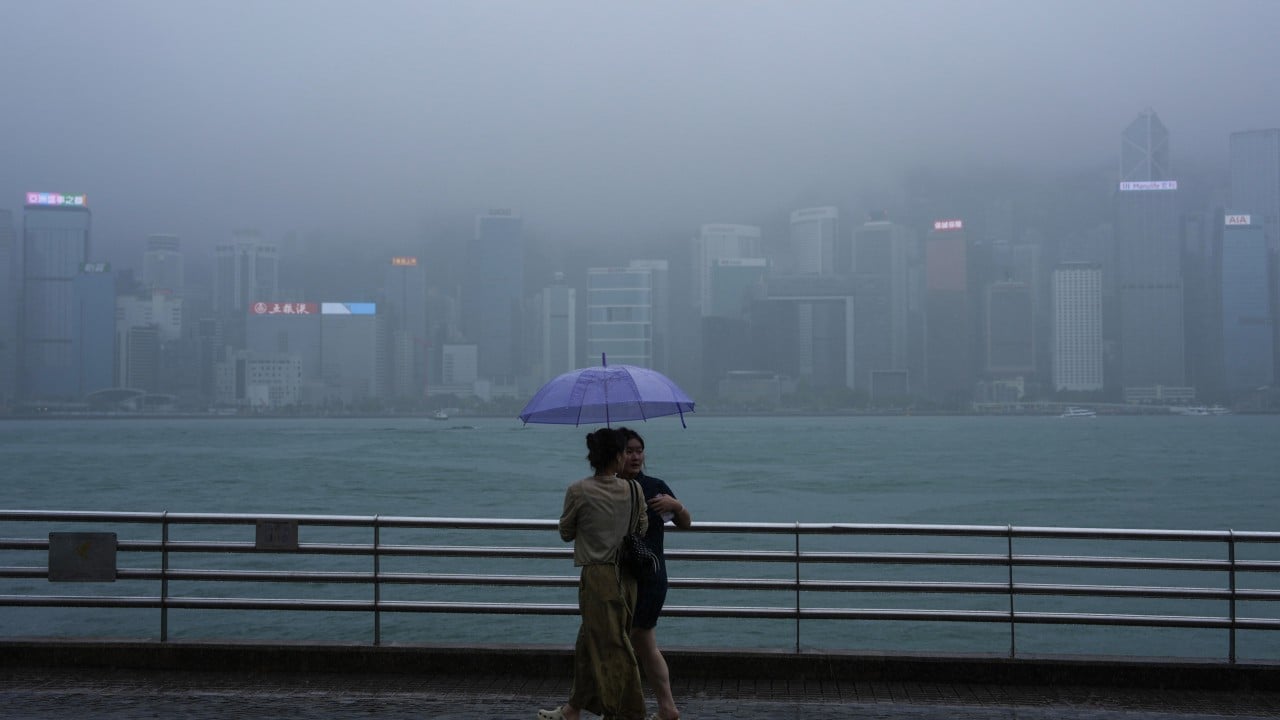
The Weight of an Amber Sky
Darkness does not always arrive with a dramatic crash. Sometimes, it pools slowly above the concrete canyons of the city, thickening until the neon signs bleed into a heavy, sulfurous haze.
For millions waking up in Hong Kong on a morning suspended between threat and routine, the sky spoke in a singular, urgent dialect. Water. Tons of it, poised at the edge of gravity, waiting for a signal.
Meteorologists watched the radar sweeps turn a bruised, violent purple. Sirens hummed low in the distance, a baseline anxiety vibrating through the glass towers and the steep, narrow stairwells of the older quarters. Parents stared at their phones, thumbs hovering over chat threads. Children laced their shoes with a strange, distracted quietness, listening to the drumbeat of wind against windowpanes.
Then, the official bulletin shifted.
The rainstorm warning was canceled. Afternoon schools would proceed as usual.
The Sudden Scramble of Real Life
Consider what happens next in a metropolis that operates like a finely tuned clock made of caffeine and adrenaline.
(Note: The following scenario illustrates the real-world friction experienced by thousands during sudden policy transitions.)
Imagine Mei-ling, a graphic designer and single mother living in a cramped flat in North Point. Ten minutes before the advisory lift, she had mentally mapped out an entire day of remote work at her kitchen table while her seven-year-old son, Ken, played blocks on the floor. Her schedule was built around the safety of four walls and a suspended workday.
When the alert tone chimed with the update, the domestic machinery had to reverse gears in seconds.
Jackets were shrugged off and replaced by school backpacks. Umbrellas—still damp from the early morning mist—were zipped back into side pockets. Mei-ling grabbed her transit card, her keys, and a half-eaten piece of toast, her heart performing a familiar, exhausting sprint against the clock. She was not angry. She was simply swept up in the abrupt velocity of a city rushing to catch up with a receding storm.
Across the harbor in Tsim Sha Tsui, office workers who had lingered over a second cup of coffee suddenly bolted for elevators. MTR stations swelled with a chaotic, shifting tide of humanity. Commuters who thought they had earned a rare, stolen afternoon of quiet found themselves shoulder-to-shoulder on crowded platforms, their damp shoes squeaking against the polished floor tiles.
Reading the Pulse of the Atmosphere
Weather in this part of the world is never just a meteorological event. It is an economic actor, a social disruptor, and a psychological test.
When the Hong Kong Observatory issues warnings—amber, red, or black—it is translating raw atmospheric fury into human terms. Each color code carries a cascade of automated consequences. Gates lock. Buses reroute. Exam timetables fracture. The decision to lift a warning is rarely a clean break; it is a calculated bet against the unpredictable whims of subtropical air masses.
To understand why thousands of citizens experience whiplash when these alerts change, you have to look at the unique topography of the territory. Urban density here is absolute. Millions of people move through vertical spaces, relying on a hyper-efficient subterranean transit network that connects subway cars to basement shopping malls and high-rise lobbies without ever exposing a traveler to the open air.
Yet, when the weather turns, that seamless infrastructure becomes a pressure cooker.
A sudden reversal means that thousands of transport workers, school administrators, and transit operators must pivot in unison. Bus drivers are recalled from standby. Canteen staff scramble to prep extra lunches. School gates, locked an hour prior, swing open to receive a flood of arriving children.
The Quiet Resilience Behind the Schedule
We tend to measure storms by the damage they leave behind. Fallen branches. Flooded underpasses. Slopes shored up with emergency netting.
We rarely measure the invisible weight of the pauses.
The mother who reorganizes her workday twice before noon. The teacher who adjusts a lesson plan while listening to the wind die down. The transit dispatcher who reroutes three dozen buses with a single keystroke. These are the small, unheralded gears that keep the massive engine of the city turning, long after the radar screens clear and the threat dissolves into a humid afternoon haze.
As the humidity rose and the damp pavement began to steam under the breaking sun, the city did not celebrate its reprieve. It simply resumed its stride. Footsteps echoed against the wet granite of the sidewalks, quick and rhythmic, marching toward whatever came next.