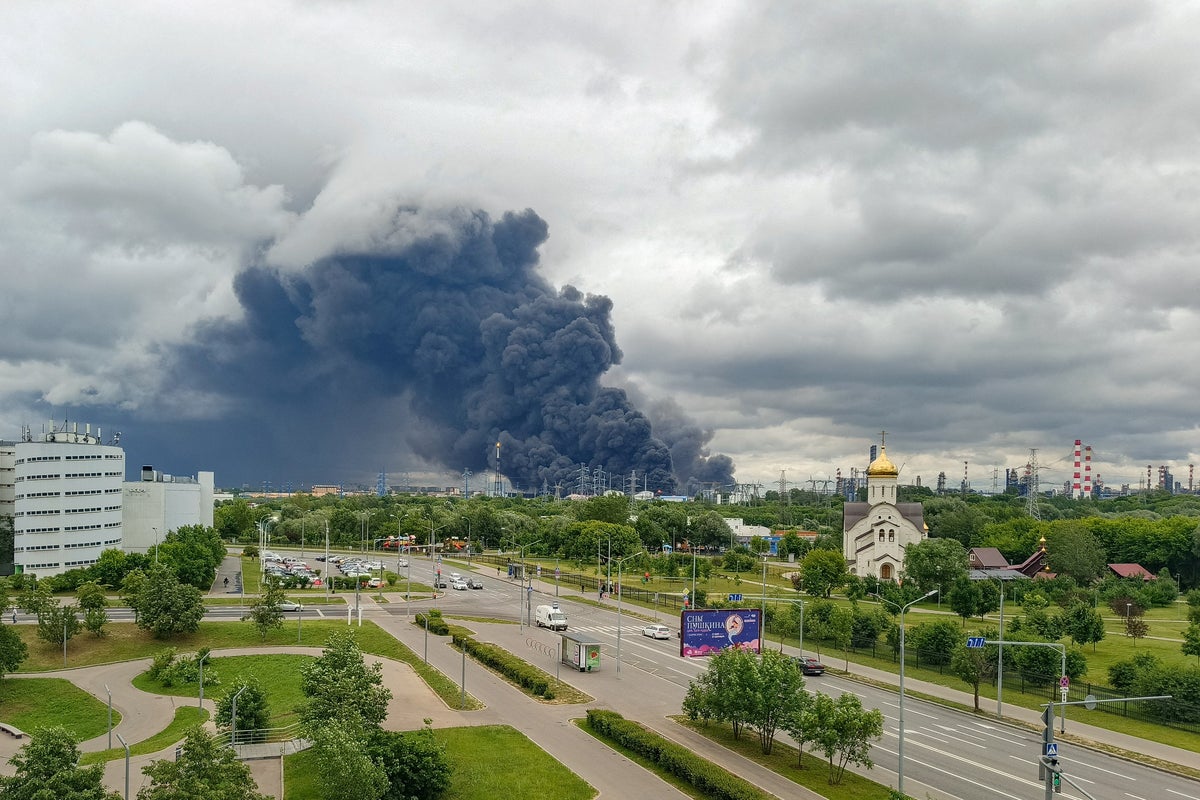
Rain fell on the cars parked in southeastern Moscow, but it was not water. It was a greasy, sooty black drizzle that stained windshields and left a bitter chemical tang in the back of the throat. A few kilometers away, the massive red-and-white smokestacks of the Moscow Oil Refinery in Kapotnya were choked by a different kind of cloud. Plumes of thick, dark smoke billowed so high they could be seen from the edges of the Kremlin.
For four years, the war was something Muscovites watched on television. It was a series of heavily edited reports from distant villages with names that sounded foreign, a geopolitical chessboard played out by professional soldiers. But when the lid of an oil storage tanker shot hundreds of meters into the sky, lifted by an explosion that rattled windows across the metropolitan area, the illusion shattered. You might also find this similar article useful: The Real Reason UN Mediation Frameworks are Failing (And How to Fix It).
War is no longer a localized tragedy. It has found its way to the pumps.
The Mathematics of the Sky
A standard news report looks at the raw data: nearly 200 drones intercepted over Moscow in a single morning, 16 major refineries hit across Russia, and roughly 30 percent of the nation's refining capacity pushed offline. Those numbers are staggering, but they fail to capture the friction of reality. As discussed in recent articles by NPR, the results are worth noting.
Consider a hypothetical driver named Alexei, trying to fill his sedan at a station in Saratov or Voronezh. He is met with new, strict limits on how much fuel he can buy. The lines are longer. The mood is tense. The same rationing is creeping across Tver, Omsk, and Tatarstan.
To understand why this is happening, look at the sky. For a long time, the conflict was defined by heavy artillery and grinding territorial shifts on the front lines. But a shift has occurred, driven by a fleet of low-cost, long-range Ukrainian drones like the Liutyi and the FP-1. These are not multimillion-dollar stealth bombers. They are essentially flying lawnmowers packed with explosives and guided by satellite networks.
They bypass sophisticated air defenses through sheer volume. When hundreds of drones fly simultaneously, some will get through. And when they hit a fractional distillation tower at a refinery, they do not just cause a fire. They destroy highly specialized, custom-built industrial components that take months—sometimes years—to replace under heavy international trade sanctions.
The Language of Leverage
The response from leadership has been a study in rhetorical pivot. Vladimir Putin publicly frames these strikes as acts of desperation. He points to the battlefield, where Russian troops continue to crawl forward, village by village, using massive, Soviet-era gliding bombs to flatten Ukrainian defensive lines. The official line is clear: Russia is winning where it matters, and these infrastructure attacks are merely attempts to destabilize society.
But the tone behind the scenes tells a different story. For months, peace negotiations mediated by international parties had fizzled. The terms offered by Moscow were maximalist, requiring total capitulation. Now, as the smoke clears over Kapotnya, the word "talks" is suddenly back in the official vocabulary, tethered to previous frameworks discussed in Istanbul.
It is a classic demonstration of changing the cost-benefit analysis of an adversary. Ukrainian President Volodymyr Zelenskyy summed it up bluntly: if one side burns, the other will too. The strategy is not to defeat the Russian army in a traditional tank battle, but to make the economic and domestic political cost of continuing the war unsustainable.
When international airlines have to cancel hundreds of flights because the airspace over Moscow’s major airports is shut down three days in a row, the disruption ripples through the elite and the middle class alike. The conflict cannot be compartmentalized when the infrastructure keeping the capital running is actively burning.
The Friction of the Machine
The true vulnerability of any industrialized nation is its supply chain. In the Russian-occupied territories of southeastern Ukraine and the Crimean peninsula, the fuel crisis is not an inconvenience; it is a critical operational bottleneck. Military trucks require diesel. Tanks require fuel. If the refineries feeding those supply lines are forced into unscheduled maintenance, the entire machinery of state slows down.
We often think of modern warfare as a clash of doctrines or political wills. In reality, it is a race against depreciation. Every drone strike forces a restructuring of logistics. It requires diverting anti-aircraft batteries from the active front lines to protect civilian industrial hubs deep inside the interior. It consumes spare parts that cannot be easily reordered on the open market.
The narrative of an unstoppable military machine breaks down when confronted with the quiet, persistent reality of a fuel pump that runs dry. The psychological impact is subtle but corrosive. It breeds a quiet uncertainty, an unspoken realization that the geographical distance protecting the center of power has evaporated.
The black rain in Kapotnya eventually stopped, replaced by the grey haze of a summer afternoon. The fires were contained, and the emergency crews went home. But the stains on the pavement remain, a permanent reminder that the front line is no longer hundreds of miles away. It is right outside the window, humming quietly in the sky.