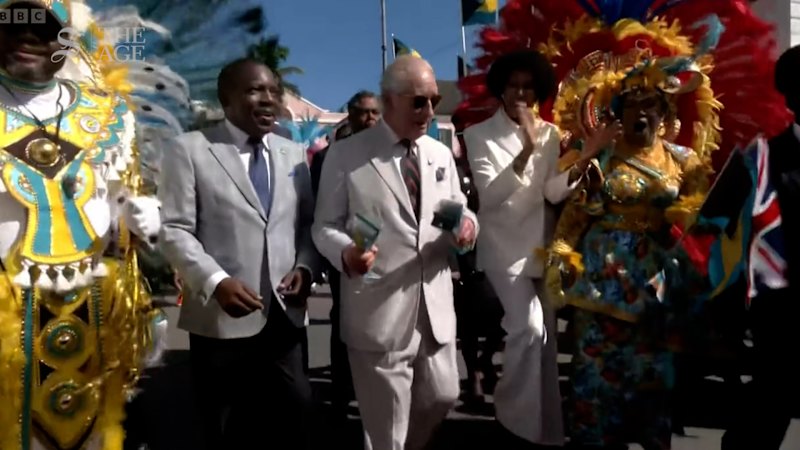
Public displays of cultural participation by the British sovereign in Commonwealth realms are frequently dismissed by mainstream media as lighthearted photo opportunities, yet they function as calculated instruments of institutional survival. When King Charles III engages in traditional Bahamian Junkanoo rhythms or local festivities, the action represents a deliberate deployment of soft power designed to offset rising republican sentiment across the Caribbean. Understanding this dynamic requires stripping away the tabloid framing of a monarch "getting into the groove" and analyzing the event as an exercise in constitutional brand management, diplomatic signaling, and political risk mitigation.
The Structural Vulnerability of the Caribbean Crown
The British monarchy faces an acute retention crisis across its remaining Commonwealth realms, particularly within the Caribbean Community (CARICOM). Following Barbados's transition to a parliamentary republic in November 2021, republican movements in Jamaica, Antigua and Barbuda, and the Bahamas gained measurable political momentum. In this environment, the Crown operates not as an executive authority, but as a symbolic asset whose continued retention depends entirely on perceived cultural relevance and diplomatic utility.
Conventional royal tours rely on rigid protocol—military inspections, formal state banquets, and top-down charitable patronages. Within post-colonial nations grappling with the legacies of the transatlantic slave trade and calls for reparatory justice, rigid formality reinforces the perception of the Crown as an external, anachronistic imposition. This creates a structural vulnerability: the wider the cultural distance between the sovereign and the local electorate, the lower the political cost for local prime ministers to initiate constitutional reform toward republicanism.
To counter this vulnerability, royal communications teams and Foreign, Commonwealth and Development Office (FCDO) strategists have shifted toward participatory cultural diplomacy. By stepping out of the formal perimeter and engaging directly with indigenous Bahamian cultural expressions—such as Junkanoo music, local culinary traditions, or community street festivals—the monarch attempts to signal cultural humility and shared identity. The operational objective is to convert the sovereign from a symbol of historical subjugation into an accessible, unifying figurehead.
Deconstructing the Mechanics of Participatory Diplomacy
When a head of state participates in local dance or music, the resulting visual assets perform specific functions across three distinct stakeholder groups. Each audience processes the event through a different political and economic lens.
- The Domestic Bahamian Electorate: For citizens in Nassau and the Family Islands, the primary friction point regarding the monarchy is legitimacy. Participation in local customs serves as a non-verbal acknowledgment of Bahamian cultural sovereignty. Rather than requiring the host nation to conform exclusively to British ceremonial standards, the monarch adapts to the host's cultural cadence. This reduces immediate populist friction, though its durability depends on whether the gesture is backed by substantive diplomatic concessions.
- Regional CARICOM Leadership: Political leaders across the Caribbean monitor royal visits closely to gauge public appetite for constitutional change. A hostile or indifferent public reception provides political cover for accelerating republic referendums. Conversely, warm public engagement—amplified by viral footage of the King interacting casually with local performers—signals to regional governments that dismantling the monarchy carries potential electoral risk or offers insufficient immediate political return.
- The Global Media and Domestic UK Audience: International broadcasts require high-contrast, emotionally resonant imagery to justify coverage of diplomatic tours. Formal speeches rarely penetrate global news cycles; a 75-year-old monarch dancing in the Caribbean reliably generates front-page visibility. For the British public, this imagery reinforces the narrative that the Commonwealth remains a cohesive, voluntary, and affectionate network of nations, thereby validating the institution's domestic funding and constitutional status.
The Economics of Royal Soft Power and Tourism Signaling
Beyond constitutional survival, high-profile royal engagements function as an uncompensated global marketing campaign for the host nation's primary economic engine. The Bahamas relies heavily on tourism, which accounts for roughly half of its gross domestic product and employs a comparable share of its workforce.
When international media outlets syndicate footage of the British monarch enjoying Bahamian culture, the destination receives immediate validation across high-income demographics in the United Kingdom, Europe, and North America. This dynamic operates through two economic mechanisms:
- Brand Association and Security Signaling: Royal visits require exhaustive security vetting by British protection officers and local authorities. The visible, relaxed participation of the King in public spaces serves as an implicit endorsement of the destination's safety and stability, countering negative travel advisories that periodically affect Caribbean jurisdictions.
- Cultural Differentiation: Caribbean destinations compete intensely for luxury and experiential travelers. By spotlighting specific Bahamian cultural assets—such as Junkanoo percussion, local craftsmanship, and environmental conservation initiatives—the coverage differentiates the Bahamas from generic sun-and-sand competitors, driving demand toward higher-margin cultural and eco-tourism sectors.
For the Bahamian government, hosting the sovereign becomes a transactional calculation. The state absorbs the direct fiscal costs of security, logistics, and hospitality in exchange for international media exposure that would cost tens of millions of dollars to purchase through conventional advertising channels.
The Friction Points and Limitations of Symbolic Gestures
While participatory diplomacy generates short-term positive media cycles, relying on cultural gestures to resolve deep-seated post-colonial tensions introduces significant strategic limitations. Public relations tactics cannot neutralize structural grievances.
The primary limitation is the Authenticity Deficit. Contemporary audiences, particularly younger demographics in the Caribbean, possess high media literacy and routinely scrutinize state-managed optics. When a monarch participates in local festivities without addressing underlying demands for formal apologies regarding the Crown's historical involvement in slavery, critics frame the behavior as performative distraction. In this scenario, the visual intended to build rapport instead highlights the absence of substantive policy action.
A second constraint is Demographic Divergence. Polling across the Caribbean consistently demonstrates a sharp generational divide regarding the monarchy. Older citizens often retain a sense of historical affinity toward the Crown, shaped by the mid-twentieth-century transition to independence. Voters under the age of 40 exhibit far lower attachment to British institutions and view the monarchy primarily through the lens of contemporary social justice and national self-determination. Viral clips of royal dancing rarely alter the structural political preferences of younger cohorts, who prioritize economic opportunity, climate finance, and full constitutional autonomy over ceremonial ties.
The third limitation involves Protocol Risk. Unscripted physical participation carries inherent reputational hazards. Any perceived awkwardness, misstep, or cultural misappropriation can instantly invert the intended narrative, turning an exercise in diplomatic warmth into a subject of global ridicule. Royal handlers must constantly calibrate the boundary between approachable participation and the preservation of institutional mystique; if the sovereign becomes too ordinary, the primary argument for hereditary monarchy—its transcendent, above-politics dignity—erodes.
Comparative Analysis of Commonwealth Retention Strategies
To evaluate the efficacy of cultural participation, it is necessary to compare it against the broader toolkit employed by Buckingham Palace and the UK government to maintain Commonwealth cohesion.
- Informal Cultural Immersion: Low-cost, high-visibility actions such as joining local dances, sampling street food, or wearing locally crafted garments. This approach yields immediate media engagement and softens the sovereign's personal image, but its political half-life is short. It buys time rather than securing permanent loyalty.
- Thematic Policy Alignment: Championing issues of existential importance to host nations, notably King Charles III's decades-long advocacy regarding climate change, ocean conservation, and sustainable urbanism. For low-lying archipelagic states like the Bahamas, which face severe existential threats from rising sea levels and intensifying hurricanes, royal alignment on climate finance carries far greater diplomatic weight than ceremonial participation.
- Historical Reckoning and Institutional Transparency: Supporting independent academic research into the monarchy's historical links to the slave trade and facilitating open dialogue with reparations advocates. This represents the highest-risk, highest-reward strategy. While it alienates traditionalists in the United Kingdom, it is the only mechanism capable of addressing the root cause of Caribbean republicanism.
The Bahamas engagement demonstrates a deliberate blending of the first and second strategies: pairing accessible cultural imagery with institutional focus on environmental resilience. However, by avoiding the third strategy—direct engagement with historical reparations—the Crown leaves its foundational vulnerability intact.
Tactical Execution for High-Stakes Diplomatic Optics
When institutions deploy leaders into culturally sensitive or politically contested environments, operational success requires strict adherence to disciplined communication frameworks. The execution observed in the Bahamas illustrates a specific sequence of tactical steps designed to maximize positive optic yield while containing downside risk:
- Pre-Event Local Integration: Ensure that local cultural practitioners, musicians, and community leaders control the creative framing of the interaction. The principal must enter the host's space as a guest following local cues, rather than staging a sanitized version of local culture inside a diplomatic compound.
- Controlled Spontaneity: Eliminate rigid time markers during community walkabouts to allow natural interactions to unfold, while maintaining tight perimeter control to prevent security incidents or organized protests from dominating the camera frame.
- Narrative Anchoring: Pair every lighthearted visual moment with a substantive policy touchpoint on the same itinerary. If the morning schedule features cultural festivities, the afternoon schedule must feature measurable commitments—such as Commonwealth scholarships, marine conservation grants, or climate resilience partnerships—to prevent critics from dismissing the trip as purely ceremonial.
- Rapid Digital Distribution: Bypass traditional broadcast delays by capturing high-resolution, vertical-format video directly through internal communications teams for immediate release across social platforms, ensuring the institution controls the initial framing before external commentators can apply cynical overlays.
Strategic Forecast for the Bahamian Crown
The current trajectory of the British monarchy in the Bahamas points toward a prolonged period of managed ambiguity rather than an immediate constitutional break. Unlike Barbados, which executed its transition to a republic via a parliamentary vote without a public referendum, the Bahamian constitution requires a national referendum to abolish the monarchy. Referendums introduce high political volatility; sitting prime ministers rarely expend political capital on constitutional ballots unless victory is assured, as a failed referendum weakens the governing party's mandate on economic and social legislation.
Consequently, cultural diplomacy—exemplified by King Charles III's active participation in Bahamian traditions—will remain a viable holding pattern for the medium term. By projecting warmth, minimizing ceremonial friction, and aligning with Bahamian environmental interests, the Crown raises the political threshold required for local leaders to campaign against it.
However, symbolic capital depreciates rapidly in the face of economic and generational shifts. To prevent an eventual, irreversible slide toward republicanism over the next decade, royal strategists must transition from passive cultural appreciation to active institutional utility. The monarchy's survival in the Caribbean will not be secured on a dance floor in Nassau, but through its capacity to broker tangible climate finance, educational exchange, and trade advocacy that deliver measurable economic returns to Bahamian citizens. Without that structural value proposition, participatory optics will merely delay an inevitable constitutional exit.