The air in San Luis Obispo County carries a specific weight in May. It is the scent of blooming jasmine clashing with the salt spray of the Pacific, a fragrance that usually signals the beginning of summer for students at Cal Poly. But for nearly thirty years, that breeze has carried something else. A question. A silence. A jagged hole in the map where a nineteen-year-old girl named Kristin Smart used to be.
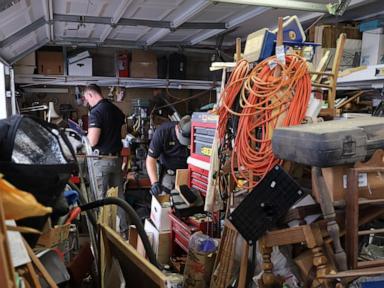
Justice does not always arrive with a gavel's strike or a dramatic confession. Sometimes, it arrives in the form of a backhoe, a ground-penetrating radar, and the persistent, rhythmic scraping of trowels against dirt. Today, that sound echoes in San Pedro, California. Investigators are once again sifting through the earth at a home connected to the man who stole Kristin’s future. They are looking for the fragments of a life that was supposed to be lived, not buried.
The Girl Who Became a Ghost
To understand the stakes of a suburban backyard being cordoned off with yellow tape, you have to remember Kristin. She wasn't a case file. She was a daughter from Stockton with a bright, wide smile and a penchant for dreaming bigger than her dorm room could hold. On Memorial Day weekend in 1996, she walked toward her residence hall after a party. She was flanked by Paul Flores, a fellow student who volunteered to walk her home.
She never made it to her door.
Flores went back to his life. He went to work. He moved. He aged. For decades, he existed in a state of suspended animation, a man shadowed by a cloud of suspicion that never quite broke into a storm. Meanwhile, the Smart family lived in a different kind of purgatory. Imagine every phone call being a potential breakthrough. Imagine every sunset being a reminder that another day has passed without her. The grief didn't shrink; they just grew larger around it.
The House on the Hill
When police descend on a property like the one in San Pedro—the home of Paul’s father, Ruben Flores—they aren't just looking for bones. They are looking for the architecture of a cover-up. The conviction of Paul Flores in 2022 for first-degree murder was a seismic shift, but it left a lingering, agonizing void. He was found guilty of killing her, but the jury was told a harrowing story: Kristin’s body had been buried under the deck of the Flores home in Arroyo Grande, then moved.
This is the "invisible stake" that haunts the central coast of California. It is the knowledge that a body was treated like cargo.
The current search is an admission that the story isn't over. Investigators are now operating on a grim logic. If a body is moved, it has to go somewhere. The earth is a vast witness, but it is also a difficult one to interrogate. You cannot simply ask the soil where it hid the evidence. You have to listen to the density of the ground. You have to look for "anomalies"—places where the dirt has been disturbed, where the natural layering of the planet has been interrupted by human desperation.
The Mechanics of a Long Shadow
Search warrants at this stage of a cold case are not "fishing expeditions." They are the result of data. They are the culmination of tipsters finally finding their courage and forensic technology catching up to old crimes. When the sheriff’s department moves in, they bring more than shovels. They bring a collective memory of every mistake made in 1996—the missed opportunities, the delayed searches, the arrogance of a killer who thought he was smarter than the system.
Consider the psychological toll of living near a site like this. Neighbors see the black SUVs. They see the men in forensic suits. It transforms a quiet street into a theater of the macabre. But for the Smarts, this isn't a spectacle. It is a biological necessity. There is a primal human need to return the dead to the earth on our own terms, not the killer's.
We often speak of "closure" as if it’s a door that clicks shut. It isn't. It’s more like a wound that finally stops bleeding but never stops being a scar.
Why We Still Care
It would be easy to look at a thirty-year-old case and ask why the resources are still being spent. The answer lies in the contract we have with one another. If a nineteen-year-old can vanish on a college campus and we simply stop looking because too much time has passed, we admit that life is cheap. We admit that if a killer is patient enough, he wins.
The persistence of this investigation is a refusal to let Paul Flores win the final round. He is behind bars, but he still holds the ultimate leverage: the location of Kristin’s remains. It is a cruel, final bit of power. By digging in San Pedro, the state is attempting to strip that power away from him.
Every bucket of dirt filtered through a screen is a message. It says that Kristin Smart is still a daughter of California. It says that the passage of decades does not dilute the requirement for the truth.
The investigators are working in the heat. They are tired. They are covered in the dust of a backyard that has kept its mouth shut for far too long. But they keep digging. They dig because somewhere, beneath the concrete or the flowerbeds or the patio stones, is a girl who just wanted to go home. And until she does, the soil remains a crime scene.