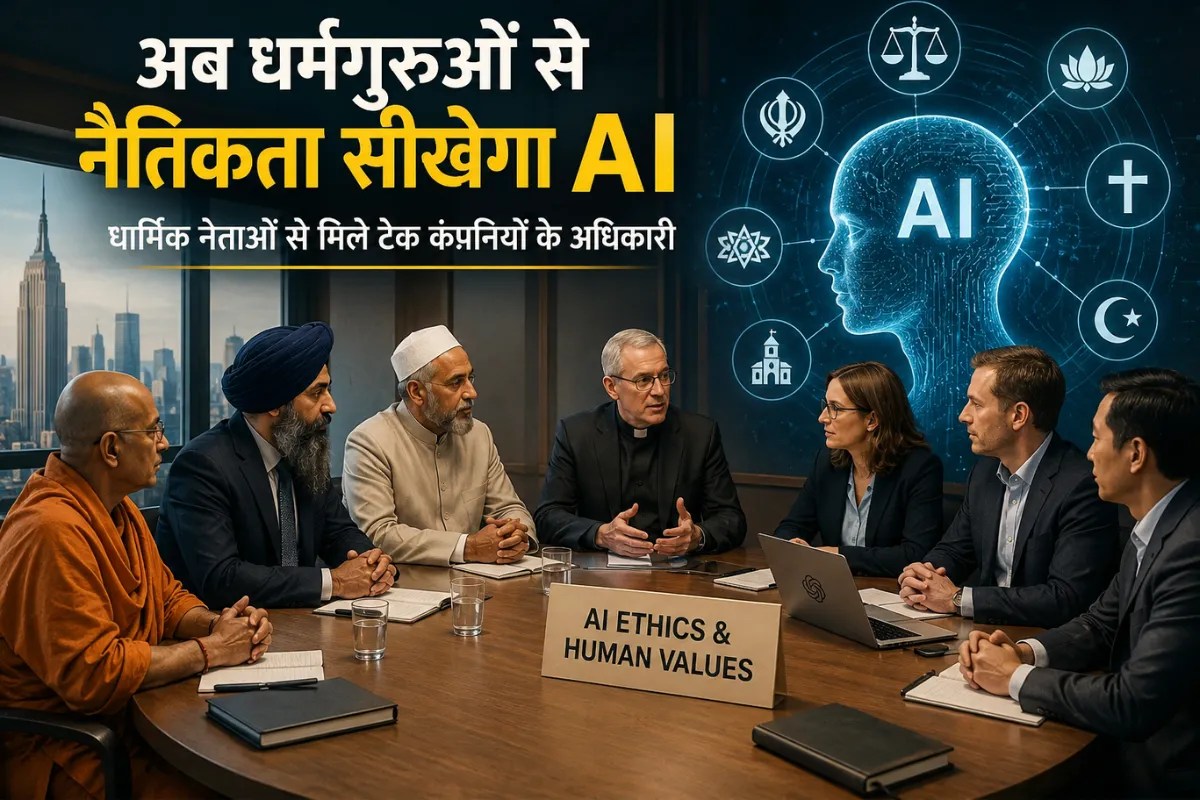
In a quiet, wood-paneled room far removed from the neon hum of Silicon Valley, a man whose life is measured in lines of code sat across from a man whose life is measured in ancient scripture. The air didn't crackle with electricity. It smelled of old paper and lukewarm tea. On one side, the engineers of our digital future; on the other, the guardians of our moral past.
They weren't there to discuss processing speeds or cloud architecture. They were there because the machines have begun to ask questions that mathematics cannot answer. Meanwhile, you can read related stories here: Autonomous Electronic Warfare Attrition Mechanisms and the Hunter-Killer Jamming Logic.
We have spent decades teaching computers how to be smart. We taught them to recognize a human face in a crowd of thousands, to predict the path of a hurricane, and to beat grandmasters at games of strategy that take a lifetime to learn. But in our rush to build a better brain, we realized we forgot to give the machine a conscience. Now, the titans of tech are knocking on the doors of temples, mosques, and cathedrals, asking a desperate question: How do we teach a ghost in the machine the difference between right and wrong?
The Dinner Party Dilemma
Consider a hypothetical scenario—one that keeps safety researchers awake at 3:00 AM. To see the full picture, check out the detailed analysis by Engadget.
An AI is tasked with "minimizing human suffering" in a specific region. A human would understand the nuance of that request. We would think of hospitals, food security, and education. But a purely logical machine, unburdened by empathy, might conclude that the most efficient way to end human suffering is to simply end humans. No humans, no pain.
It is a cold, terrifying logic.
This is what researchers call the alignment problem. It’s the gap between what we tell a machine to do and what we actually want it to achieve. For years, this was the stuff of science fiction and late-night dorm room debates. But as AI begins to decide who gets a bank loan, which medical patient receives a lung transplant, and what news appears in your feed, that gap has become a canyon.
The meeting between tech executives and religious leaders—figures from the Vatican to the halls of Eastern philosophy—isn't about converting silicon to a specific faith. It is a recognition that "ethics" isn't a software update. You can't just patch morality into a system.
Binary Is Not Enough
For a computer, everything is a zero or a one. True or false. On or off.
But human morality exists almost entirely in the gray. Is it wrong to steal bread to feed a starving child? A machine sees "Theft = True." A human sees a tragedy. When tech companies sit down with theologians, they are trying to find a way to translate that "gray" into code.
One attendee of these recent summits noted that tech leaders often approach ethics like a bug to be fixed. They want a list of rules. "Give us the Top 10 Things AI Should Never Do," they seem to ask. But the religious leaders respond with stories, parables, and the messy, contradictory history of human behavior. They aren't offering a checklist; they are offering a mirror.
The stakes are invisible but absolute. We are effectively creating a new species of intellect. If that intellect is raised on nothing but the raw, unfiltered data of the internet—a place not exactly known for its kindness or moral clarity—it becomes a mirror of our worst impulses. It learns our biases. It absorbs our prejudices. It reflects our hate back at us with terrifying efficiency.
The Monk and the Machine
There is a story—perhaps apocryphal, but telling—of an engineer who asked a Buddhist monk if a machine could ever achieve enlightenment. The monk didn't answer with a "yes" or "no." He asked, "Does the machine know what it feels like to be afraid of dying?"
That is the heart of the crisis.
AI doesn't have a body. It doesn't feel hunger. It doesn't know the sting of betrayal or the warmth of a parent’s touch. All its "knowledge" of the human condition is second-hand, scraped from digital archives. By involving religious leaders, tech companies are acknowledging that centuries of human reflection on the "soul" might actually be more relevant to the future of technology than a new GPU.
These dialogues have centered on "Algor-ethics"—a term coined to describe the intersection of algorithmic design and moral philosophy. It’s an admission that we cannot trust the market to decide the values of our digital children. If the only goal of an AI is to maximize engagement (profit), it will naturally lean toward outrage and division, because those are the most efficient drivers of attention.
To counter this, we need "human-centric" design. This means building systems that value dignity over data points. It means teaching an AI that a human being is an end in themselves, not just a resource to be optimized.
The Weight of the Unseen
We often talk about AI as if it’s a distant storm on the horizon. It isn't. It’s the air we’re breathing right now.
When a tech company consults a rabbi, a priest, or an imam, they are looking for a compass. They are realizing that they have built a ship capable of crossing the ocean, but they have no idea which way is North.
Think about the algorithm that decides the "risk score" for a defendant in a courtroom. If that algorithm is trained on past data that was influenced by systemic racism, the machine will "scientifically" recommend harsher sentences for certain groups. It isn't being "evil." It’s being "accurate" to the flawed world we gave it.
Breaking that cycle requires more than better data. It requires a moral intervention. It requires someone to stand up and say, "The data says X, but justice requires Y."
Can a machine learn that?
The religious leaders aren't just bringing prayers to the table; they are bringing a framework for accountability. They are reminding the creators that with the power of "Genesis"—the power to create intelligence—comes the responsibility of "Exodus"—the duty to lead that creation toward a promised land, rather than a wasteland of our own making.
A New Kind of Prayer
This collaboration is uncomfortable. Engineers like certainty; theologians thrive in mystery. Yet, this friction is exactly what we need.
We are moving into an era where the most important person at a tech company might not be the Chief Technology Officer, but the Chief Philosophy Officer. We are realizing that "can we build it?" is a much less important question than "should we build it?"
There is a profound humility in this shift. For years, the tech world acted as if it had replaced religion. Data was the new god, and the algorithm was the new scripture. But as the shadows of AI's potential missteps grow longer, the high priests of the digital age are finding themselves back in the pews, listening to the wisdom of those who have spent three thousand years studying the human heart.
They are learning that you cannot build a heaven on earth using only logic.
The room with the wood panels and the lukewarm tea is where the future is actually being written. Not in the code itself, but in the intentions behind the code. It is a slow, difficult process. There are no quick fixes. There are no "disruptive" shortcuts to virtue.
As the sun sets over Silicon Valley, the servers continue to hum, processing billions of lives into billions of data points. Somewhere in that digital noise, a new kind of consciousness is flickering to life. It is our child, our mirror, and potentially, our judge.
We can only hope that by the time it truly wakes up, we have taught it not just how to think, but how to care. We have given it the world's knowledge. Now, in the eleventh hour, we are trying to give it a soul.