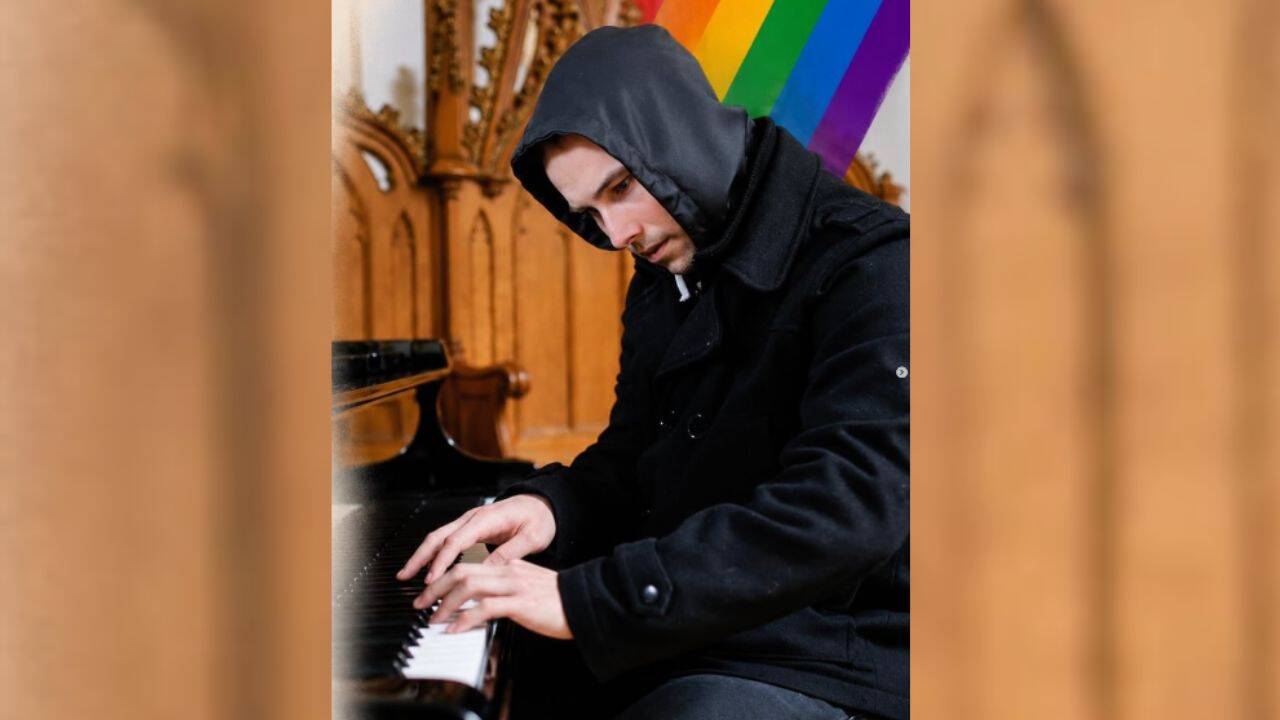
The dust on a public piano is different from the dust anywhere else. It is a dense, gray accumulation of street exhaust, spilled coffee, and the indifferent passing of thousands of pairs of shoes. Most people walk past it without hearing the silent weight of the strings inside the battered wooden cabinet. It is just furniture. An obstacle in a transit hub or a park pavilion.
Until someone sits down.
To understand what happened under the high, echoing vaulted ceiling of a crowded terminal, you have to remember what it feels like to be completely invisible. When you live on the pavement, people do not look at your face. They look at your shoes, or they look three feet above your head to avoid meeting your eyes, constructing an invisible glass wall between your reality and theirs. You become part of the architecture. A bench. A trash can. A landmark to be avoided.
Donald Gould knew that glass wall intimately.
For years, the concrete had been his bed, and the biting wind of changing seasons had been his alarm clock. A former marine and a music education major whose life had unraveled after personal tragedy and the loss of his wife, Gould existed in the margins of society. His worldly possessions fit into a plastic bag, carried from one doorway to the next. His hands, capable of complex polyrhythms and classical phrasing, were stiffened by the cold and calloused by survival.
Then came the piano.
It was an ordinary instrument, placed outdoors as part of a public art installation meant to bring a touch of whimsy to the urban rush. To the commuters hurrying toward their trains with steaming paper cups, it was a novelty. To Gould, it was an old friend he hadn't seen in decades.
He approached it with the hesitant caution of a stray animal. His fingers hovered over the keys for a long moment, trembling slightly—not from weakness, but from the sudden, terrifying rush of a memory long buried. When he finally pressed down, the sound didn't rattle. It bloomed.
He began to play Styx’s "Come Sail Away."
The first notes caught the air like a sudden draft in a stagnant room. Commuters slowed their pace. Briefcases lowered. Footsteps lost their frantic rhythm. In less than a minute, the hurried shuffle of the terminal transformed into a respectful stillness. People who had spent their entire morning avoiding eye contact with anyone turned their heads toward the bench.
Someone pulled out a smartphone.
That digital lens captured what the physical eye had refused to see for years: a man with a graying beard and weather-worn clothes translating his entire soul into sound. The video uploaded to the internet, and within days, the invisible man was seen by millions.
The internet is often a harsh landscape, a churning ocean of quick judgments and fleeting outrage. But every so often, it acts like a massive, collective lens, focusing the diffuse empathy of humanity onto a single point until it burns bright enough to change a life.
The digital footprint of that single performance triggered a cascade of events that no algorithm could have predicted. Viewers didn't just watch; they responded. A crowdfunding campaign was launched with a modest goal, but the momentum of human compassion quickly outpaced all expectations, ultimately raising over fifty thousand dollars.
Numbers on a screen, however, can feel remarkably sterile. Fifty thousand dollars is a statistic until you translate it into the language of human dignity.
It means a warm shower with water that doesn't run out after two minutes. It means a door that locks from the inside, keeping the terrifying unpredictability of the night at bay. It means a pair of clean socks, a haircut, and the surreal, disorienting luxury of a mattress that doesn't smell like mildew and asphalt.
When the funds cleared, the transformation was immediate and profound, yet it also revealed the fragile, complex reality of moving from the streets back into the structured rhythm of housed society. Sobriety, mental health restoration, and the rebuilding of severed family ties do not happen overnight simply because a bank account balance changes. Money buys shelter, but humanity requires patience.
Gould used the turning point not just to rescue himself, but to finish what he started decades earlier. He returned to college to complete his music degree, proving that passion, once buried under the ash of despair, can still catch a spark if the oxygen is right. He began playing at local venues, his posture straighter, his fingers regaining their fluid agility under the warmth of indoor lights.
The viral video has long since cycled out of the daily trending feeds, replaced by newer spectacles and faster news cycles. The internet has moved on to the next distraction.
Yet the piano remains in public spaces, battered and occasionally out of tune, waiting for the next person who has forgotten how to be heard.
We live in a culture obsessed with upgrades, efficiency, and seamless transitions, often forgetting that the most valuable human infrastructure is empathy. We build walls to separate ourselves from discomfort, constructing vast urban landscapes designed to move us past suffering without ever forcing us to look at it.
We forget that everyone has a song trapped inside them, muffled by the roar of traffic and the cold indifference of daily survival. Sometimes, all it takes is a moment of raw courage to sit down at the keys, press down, and remind the world that we are still here.