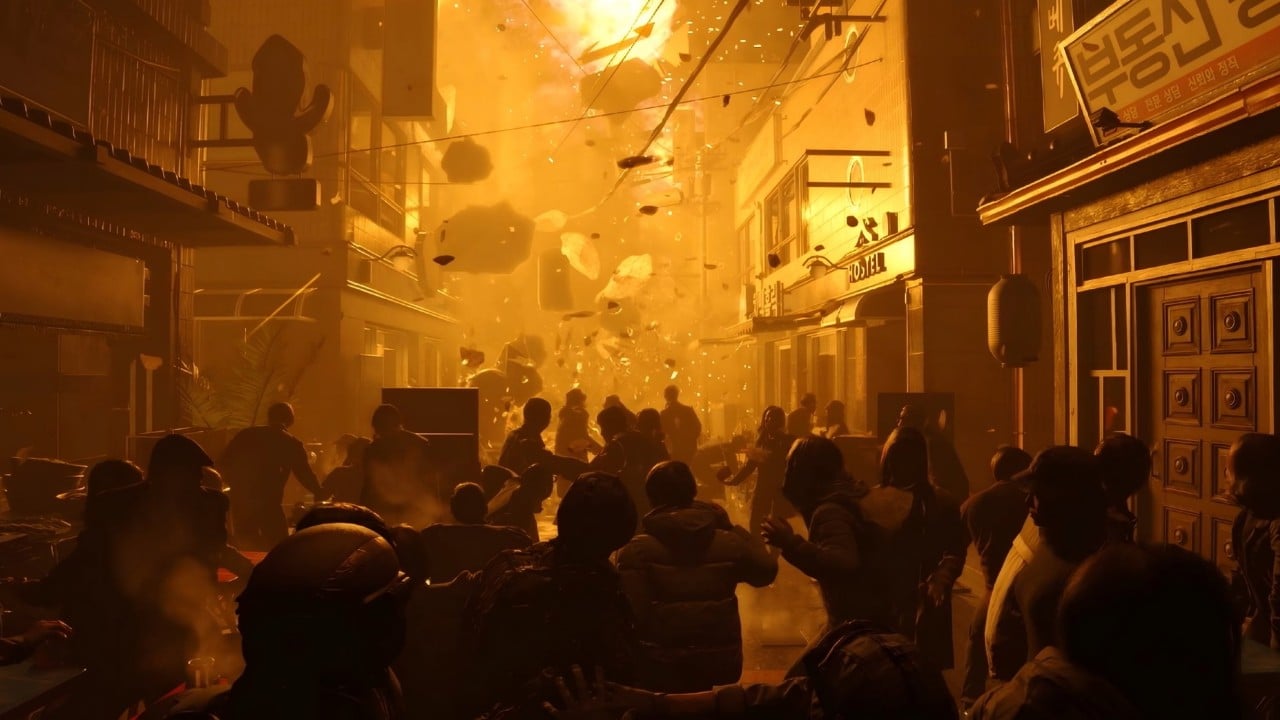
The fluorescent lights of a Seoul PC bang hum at a frequency that vibrates right behind your eyes. It is 2:00 AM. The air smells faintly of instant ramen, ozone, and cold canned coffee. Around the room, twenty-somethings are hunched forward, bathed in the strobing blue glare of high-refresh-rate monitors, their fingers dancing across mechanical keyboards with a rapid, clicking cadence that sounds like rain on a tin roof.
On their screens, a drone buzzes low over a shattered concrete highway. A reticle snaps onto a heat signature behind a rusted shipping container. A click. A flash of white. Silence.
To a sixty-something politician sitting in the quiet, wood-paneled chambers of the National Assembly in Yeouido, that scene looks like wasted youth. It looks like escapism, thumb-twiddling, a distraction from the serious business of GDP growth and diplomatic cables.
Which is why, when South Korean lawmaker Ha Tae-keung stood up during a parliamentary session and publicly urged President Yoon Suk Yeol to play Call of Duty, half the room probably thought it was a publicity stunt. A cheap soundbite engineered for the evening news cycle.
They were wrong. Dead wrong.
Behind the viral headline lies a terrifying truth about the modern battlefield, a widening generational blind spot in the halls of power, and the quiet realization that the next war on the Korean Peninsula will not look anything like the last one.
The Ghost of 1950
To understand why a conservative politician would tell the commander-in-chief to boot up a first-person shooter, you have to understand how deeply the memory of the Korean War is etched into the concrete of Seoul.
If you walk through the War Memorial of Korea in Yongsan, the story told in bronze and steel is one of mass and momentum. Rows of Soviet-built T-34 tanks rolling south across the 38th parallel. Columns of infantry marching through mountain passes in the freezing dark. Artillery barrages pounding fixed ridges until the rock turned to powder. For seventy years, South Korea’s entire military doctrine—and the mental model of almost every leader who has occupied the Blue House or the presidential office in Yongsan—has been built around preparing for a louder, deadlier sequel to 1950.
You count the tanks. You count the artillery tubes aimed at the capital from just thirty-five miles away. You drill hundreds of thousands of conscripted young men to dig trenches, clean rifles, and hold a line.
Consider a hypothetical scenario, one that military planners in Seoul lose sleep over every single night. Picture a nineteen-year-old corporal—let’s call him Min-jun—stationed at a forward observation post near the Demilitarized Zone. He has been trained to watch the ridgeline through binoculars for troop movements. He knows how to strip his K2 rifle blindfolded. He knows what incoming mortar fire sounds like.
What he has not been trained for is a swarm of fifty commercial quadcopters, each costing less than a mid-range smartphone, dropping out of the low cloud cover at ninety miles an hour. There is no thunderous artillery roar to warn him. Just a high-pitched, mechanical whine like a nest of angry hornets, followed by fifty precision strikes hitting radar dishes, fuel trucks, and command bunkers simultaneously.
In that hypothetical dawn, the traditional frontline does not collapse. It simply evaporates.
What the Screen Knows That the Briefing Books Don't
I remember the first time I played Call of Duty: Modern Warfare with a headset turned all the way up, sitting in a cramped apartment in Busan years ago. I wasn't thinking about geopolitics. I was just trying to survive a virtual night raid.
What struck me wasn't the explosions. It was the sensory overload. You aren't just looking down the sights of a gun anymore; you are toggling thermal optics, calling in reconnaissance drones, watching a mini-map pulse with electronic jamming, and trying to figure out where a sniper is hiding while a virtual helicopter blinds you with a spotlight. Everything happens in three dimensions, at blinding speed, mediated entirely through screens and sensors.
Ha Tae-keung’s argument to the president wasn't about turning the military into a video game. It was about cognitive empathy.
When top brass brief a president, they bring thick binders, sanitized PowerPoint slides, and neat topographic maps with blue arrows pushing against red arrows. Those maps lie. They flatten chaos into tidy geometry. They make war look slow, deliberate, and manageable from a leather chair.
A modern military shooter, for all its Hollywood theatrics, accidentally captures something that a briefing binder never can: the sheer, claustrophobic terror of asymmetric, tech-saturated combat. When you play Call of Duty—specifically the newer titles that mirror the drone warfare currently tearing through Eastern Europe and the Middle East—you experience firsthand how useless a multi-million-dollar armored vehicle becomes when a teenager with a joystick and an explosive-laden drone can fly straight through its open hatch.
You feel the disorientation of electronic warfare when your screen scrambles into static. You learn, in a visceral, gut-level way, that the soldier with the best information network wins before the first bullet is even fired.
The Analogue Generation in a Digital Crossfire
There is an uncomfortable truth sitting at the center of South Korean politics, and indeed most democracies around the world. The people making life-and-death decisions about autonomous weapons, cyberwarfare, and drone defense grew up in an analogue world.
Look at the numbers. South Korea boasts one of the fastest-aging populations on Earth, and its political leadership reflects that demographic curve. Many of the senior officials shaping defense budgets cut their teeth during the Cold War. Meanwhile, the young men actually filling the barracks—the nineteen- and twenty-year-olds serving their mandatory eighteen months of military service—are digital natives who grew up in the global capital of esports.
Think about that disconnect.
South Korea is a country where professional StarCraft and League of Legends players fill stadiums and earn celebrity status. It is a nation whose youth possess arguably the highest average hand-eye coordination, spatial awareness, and real-time tactical processing speed on the planet. Yet, when those same young men put on a military uniform, they are often handed decades-old equipment, forbidden from using smartphones for most of the day, and drilled in tactics designed for their grandfathers.
It is like recruiting Formula 1 drivers and putting them behind the wheel of a 1970s tractor.
When Ha Tae-keung urged President Yoon to pick up a controller, he was pointing a finger directly at this cultural chasm. He was saying, in effect: You cannot lead a twenty-first-century military if you refuse to understand the medium in which modern war is fought.
The Invisible Battlefield
We tend to think of weapons as things you can touch. Steel, gunpowder, uranium. Things that rattle windows when they roll down a boulevard during a military parade.
North Korea loves parades. Pyongyang rolls out massive intercontinental ballistic missiles on twelve-axle trucks under floodlights, designed specifically to intimidate cameras and terrify neighbors. Those missiles are real, and the nuclear threat they carry is existential.
But while the world stares at the giant missiles, the actual character of conflict has shifted toward the invisible and the cheap.
Look at what has happened in global conflict zones over the past few years. Commercial drones modified with 3D-printed fins dropping mortar shells. Satellite internet terminals keeping encircled troops connected to artillery spotters hundreds of miles away. Deepfake audio clips spoofing commanders' voices to sow panic in the trenches.
In this new environment, a country’s software literacy matters just as much as its hardware stockpile.
South Korea is already an arms-exporting powerhouse. Polish soldiers are driving South Korean K2 Black Panther tanks; Australian troops are ordering South Korean self-propelled howitzers. The country’s defense contractors are brilliant at forging heavy metal.
Yet heavy metal without digital agility is a coffin. If an adversary can blind your satellites, jam your radio frequencies, and swarm your tank columns with loitering munitions guided by basic artificial intelligence, the thickness of your armor plating stops mattering.
The Humility of Picking Up the Controller
Of course, critics had a field day with the lawmaker’s suggestion. Pundits scoffed that war is not a game, that real blood cannot be reset with a respawn timer, and that trivializing national security through pop-culture references insults the gravity of the office.
They missed the point entirely.
Nobody is claiming that pressing buttons on a console teaches you the moral weight of sending young people to die. No video game replicates the smell of cordite, the weight of a rucksack in the mud, or the grief of a mother receiving a folded flag. To confuse a simulation with reality is dangerous.
But to ignore what a simulation reveals about reality is fatal.
Historically, the militaries that suffer the most catastrophic defeats at the outbreak of a war are rarely the ones lacking courage. They are the ones lacking imagination. In 1940, French generals trusted the concrete fortresses of the Maginot Line because those fortresses made sense according to the logic of 1918. They couldn't imagine armored divisions slicing through the Ardennes forest at thirty miles an hour, coordinated by two-way radios.
In 2026, our Maginot Line is the assumption that high-tech warfare is solely the domain of billion-dollar fighter jets and massive naval fleets, rather than agile, networked, consumer-grade technology wielded by operators who think like gamers.
If a president sits down, picks up a controller, and gets humiliated in a virtual firefight because he didn't check his flank for a reconnaissance drone, that is not a waste of state time. That is a cheap lesson. It costs zero lives, zero won, and forces a healthy dose of humility onto someone whose job requires anticipating the unthinkable.
The Glow in the Dark
Back in that PC bang in Seoul, the clock ticks past 3:00 AM. A young man leans back in his chair, rubs his eyes, and takes a sip of lukewarm coffee. On his screen, the match is over. A scoreboard flashes kill-death ratios, accuracy percentages, and objective times.
In six months, his draft notice will arrive. He will shave his head, say goodbye to his parents at a training camp gate in Nonsan, and put on camouflage fatigues.
He will bring with him an intuitive, muscle-memory understanding of how sensors, drones, and digital networks interact under pressure. He will understand how quickly a safe zone turns into a kill box when an invisible eye is watching from above.
The only question is whether the people commanding him from the air-conditioned offices of Seoul will understand it too—or whether they will still be looking through binoculars at an empty ridge, waiting for a war that ended seventy years ago.


