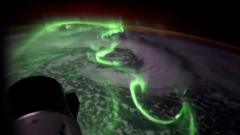
You have probably seen a dozen aurora videos this week. Solar activity is peaking, your social feed is flooded with neon green streaks, and everyone with a smartphone thinks they are an astrophotographer. But honestly, watching the Southern Lights from the ground is a completely different experience than seeing them from 250 miles above the planet.
When astronauts on the International Space Station look out the cupola window, they do not just see a glow on the horizon. They fly right through it.
Recent footage captured by crew members onboard the station shows the Aurora Australis in a way that makes ground photography look flat. The time-lapse reveals a massive, glowing green and red ribbon stretching across the southern hemisphere, pulsing with energy as the station zips past at 17,500 miles per hour. It is a violent, beautiful reminder of the magnetic battleground protecting our planet.
If you want to understand what you are actually looking at in these space time-lapses, we need to talk about why the view from orbit changes everything.
Why the View From Orbit Changes Everything
Earth gets in the way of its own light show. When you stand in Antarctica, Tasmania, or the southern tip of New Zealand, you look up through dense layers of atmosphere. Dust, water vapor, and light pollution distort the view. You see a curtain of light hanging in the sky.
From the space station, astronauts look down and across the horizon. They see the entire thickness of the atmosphere at once. The Southern Lights appear as a three-dimensional wall of fire rising from the edge of the planet.
This perspective reveals the vertical structure of the aurora. The bottom edge sits about 60 miles up, glowing a sharp, bright green. The top edge can bleed into deep reds and purples, stretching more than 200 miles into space. The time-lapse captured from orbit makes the atmosphere look like a thin, glowing neon bulb wrapped around a dark marble.
The motion changes too. On Earth, an aurora can look like it is drifting slowly. From orbit, the speed of the space station combined with the rapid pulsing of the solar particles creates a hyper-kinetic dance. You watch a wave of energy ripple across thousands of miles of ocean in just a few seconds.
The Chemistry Behind the Colors in Space Time-Lapses
The colors in these videos are not random camera artifacts. They are a direct map of atmospheric chemistry and altitude.
When the sun blasts a stream of charged particles toward Earth during a coronal mass ejection, our magnetic field channels them toward the poles. These solar particles smash into gases in our upper atmosphere, exciting the atoms and causing them to release light. It is the exact same mechanism used in neon signs.
The green you see dominating the time-lapse comes from oxygen atoms located between 60 and 150 miles up. At this specific altitude, the atmosphere is dense enough that collisions with oxygen atoms are frequent, producing a bright, yellowish-green light at a wavelength of 557.7 nanometers.
Red is a different story. The deep crimson at the very top of the aurora also comes from oxygen, but it happens higher up, above 150 miles. Up there, the atmosphere is incredibly thin. The excited oxygen atoms take a long time to emit a photon, and if they hit another atom in the meantime, the energy gets lost. Because the vacuum of space is so empty at that altitude, the atoms can finally relax and release that rare red light at 630.0 nanometers.
Astronauts get a front-row seat to this red layer. From Earth, human eyes struggle to see the red aurora because our night vision is poorly attuned to that part of the spectrum. Cameras on the ground pick it up during long exposures, but the space station cameras capture it in real-time clarity because they are sitting right next to it.
Capturing High-Speed Space Photography
You cannot just point a standard camera out an orbital window and expect a crisp time-lapse. The space station moves fast. It circles the Earth every 90 minutes. That means the landscape underneath is a blur if your shutter speed is too slow.
To create these time-lapses, astronauts use modified commercial DSLR and mirrorless cameras, often mounted in the Cupola—the seven-window observation module. They use ultra-fast lenses, usually with apertures like f/1.2 or f/1.4, and crank the ISO sensitivity incredibly high.
The process involves shooting hundreds of consecutive frames with short exposures, typically around one second each. If the exposure is any longer, the stars and the aurora blur because of the station's orbital velocity. Software on the ground then stitches these individual frames together into a fluid video file.
The camera also has to contend with orbital glare. Internal lights from the station reflect off the thick, multi-paned glass windows. Astronauts often use special black cloaks or shrouds around the camera lens to block out internal reflections, ensuring the sensor only picks up the faint light from the atmosphere below.
Tracking Space Weather Yourself
You do not have to wait for the next NASA release to see this happen. Solar Cycle 25 is currently driving massive amounts of solar activity, meaning these intense auroral displays will keep happening frequently.
You can monitor the same space weather data that predicts these orbital spectacles. The National Oceanic and Atmospheric Administration operates the Space Weather Prediction Center, which provides real-time tracking of solar flares and geomagnetic storms.
Look for the Kp-index. It is a scale from 0 to 9 used to measure geomagnetic activity. When the Kp-index hits 5 or higher, it means a geomagnetic storm is underway, and the auroral oval is expanding. If you see a Kp-index of 7 or 8, astronauts are likely scrambling to the windows with their cameras, and people at high latitudes on Earth need to head outside.
Download a reliable space weather tracking app on your phone. Apps like Aurora Alerts or My Aurora Forecast pull direct data from NOAA satellites. Pay attention to the interplanetary magnetic field data, specifically the Bz value. When the Bz points south, it means the solar wind is connecting effectively with Earth's magnetic field, opening the door for the bright displays captured in these famous time-lapses.

:max_bytes(150000):strip_icc():focal(665x0:667x2)/gettyimages-50733149-2000-8b129a2475974982a915418ce92a73d8.jpg)

