Twelve months can pass like smoke. A calendar page turns, a season shifts from the biting chill of a Quebec winter into the humid hum of summer, and life presses its heavy thumb forward. People catch buses. Coffees are bought in paper cups that crinkle in frozen hands. Traffic hums along Taschereau Boulevard. The world moves because it is designed to move, engineered with a cruel, indifferent momentum that demands forgetting.
Except when it shouldn't.
Stand on a corner in Longueuil when the sun dips low enough to cast long, blue shadows across the asphalt, and the noise of the city begins to fracture. You can almost hear the absence. It is a strange, heavy thing, the absence of a person. Nooran Rezayi is not here to walk these streets. He is not here to argue about the small, mundane frictions of an ordinary Tuesday, or to laugh with friends over a shared meal, or to wonder what tomorrow will bring.
Tomorrow was stolen from him.
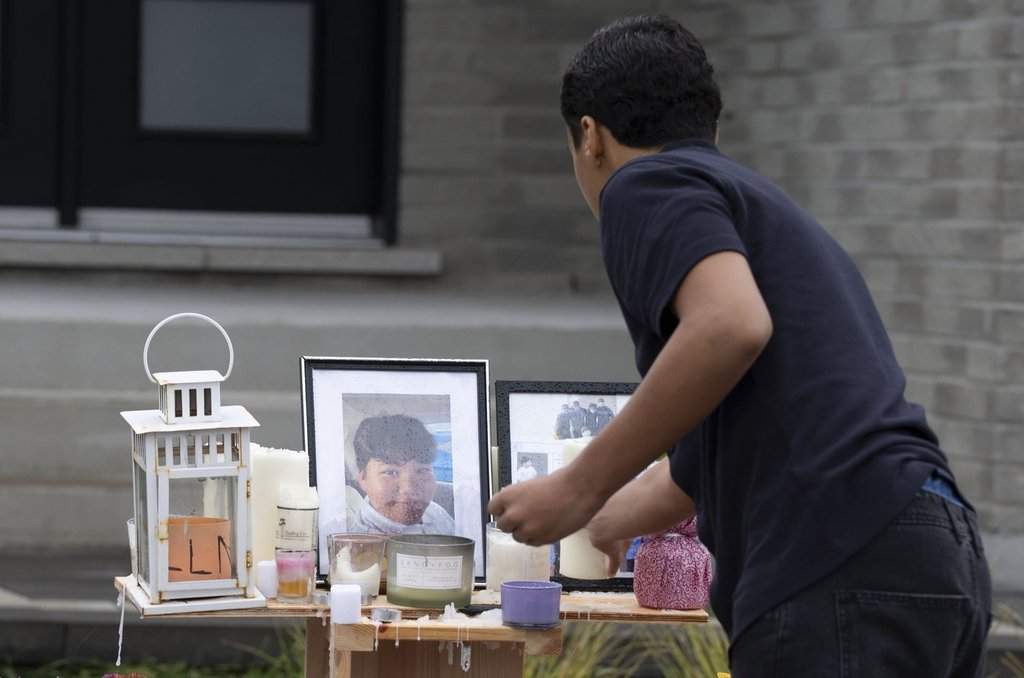
One year. Three hundred and sixty-five days of grief that does not wear a neat suit or speak in measured administrative terms. Grief is messy. It lives in the throat. It echoes in living rooms where a coat still hangs by the door long after the wearer has any use for it. On this anniversary, a vigil gathers. Not just to mark time, but to anchor it. To plant a flag in the ground of public memory and declare that a life was extinguished here, under the cold authority of a state-sanctioned weapon, and that the echoes of that single gunshot have not faded.
To understand why people are gathering with candles and quiet fury, we have to look past the sanitized police reports and the clinical distance of news tickers. We have to look at what it means to live in a community where the people sworn to protect the peace are sometimes the very ones who shatter it beyond repair.
The Anatomy of a Single Second
Imagine the air inside a cramped hallway or a tense suburban street corner. Time does not flow evenly in moments of crisis; it stretches, pooling into thick, viscous seconds where every breath feels like swallowing glass.
In the chaotic calculus of a police intervention, decisions are made in fractions of time that defy rational reconstruction. Officers arrive with training manuals etched into their muscle memory—manuals built on the premise of threat assessment, perimeter control, and lethal force as an ultimate, regrettable shield. But behind the heavy utility belts and the mirrored sunglasses, human beings collide with human beings. And sometimes, panic wears a badge.
When Nooran Rezayi met his end at the hands of the Longueuil police a year ago, the initial statements followed a familiar script. Words like altercation, threat, and protocol were tossed into the public sphere like smoke grenades meant to obscure the human cost. Police boards open investigations. Independent watchdogs like the Bureau des enquêtes indépendantes step in to examine trajectories, angles, ballistics reports, and radio logs.
Files grow thick in government offices. Bureaucrats shuffle papers. Months bleed into one another.
Yet, for a family waking up in an empty house, the investigation is not an intellectual exercise. It is an open wound. Every technical term used to describe the use of lethal force feels like a linguistic shield designed to soften the blow of an irreversible tragedy.
We are often told to trust the system. We are urged to wait patiently for findings, to respect the process, to let the wheels of justice grind exceeding fine. But patience is a luxury worn thin by history. When marginalized individuals or young men from immigrant families find themselves on the receiving end of police bullets, the question is rarely just about one bad call on one bad night. It is about an entire architecture of policing that too often views community members not as citizens to be safeguarded, but as hazards to be neutralized.
The Weight of a Name
Nooran Rezayi was more than a statistic in an annual report on police-involved shootings. He was a son, a brother, a friend, a person with a complex inner life that stretched far beyond the final, terrifying frame of his existence.
When we reduce a human being to the manner of their death, we commit a secondary violence. We strip away their laughter, their ambitions, their flaws, and their potential. We turn a living, breathing soul into a legal battleground.
At the vigil, the faces in the flickering candlelight tell a different story. They belong to people who refuse to let Nooran be reduced to a file number. They hold signs bearing his name, handwritten on poster board that has begun to curl at the edges from the damp evening air. They speak in hushed tones, sharing memories that resurrect him for a few brief hours.
Consider what it takes to sustain that kind of grief in public. It is exhausting. It requires families who are already broken by loss to become activists, legal scholars, and public speakers overnight. They must stand before microphones and television cameras, reliving the worst day of their lives over and over again, simply to ensure that society does not shrug its shoulders and move on to the next headline.
The vigil in Longueuil is not just an act of mourning; it is an act of defiance. In a world that wants to sanitize violence when it is committed by men in uniform, remembering is a revolutionary act.
The Question We Refuse to Answer
Why does this keep happening?
It is the question that hangs over every police commission, every coroner’s inquest, and every community protest from Montreal to Vancouver. We tweak policies. We introduce de-escalation training. We talk about implicit bias workshops and community-policing initiatives. We spend millions of dollars on equipment and commissions, searching for the technological or procedural silver bullet that will stop the bleeding.
And yet, the body count climbs.
The core issue is not merely a lack of training; it is a fundamental imbalance of power. When an armed officer interacts with a civilian, the state has already stacked the deck with absolute authority. Accountability mechanisms are notoriously slow, insular, and reluctant to pierce the corporate veil of police solidarity. When independent oversight agencies investigate, criminal charges against officers remain exceedingly rare. Convictions are rarer still.
This creates a pervasive sense of impunity. It sends a chilling message to racialized communities and working-class neighborhoods: your safety is conditional, and the state’s monopoly on violence is absolute, error-prone consequences be damned.
When people gather in Longueuil today, they are demanding something much more radical than a press release or a mild administrative reprimand. They are demanding systemic honesty. They are asking what kind of society we are building when the deployment of lethal force is treated as an acceptable hazard of urban life rather than an catastrophic failure of the social contract.
The Flame That Does Not Go Out
Night has fully settled over the park now. The wind picks up, making the candle flames dance wildly against the encroaching dark. People pull their coats tighter around their shoulders, breathing out little clouds of white mist into the autumn chill.
No one wants to be here. They would all trade this cold pavement and these mournful chants for a universe where Nooran Rezayi was at home tonight, cooking dinner, arguing about sports, or simply scrolling through his phone. But time cannot be unwound. The past is a locked room, and the key was thrown away twelve months ago.
All that is left is the present. And the future we choose to demand.
As the vigil winds down and the wax drips onto the concrete, pooling into hardened white stalagmites, the crowd begins to disperse. They walk back to their cars, back to their buses, back to the quiet, heavy rooms waiting for them. But they do not leave empty-handed. They carry the memory of a young man whose life was cut short, and they carry the burning insistence that his death must mean something.
The candles burn out one by one, smoke curling up into the indifferent night sky, leaving behind a lingering scent of melted wax and fire. But the darkness does not win. In the hearts of those standing on the streets of Longueuil, the light has already been passed. And it will not be extinguished so easily.