The Ghost Stage in Orbit
Space debris usually burns up silently in the upper atmosphere, turning into a fleeting streak of ionized gas for backyard astronomers to photograph. But occasionally, human hardware escapes Earth's immediate gravity well, drifting out into the deep void of cislunar space. That is precisely what happened to a discarded Falcon 9 second stage booster launched back in 2015. For nearly seven years, this multi-ton piece of painted aluminum and steel tumbled through an erratic, chaotic orbit, caught in the gravitational tug-of-war between Earth and the Moon.
When independent astronomers finally calculated its trajectory in early 2022, they realized it was on a direct collision course with the lunar surface. The impact occurred on March 4, 2022, striking the far side of the Moon near the Hertzsprung crater at roughly 5,800 miles per hour. While the event initially sparked a fierce debate over misidentified rocket parts—with early confusion pointing toward a Chinese Chang'e mission—the broader implications went far beyond a simple case of orbital mistaken identity. It marked the first time an accidental piece of human-made space junk struck the Moon completely uncontrolled. For a different look, check out: this related article.
The Anatomy of a High-Velocity Impact
Physics at nine thousand kilometers per hour leaves very little room for error. When the empty Falcon 9 booster—weighing roughly four metric tons—slammed into the lunar regolith, it did not hit like a feather. It hit with the kinetic energy equivalent of several tons of TNT, vaporizing a portion of its own structure and violently excavating the basaltic crust of the lunar surface.
Without an atmosphere to slow it down or burn it up, the booster retained every ounce of orbital velocity. Kinetic energy scales with the square of velocity, meaning the destructive potential of space debris scales exponentially as speed increases. Upon impact, the kinetic energy converted instantaneously into extreme heat and shockwaves. Further reporting on the subject has been shared by ZDNet.
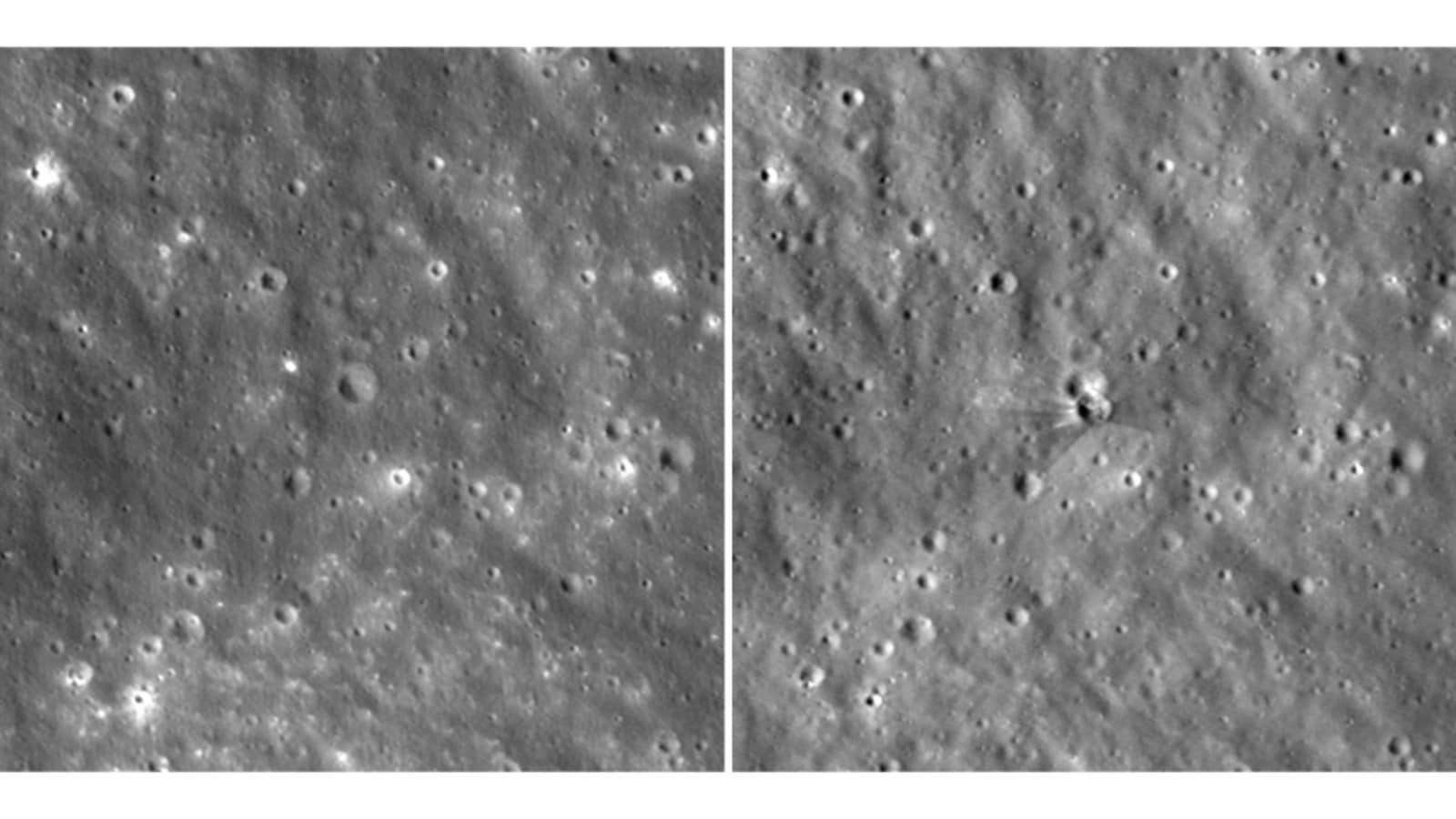
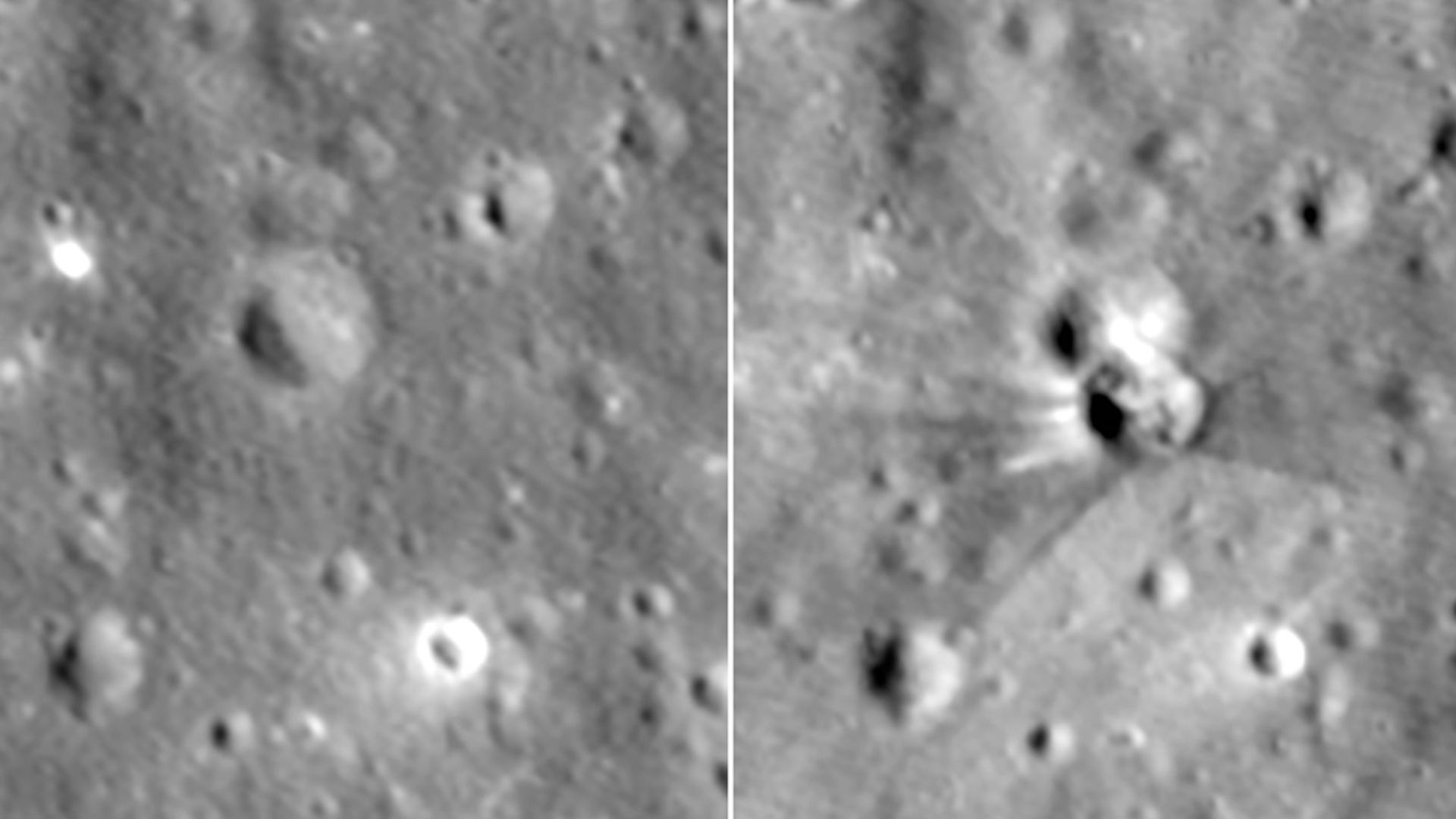
The resulting crater was not just one hole. Subsequent imaging and orbital analysis revealed a surprising double crater signature. This weird structural anomaly sparked intense discussions among aerospace engineers and planetary scientists.
Decoding the Double Crater Mystery
When NASA's Lunar Reconnaissance Orbiter passed over the impact site months later, planetary scientists expected to find a single, clean bowl-shaped depression. Instead, the camera revealed an overlapping double crater: an eastern crater about 18 meters in diameter superposed on a western crater about 16 meters across.
This unusual geometry immediately challenged standard hypervelocity impact models. Most spent rocket stages are cylindrical tubes with most of their massive weight concentrated at one end—usually the heavy engine bell—while the rest of the stage consists of hollow propellant tanks and empty plumbing.
- The heavy engine components carried significant mass concentrated at the tail.
- The empty propellant tanks formed a long, lightweight structural body trailing behind.
- The dual-mass distribution meant the object struck the surface as two distinct heavy points of failure rather than a uniform projectile.
As the tumbling rocket hit the dusty lunar plain, the lightweight fuel tanks crushed first, followed immediately by the dense, heavy engine components driving through the debris. This asymmetric mass distribution created two distinct impact cavities side-by-side. It was a physical signature written in rock and dust, confirming how hollow aerospace structures behave when subjected to planetary-scale collisions.
The Broader Crisis of Orbital Debris
We treat cislunar space as an infinite dumping ground. For decades, space agencies focused almost exclusively on low Earth orbit, tracking defunct satellites, discarded booster stages, and micro-particles threatening the International Space Station. The space surrounding the Moon was widely considered empty, safe, and vast enough to absorb our discarded technological skeleton.
That assumption is dead. As lunar exploration accelerates through commercial ventures, national space programs, and crewed Artemis missions, the volume of traffic traveling between Earth and the Moon is scaling rapidly.
Every mission requires trans-lunar injection stages, maneuvering modules, and adapter rings. Most of these hardware pieces are left behind in heliocentric or unstable lunar orbits once their utility expires. They become dead weights, untracked by primary defense radar networks optimized for low altitude passes.
Tracking the Untracked Void
The tracking gap is staggering. While the United States Space Force and private entities like LeoLabs maintain robust catalogs of objects circling Earth, deep space tracking is largely left to a loose collective of amateur astronomers, academic researchers, and space enthusiasts.
Astronomers like Bill Gray, who first flagged the trajectory of the 2015 Falcon 9 stage, rely on optical telescopes and painstaking photometric measurements to predict where derelict hardware will end up weeks or months in advance. These calculations require immense computing power and historical telemetry data that is often proprietary or completely missing.
When a private aerospace company launches a payload, the precise disposal trajectory of upper stages leaving Earth orbit is not always publicly disclosed in real time. Without mandatory registration and active tracking of deep space hardware, planetary bodies become silent crash test dummies for our industrial expansion.
Environmental Consequences for the Moon
The Moon has no atmosphere, no plate tectonics, and no wind or rain to heal its scars. Every impact is permanent. When a rocket booster crashes into the lunar regolith, it leaves behind a physical record that will endure for millions of years, altered only by the slow accumulation of micrometeorite bombardment.
Beyond aesthetics or historical preservation, contamination is a growing concern. Modern rockets carry residual hydrazine fuel, battery acids, composite fibers, lubricants, and various synthetic polymers. While high-temperature impacts vaporize a significant fraction of these materials, some chemical residues inevitably bake into the lunar dust or scatter across the surrounding crater rim.
As we plan permanent human settlements, scientific outposts, and resource extraction operations on the lunar surface, preserving uncontaminated baseline environments becomes critical. Finding industrial solvents or hydrazine breakdown products in pristine polar ice traps or ancient volcanic plains could compromise decades of astrobiological research.
The Accountability Vacuum
International space law remains woefully inadequate for regulating garbage in deep space. The Outer Space Treaty of 1967 states that nations retain jurisdiction and control over objects they launch into space, and remain internationally liable for damage caused by their space objects.
However, liability frameworks were designed for falling debris hitting Earth's surface or damaging other active spacecraft in orbit. They do not account for the passive, long-term littering of celestial bodies like the Moon or Mars.
- No international body enforces deep space debris mitigation standards.
- Private companies face minimal oversight once payloads exit low Earth orbit.
- No mechanism exists to clean up or safely deorbit abandoned stages drifting between worlds.
When a rocket stage crashes on the far side of the Moon, nobody pays a fine, no environmental impact statement is filed, and no cleanup crew is dispatched. It simply becomes another permanent footnote in the geological ledger of our solar system.
Designing for End-of-Life Disposal
Fixing the problem requires engineering out the danger before launch. Aerospace manufacturers must transition away from treating deep space stages as disposable waste.
Engineers already possess the technology to execute disposal burns, redirecting spent boosters into controlled heliocentric orbits where they will not impact planetary bodies, or directing them to burn up safely in Earth's atmosphere upon return. Alternatively, adding dedicated deorbit propulsion reserves to upper stages ensures they can be actively steered away from lunar intersection paths.
Space exploration has always demanded a high tolerance for risk. Yet treating the solar system like an open highway littered with discarded metal parts is an outdated artifact of early space age hubris.
The double crater on the far side of the Moon stands as a permanent reminder of our expansion into the cosmos. It shows we are capable of reaching other worlds, but it also exposes our persistent unwillingness to clean up after ourselves along the way.