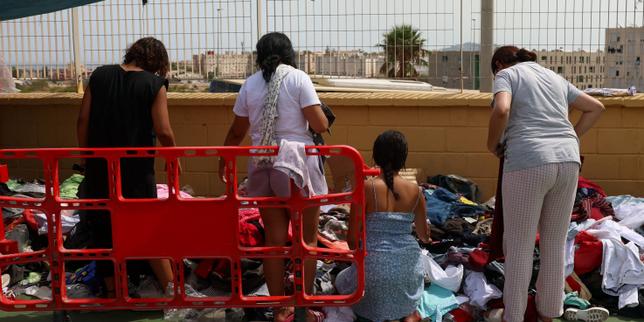
The Spanish government is currently rushing to establish emergency accommodation for 1,800 migrants in Ceuta, a move prompted by a sharp surge in irregular arrivals that has overwhelmed the enclave's existing infrastructure. This rapid deployment of temporary facilities aims to manage the immediate humanitarian strain, yet it highlights a recurring operational failure in border management that has left officials scrambling rather than planning.
For years, this tiny Spanish autonomous city on the North African coast has served as a primary pressure point for migration flows. It is not merely a geographic anomaly but a high-stakes frontline where European immigration policy collides with the harsh realities of desperate human movement. When boats hit the shore or groups scale the perimeter fence, the local authorities are often left with hours to react. The decision to house 1,800 individuals is a stopgap, a frantic attempt to avoid a complete breakdown of services in a territory where space is geographically capped by the Mediterranean and the Moroccan border.
The Geography of Containment
Ceuta functions differently from mainland Spain. Because of its location, the city acts as a bottleneck. When migrants arrive, they remain trapped within a limited urban footprint. Unlike Madrid or Barcelona, there is no hinterland to absorb the arrival numbers. Every tent raised and every meal served is a logistical project executed under intense scrutiny from both Brussels and Rabat.
The sudden expansion of housing capacity reveals the fragility of current agreements. Officials often speak about humanitarian urgency, yet the underlying truth remains that these centers operate at maximum capacity during calm periods, leaving zero margin for error when numbers climb. This is not a surprise. It is a predictable outcome of a system that relies on reactive measures rather than proactive infrastructure.
The Spanish state frequently finds itself caught between two competing political realities. On one side, domestic voters demand a secure, orderly border. On the other, international human rights obligations mandate humane treatment for those who have reached European soil. The current expansion is an effort to satisfy both, providing a roof to keep people off the streets while maintaining the government's claim that it controls who enters and exits the territory.
Behind the Numbers
Behind the headline figure of 1,800 lies a messy, human-centered conflict. The logistical burden of feeding, processing, and housing these individuals in a confined space is immense. It requires constant coordination with private contractors, health services, and security forces. For the residents of Ceuta, the sudden spike in arrivals often translates into a feeling of instability. Services that are already stretched thin must suddenly redirect resources to support the newcomers, creating friction between the local population and the temporary arrivals.
Observers often focus on the politics of the border, but the reality is dictated by supply chains. Securing enough water, sanitation, and medical support for such a large group in a matter of days is a massive undertaking. Failures here do not just result in bad press; they create public health risks and security vacuums. The government’s choice to build these centers is a recognition that the status quo of simply "processing" people and sending them on is failing to keep up with the volume.
The Moroccan Connection
No analysis of the situation in Ceuta is honest without acknowledging the role of Morocco. The relationship between Madrid and Rabat is complex, defined by shared security interests and periodic flare-ups over migration control. When the border becomes porous, it is rarely due to a simple failure of fences or maritime patrol. It is almost always a signal sent through the movement of people.
Migration is frequently used as a diplomatic lever. When relations sour, arrivals increase. When negotiations improve, the pressure on the perimeter drops. The current emergency accommodation is a response to a spike that is as much about diplomatic maneuvering as it is about desperate individuals seeking a better life. Understanding this prevents the error of viewing the 1,800 migrants solely as a humanitarian statistic. They are part of a much larger, darker game of geopolitical positioning.
The Cost of Reactive Policy
The financial burden of maintaining these temporary sites is not sustainable. Every emergency tent, every modular unit, and every extra hour of police overtime is billed to the public treasury. Yet, there is little movement toward permanent investment. Building out large-scale, long-term facilities in Ceuta would be politically toxic. It would signal to the world that this is a permanent transit zone rather than a secure border, encouraging even more people to attempt the crossing.
Consequently, Spain opts for the middle path. They build just enough to avoid a catastrophe, but never enough to signal permanence. This cycle of building, dismantling, and rebuilding is incredibly inefficient. It serves no one well. The migrants arrive to conditions that are constantly in flux, and the public servants charged with managing the centers work in environments designed to be temporary, which inevitably degrades the quality of care.
Beyond the Perimeter
The discourse in Madrid suggests that this crisis will eventually pass, that the flow will stabilize. This is an optimistic assessment that ignores the long-term drivers of this migration. Economic disparity across the Mediterranean is not narrowing; it is widening. The desire to reach Europe remains the most powerful force in the region, one that will not be deterred by temporary housing or shifts in border patrols.
Spain needs to decide whether Ceuta is an outpost of European values or merely a holding pen. If the goal is to provide a dignified, orderly process, the current strategy of emergency housing is a failure. It is a system built on the hope that if they look away, the problem will shrink. But the problem is not shrinking. It is finding new ways to circumvent the old methods.
The resources poured into these temporary centers represent money that could have been used to strengthen regional cooperation or create more stable, predictable entry processes. Instead, the focus remains on putting out fires. The people currently housed in these facilities are living through a system that is terrified of its own instability, a system that views them as an administrative burden to be managed until they can be shuffled elsewhere. Until the approach shifts from emergency containment to long-term regional strategy, the cycle will repeat. The next time the numbers spike, the government will find itself back in the same position, scrambling to find space where there is none left.