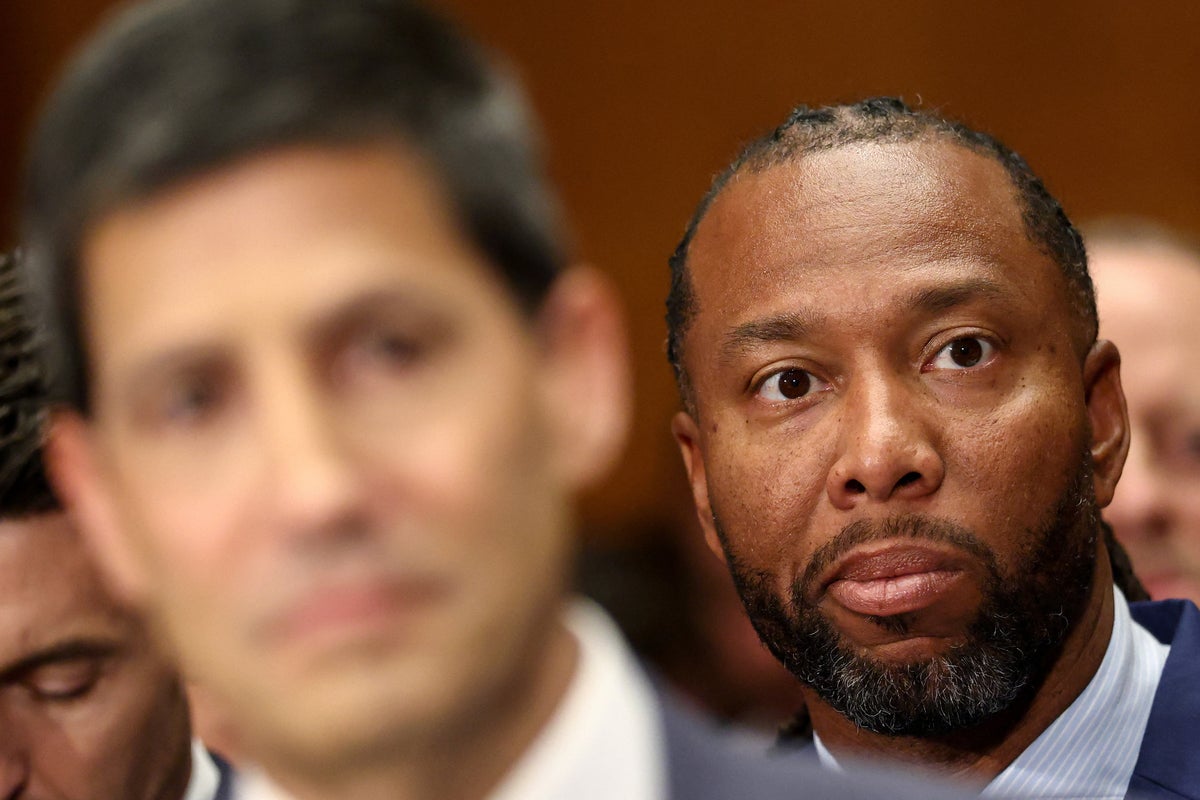
The camera didn’t mean to find him. It was supposed to be a shot about the machinery of power—the kind of dry, televised broadcast that usually serves as background noise in sterile waiting rooms. There, in the foreground, sat Kevin Warsh. He is a man who speaks the language of basis points and inflationary hedges, a candidate for the Chair of the Federal Reserve who carries the polished, impenetrable air of a career spent in the highest corridors of finance. But the frame slipped. It widened just enough to capture the man sitting directly behind him, and suddenly, the internet stopped breathing.
Larry Fitzgerald wasn’t supposed to be there. At least, not according to the mental silos we build for our public figures.
Fitzgerald is a ghost of the gridiron, a legend whose hands seemed to possess their own gravitational pull during his seventeen seasons with the Arizona Cardinals. He is the personification of physical grace and quiet reliability. Seeing him positioned like a silent sentinel behind the man who might soon control the global economy felt less like a coincidence and more like a glitch in the cultural matrix. It was a collision of two worlds that we desperately try to keep separate: the visceral, sweat-soaked reality of professional sports and the cold, calculated abstractions of monetary policy.
The digital world ignited.
The Anatomy of a Distraction
In the age of the second screen, we are all detectives. Within minutes of the broadcast hitting the airwaves, the screen grabs were circulating. Why was the greatest receiver of a generation watching a potential Fed Chair testify? Was it a signal? A friendship? A bizarre new chapter in the intersection of celebrity and governance?
The noise was deafening, but it missed the heartbeat of the moment. We focus on the "why" because the "what" is too intimidating. Understanding the Federal Reserve is hard. It is a dense thicket of economic theory and high-stakes gambling that dictates whether a family can afford a mortgage or if a small business survives the winter. Larry Fitzgerald, however, is easy to understand. He is excellence. He is a memory of a Sunday afternoon catch that defied physics.
When we saw Fitzgerald behind Warsh, we weren't just seeing a football player. We were seeing a bridge.
Consider the hypothetical observer sitting at home, someone we’ll call Marcus. Marcus knows football. He can tell you Fitzgerald’s career receiving yards—17,492—without checking his phone. But Marcus feels a knot in his stomach when he hears the word "inflation." He feels like a spectator in his own life, watching a game where the rules are written in a language he doesn't speak. Then, he sees Larry. Suddenly, the room where the "Architects" of the economy sit feels a little less like an alien planet.
The Invisible Stakes of the Front Row
Kevin Warsh is a man of the institution. To understand the weight of his position, you have to look past the suit. Being the Fed Chair isn't just about moving numbers on a ledger. It is about the terrifying responsibility of maintaining the collective hallucination we call "value." If the Chair loses the room, the currency falters. If the currency falters, the social contract shreds.
The stakes are invisible until they aren't.
When the Fed adjusts a rate by a quarter-percentage point, it feels like a mathematical abstraction. But the reality is a ripple effect that ends at a kitchen table. It is the difference between a young couple buying their first home or staying trapped in a cycle of rising rent. It is the difference between a grocery bill that stays steady and one that creeps up until the meat is swapped for pasta, and the pasta is swapped for prayer.
Warsh represents the "how" of our survival. Fitzgerald, in this strange tableau, represents the "who."
The irony is that Fitzgerald himself has always been an architect of his own brand. He didn't just play football; he studied the business of it. He is a man who traveled the world, who sat in boardrooms while his peers were in nightclubs, and who understood early on that a career in the sun is brief. His presence behind Warsh wasn't an accident of seating. It was a testament to a life lived with the intention of being in the room where it happens.
The Human Element in a World of Data
We often treat our leaders like algorithms. We want the Fed Chair to be a machine that inputs data and outputs stability. We want our athletes to be machines that input effort and output touchdowns. But the moment those two spheres touched, the machine broke, and we were left with something much more interesting: human connection.
There is a specific kind of silence in those hearing rooms. It’s a dry, recycled air silence, punctuated by the scratching of pens and the hum of cameras. In that environment, the presence of a man known for his physical prowess acts as a grounding wire. It reminds us that these policies—these grand, sweeping declarations of economic intent—are ultimately about people.
They are about the fans who saved up for season tickets and are now wondering if they should cancel them to pay the electric bill. They are about the retired scouts living on a fixed income, watching the purchasing power of their pension evaporate like mist.
Fitzgerald’s calm, stoic face served as a mirror. While the internet went "crazy" looking for a meme, they were actually reacting to a rare moment of honesty. We saw a person we trust in a place we usually find suspicious.
The Unspoken Alliance
Why does it matter that a retired wide receiver knows a potential Fed Chair?
It matters because power is never as solitary as it looks. The narrative of the "lone genius" fixing the economy is a myth we tell to keep from panicking. In reality, power is a network. It is built on relationships, on shared dinners, and on the mutual respect of people who have reached the top of their respective mountains.
Warsh and Fitzgerald are both masters of high-pressure environments. One had to decide where to throw the ball with three 300-pound men screaming toward him; the other might have to decide how to stabilize a global market while the entire world screams for a miracle. The disciplines are different, but the nervous system required to survive them is the same.
The spectacle of the internet "sleuths" uncovering their connection is really just the sound of a society trying to make sense of its own complexity. We want to know the secret. We want to know what they talked about. We want to believe that there is a plan, a strategy, a play-call that can get us out of the shadow of our own end zone.
The Frame remains
As the hearing progressed, the focus eventually shifted back to the questions. The senators droned on about labor markets and quantitative tightening. The viral moment began to age, as all things do in the digital centrifuge.
But for those few hours, the wall was down.
The image of Fitzgerald behind Warsh persists because it represents a longing for a world that makes sense—a world where the things we love and the things we fear sit in the same row. It was a reminder that even in the most sterile corridors of the capital, the human story is always running in the background.
We are all sitting in that room, in a way. We are all behind the people making the big calls, watching the back of their heads, hoping they know what they’re doing. We are looking for a sign, a familiar face, or a pair of hands we know can catch whatever is thrown their way.
The camera eventually cut away to a commercial. The data points returned to the screen. The legend and the architect remained in the room, two men from vastly different worlds, bound by the strange, flickering light of a public life, while the rest of us tried to figure out if we were watching a game or a funeral.
Everything in the room was silent, save for the rhythmic, steady ticking of a clock that didn't care about football or finance, measuring the time we have left to get the answer right.