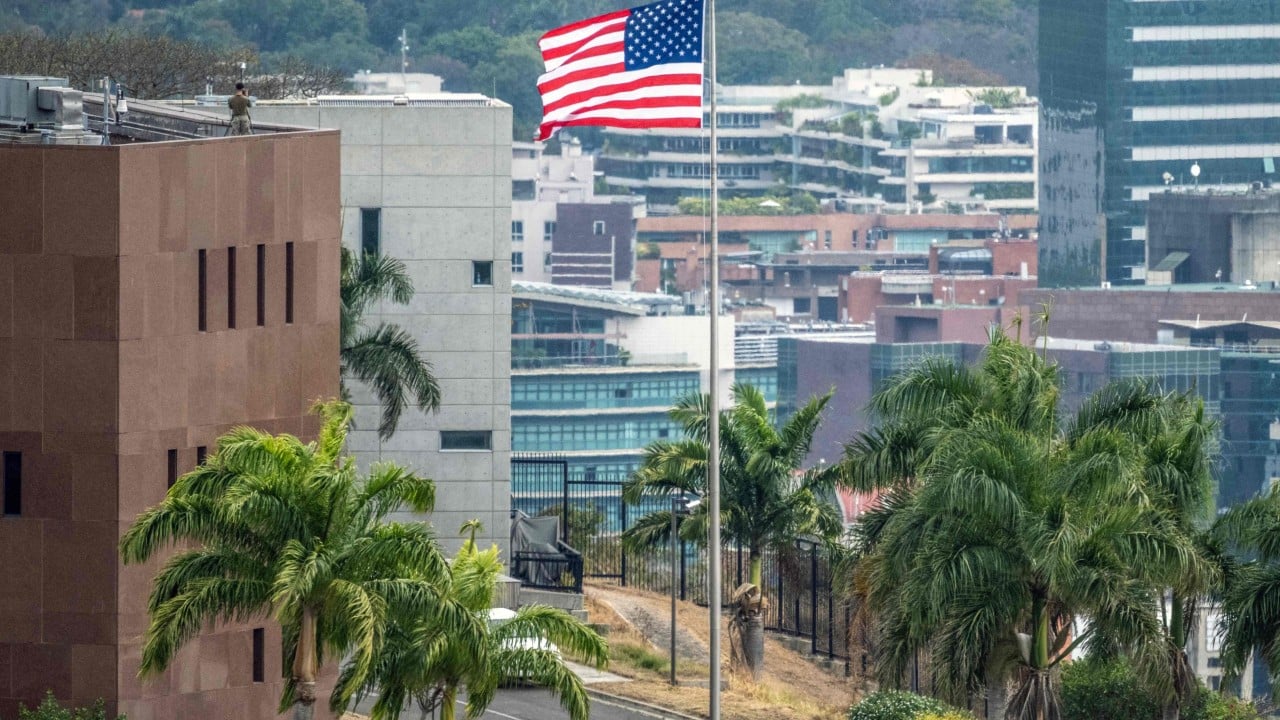
The metal rings clinked against the pole with a sound that felt much louder than it actually was. In the humid, heavy air of the Valle de Caracas, that rhythmic clink-clink-clink carried the weight of seven years of silence. For the diplomats standing on the manicured grass of the hilltop compound in Valle Arriba, the sound wasn't just mechanical. It was the heartbeat of a relationship restarting after flatlining.
The blue, white, and red fabric caught a sudden breeze, unfurling over a city that has spent nearly a decade looking at this specific hill and seeing a ghost. Since 2019, the U.S. Embassy in Venezuela had been a shell—a fortress of empty desks, abandoned coffee mugs, and files shredded in haste. But today, the wind finally had something to catch. Meanwhile, you can find related events here: The Cold Truth About Russias Crumbling Power Grid.
The Long Winter of the Hilltop
To understand why a piece of nylon rising up a pole matters, you have to understand what it looks like when a bridge collapses between two worlds. When the U.S. shuttered its diplomatic mission in March 2019, it wasn't just a political statement. It was a divorce that left millions of people in the middle of a burning house.
Imagine a father in Maracaibo. Let's call him Carlos. For years, Carlos worked for an American oil services firm. When the flag came down in 2019, his world didn't just change; it vanished. The lines of communication snapped. Visas became myths. If you needed to see a sick relative in Miami or renew a passport, you didn't drive to Caracas. You flew to Bogotá. You crossed borders on foot. You waited in lines that stretched across countries. To understand the full picture, check out the recent report by The Guardian.
The embassy became a "zombie" building. The lights stayed off. The gates remained locked. In the eyes of the international community, it was a physical manifestation of a "Maximum Pressure" campaign that sought to isolate the Maduro government. But isolation is a double-edged sword. While the politicians in Washington and Miraflores traded insults, the connective tissue of two cultures began to atrophy.
The Mechanics of Reconnection
Geopolitics is often described as a chess match, but it is actually more like plumbing. It’s about which pipes are open and which are clogged with the rust of ideology. The return of the flag signals that someone has finally started turning the wrenches.
The decision to restore a presence in Caracas didn't happen because of a sudden burst of friendship. It happened because of gravity. The reality of the global energy market, the pressure of regional migration, and the sheer exhaustion of a decade-long stalemate forced both sides back to the table.
- The Energy Factor: Venezuela sits on the world’s largest proven oil reserves. In a world rattled by Eastern European instability, those barrels are no longer just commodities; they are leverage.
- The Human Factor: Thousands of people cross the Darien Gap every month. You cannot manage a migration crisis through a megaphone. You need people on the ground, processing paperwork and talking to local authorities.
- The Security Factor: An empty embassy is a blind spot. Without eyes and ears in the capital, intelligence becomes a game of whispers and echoes.
Restoring the flag is the first step in a "Holistic" (a word diplomats love, but we’ll call it "whole-picture") approach to stabilizing the region. It acknowledges that you cannot influence a room if you refuse to walk through the door.
The Ghost in the Hallway
Inside the embassy, the air is still slightly stale. Imagine the "Advance Team"—the small group of State Department personnel tasked with bringing the building back to life. They walked into a time capsule. On some desks, calendars were still flipped to March 2019.
They had to check the wiring. They had to flush the pipes. They had to ensure the secure lines weren't compromised. It is a grueling, unglamorous process of reclaiming space from the dust. Every lightbulb changed is a tiny victory for normalcy.
But the real work isn't in the infrastructure. It's in the eyes of the Venezuelan staff who worked there for twenty years and were suddenly told to stay home in 2019. For them, the return of the American flag isn't about foreign policy. It’s about the return of their livelihoods and the hope that their country is no longer a "no-go zone" for the rest of the world.
A Fragile Symmetry
We often think of progress as a straight line, but in Caracas, it is a circle. We are back where we were, yet everything is different. The city below the embassy hill is transformed. It is a city of "dollarization," where high-end Ferraris weave through streets where people still struggle to buy flour. It is a city of staggering inequality and resilient spirit.
The flag waving over Valle Arriba doesn't solve the inflation. It doesn't fix the power grid. It doesn't magically create a fair election. What it does is provide a point of contact. It creates a space where a "No" can eventually become a "Maybe," and a "Maybe" can become a "Yes."
Diplomacy is often criticized as being "all talk." But talk is the only thing that stands between us and the silence of the last seven years. When the flag rose, it wasn't just an American symbol going up. It was the sound of the silence finally breaking.
The View from the Street
Down in the Chacao district, a street vendor looks up. He sees the speck of color on the hill. He remembers 2019—the blackouts, the protests, the feeling that the world was closing in. He doesn't care about the nuances of the Monroe Doctrine or the specifics of oil sanctions.
He cares that the "Gringos" are back in their building. To him, it feels like the weather is changing. It feels like the storm might be breaking, even if the clouds are still dark.
The stars and stripes are small from a distance. They look like a toy. But for the people of Caracas, that toy is a lighthouse. It is a reminder that no matter how deep the isolation, the world eventually finds its way back to your door.
The wind picked up. The fabric snapped tight. The clinking of the metal rings finally stopped as the rope was secured. The officer stepped back and saluted.
The hill was no longer empty.
The ghosts were gone.
Work, at long last, had begun.
The sun began to set behind the Avila mountain range, casting long shadows across the valley. For the first time in a long time, the shadow of the pole had a flag attached to it, stretching across the grass like a hand reaching out toward the city below.