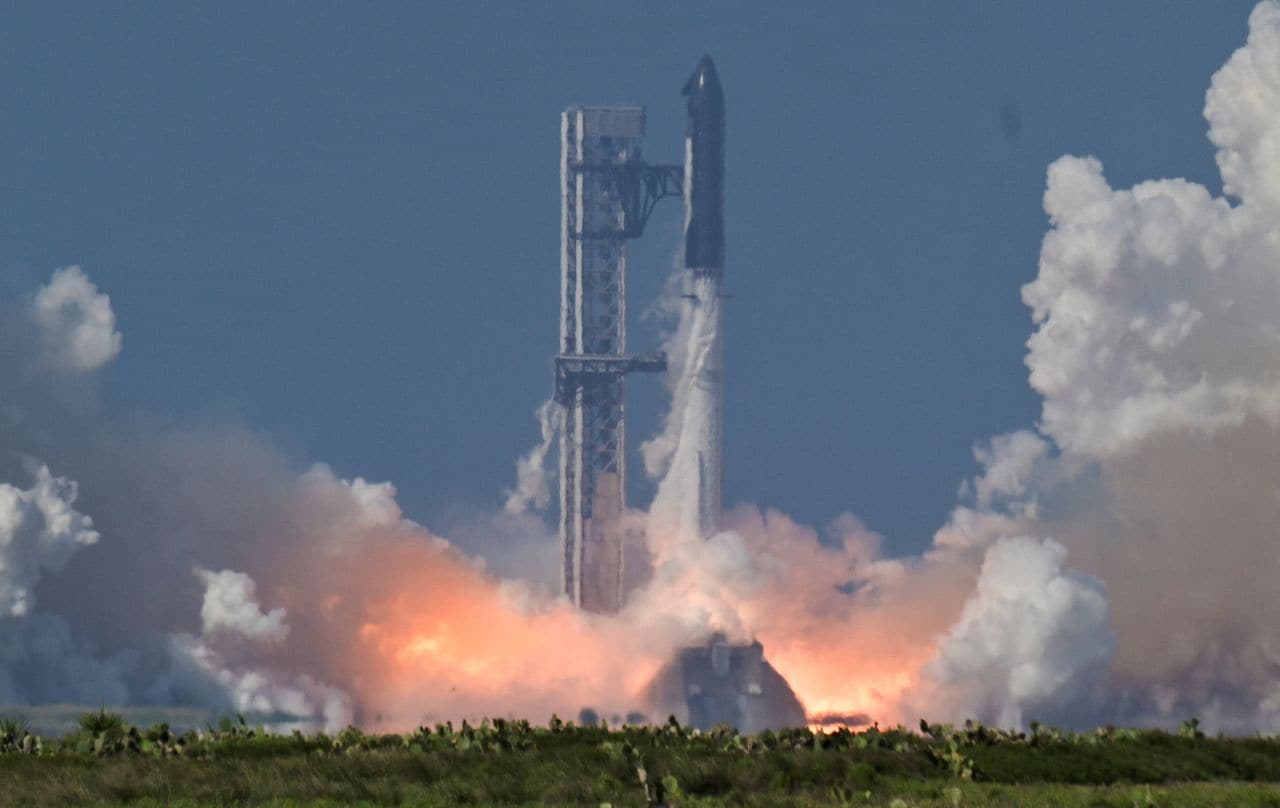
Mainstream tech journalism loves a predictable script. A giant stainless-steel rocket clears the tower, survives atmospheric reentry with its flaps glowing cherry-red, and plops into the ocean. Cue the breathless headlines about a flawless victory and a historic milestone.
The recent Starship test flight coverage followed this exact playbook. The consensus narrative is comforting: SpaceX is marching steadily toward making humanity multi-planetary, one successful splashdown at a time. It is a neat, linear story of inevitable triumph. Expanding on this idea, you can also read: Why ISIS is Terrified of AI and Why Western Intelligence is Missing the Real Threat.
It is also fundamentally wrong.
Celebrating a ocean splashdown as a definitive victory misses the entire point of what makes this vehicle economically viable. We are being conditioned to accept slow, iterative milestones as radical breakthroughs because the alternative—admitting the staggering, unresolved engineering bottlenecks of rapid reuse—is too uncomfortable for the space cheerleaders to contemplate. Observers at Mashable have also weighed in on this situation.
The Fatal Flaw in the Splashdown Celebration
Let’s dismantle the biggest myth of the latest flight: that a successful wet landing in the Indian Ocean or the Gulf of Mexico proves the architecture works.
It does not.
Starship is designed to be a fully and rapidly reusable system. In the launch business, "rapid" does not mean pulling a salt-encrusted booster out of the ocean with a crane, hauling it back to a shipyard, and spending three months replacing corroded hardware. That is not a paradigm shift; that is just a larger, more expensive version of the Space Shuttle solid rocket boosters.
For the economics of this platform to make sense, the booster and the ship must land directly back on the launch mount and fly again within hours. Every time a prototype hits the water, it is a write-off. The hardware is gone. The telemetry gathered is valuable, yes, but treating a destructive ocean landing as a mature operational capability is a coping mechanism for a delayed timeline.
The real metric of success isn't surviving the plasma of reentry. It is surviving the mechanical violence of the catch mechanism at Starbase. Until the upper stage is routinely grabbed out of mid-air by a pair of giant mechanical arms without exploding, we are still playing in the sandbox.
The Math of Reusability vs. Disposable Reality
To understand why the current praise is premature, we have to look at the brutal physics of the payload penalty.
Disposable Rocket Architecture: Maximizes payload to orbit by burning all structure.
Fully Reusable Architecture: Sacrifices up to 40% of potential payload for fuel, fins, and heat shields.
When you choose to build a fully reusable rocket, you voluntarily tie an economic anvil around your neck. You are carrying hundreds of tons of dry mass—stainless steel structure, sea-level raptor engines, header tanks, actuation systems, and thousands of fragile ceramic heat shield tiles—all the way to orbit and back.
If you don't reuse that hardware immediately, you are paying a massive performance penalty for absolutely zero economic return. A expendable Falcon Heavy or a Delta IV Heavy could park massive payloads into precise geostationary orbits without the structural dead weight.
I have watched aerospace companies burn through billions of dollars trying to optimize weight-to-thrust ratios. Spaceflight history is littered with projects that looked brilliant on a whiteboard but collapsed under the weight of operational reality. The current iteration of Starship is an incredibly heavy, drag-heavy vehicle that requires unprecedented flight cadence just to break even on its mass inefficiencies.
If SpaceX cannot achieve a turnaround time measured in days rather than months, the stainless-steel monolith becomes an economic liability, not an asset.
The Heat Shield Problem Nobody Wants to Talk About
Look closely at the footage of the recent reentry. You see individual thermal protection tiles peeling away under the intense aerodynamic load. You see structural flap joints melting under the concentrated plasma streams.
The media calls this a "successful test of thermal endurance." Let’s call it what it actually is: a glaring material science bottleneck.
Starship uses roughly 18,000 hexagonal ceramic tiles to survive the $1500^\circ\text{C}$ heat of reentry. Every single one of those tiles must be inspected, maintained, and verified before every single flight. If a handful of tiles fail on a disposable test vehicle, it makes for great video footage before the ship hits the water. If a handful of tiles fail on an operational vehicle meant to fly three times a day, the vehicle disintegrates over a populated area.
The current thermal protection system is a maintenance nightmare. It is the exact same operational trap that crippled the Space Shuttle fleet. NASA promised the Shuttle would fly 50 times a year. It managed a fraction of that because thousands of technicians had to manually inspect and replace individual tiles after every touchdown.
SpaceX is trying to automate this process, but the physics of ceramic-to-metal bonding do not care about software agility. The constant expansion and contraction of the steel hull during cryogenic fueling and atmospheric heating creates immense structural stress. Expecting these tiles to remain pristine across dozens of flights without exhaustive manual labor is a statistical gamble that the aerospace industry has already lost once before.
Dismantling the Prevalent Space Queries
The public discourse surrounding this program is warped by flawed assumptions. Let's address the questions people are actually asking, without the corporate PR spin.
Why don't they just use a traditional capsule design?
Because capsules lack volumetric capacity. If your goal is to launch tens of thousands of mass-manufactured internet satellites or build a heavy industrial base off-planet, you cannot rely on small, aerodynamic cones that drop into the ocean under nylon parachutes. The scale of the ambition dictates the awkward, massive shape of the vehicle. But acknowledging the necessity of the design doesn't mean we should ignore its inherent fragility during high-velocity atmospheric braking.
Is Starship ready to land astronauts on the Moon for Artemis?
Absolutely not. The current timeline driven by political mandates is a fiction. To send a single Starship to the Moon, SpaceX must launch anywhere from 8 to 16 propellant tanker variants into low Earth orbit to refill a single human-rated lander.
Think about the operational complexity of that requirement. You need a launch cadence that does not exist anywhere on Earth. You need rapid orbital docking, cryogenic fluid transfer in zero gravity—a technology that is still highly experimental—and zero critical failures across nearly twenty consecutive launches. A single scrub or a pad failure resets the clock. To claim that a simple ocean splashdown means the lunar landing architecture is on track is a delusion of scale.
The Monopolization Threat the Industry Ignores
While the public gawks at the spectacle of burning metal over the Indian Ocean, the broader aerospace industrial base is quietly rotting away.
The success of SpaceX’s launch model has created a monoculture. Legacy providers like United Launch Alliance and European alternatives are lagging years behind, crippled by bureaucratic inertia and a reliance on cost-plus government contracts.
But a monopoly in launch services is dangerous, even if that monopolist is run by a visionary.
When you eliminate competition, you eliminate the pressure to diversify technical architectures. If the Starship design encounters a fundamental, unfixable physics dead-end regarding rapid thermal reuse, Western space access will contract sharply. We have put all our strategic eggs into a single, unproven basket made of cold-rolled 304L stainless steel.
The downside of this contrarian reality is bleak: if this aggressive, iterative approach fails to achieve its core economic goal of sub-$10 million per launch, there is no backup plan. The global satellite industry, the military’s space logistics framework, and the deep-space scientific roadmap are all tethered to a vehicle that still cannot land on solid ground without blowing up.
Stop Applauding the Fireworks
The engineering team at Starbase is performing incredible feats of manufacturing velocity. Building massive rockets at the scale of a water tower is an impressive industrial achievement.
But stop grading a revolutionary transport system on a curve.
A rocket that lands in the water is a disposable rocket. A rocket that loses its heat shield during reentry is a maintenance bottleneck. A system that requires dozens of orbital refueling flights just to reach the Moon is an operational risk of unprecedented proportions.
The next time you see a giant rocket tip over into the ocean and explode in a ball of fire and sea spray, do not join the chorus of uncritical applause. Demanding true operational reusability means refusing to celebrate expensive, high-altitude scrap metal.


