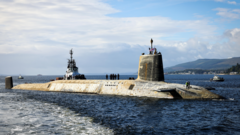
The air inside a shipyard smells of burnt ozone, hot metal, and salt spray. If you have ever stood on a dock in Barrow-in-Furness or along the Clyde when the wind is low, you know the sound. It is a rhythmic, concussive heartbeat. Clang. Clang. Clang. It is the sound of heavy industry building things that defy gravity and pressure, things designed to sink beneath crushing miles of dark water and stay there for months at a time, entirely invisible.
Most people never think about those ships. They live their lives miles inland, paying electricity bills, driving to grocery stores, worrying about mortgages. They assume the security of a nation is like the air they breathe: weightless, free, and infinite.
It is not.
Security is manufactured. It is bolted together by men and women wearing welding masks, working through freezing winters in massive sheds where the cranes overhead feel like cathedral rafters. When Andy Burnham speaks about investing in nuclear submarines, the headlines usually reduce it to sterile numbers. Billions of pounds. Thousands of jobs. Cold political calculations made in Westminster committee rooms.
The spreadsheets miss the human core. They miss the apprentice who dropped out of school at sixteen with zero prospects, only to spend three years learning how to weld titanium to tolerances measured in microns. They miss the supply chain stretching from a small machine shop in Sheffield to the shipyard gates, keeping three generations of a single family employed.
Let us be entirely honest. Nuclear submarines are terrifying machines. They are floating apex predators of the deep ocean, powered by controlled nuclear fission, armed with capabilities that make the mind recoil. No one wakes up in the morning hoping the world requires more of them. But we do not live in the world we wish existed. We live in the one that is here.
And in this world, deterrence is an architecture of steel.
Consider what happens when a nation stops building things. Not software. Not financial derivatives. Real, heavy, physical things. The skills vanish. You cannot download a generation of shipwrights from the internet. When the shipyards went quiet in previous decades, whole communities hollowed out. Pubs closed. High streets boarded up their windows. The young people left for London or Manchester, and the knowledge—passed down from parent to child through decades of soot and sweat—evaporated.
That is the invisible risk Burnham is trying to intercept.
When you inject capital into defense manufacturing, you are not just buying hulls. You are buying time. You are buying stability. You are funding the physics labs at regional universities where nineteen-year-olds are writing code for acoustic dampening. You are keeping the foundry fires burning in towns that would otherwise become ghost stories.
There is a strange paradox at the heart of industrial defense policy. To keep the peace, you must prepare for the unthinkable. To keep an economy resilient, you must sometimes invest billions into assets that everyone hopes will never have to fire a shot in anger.
Step inside a submarine construction hall, and the scale is biblical. The hull sections are so vast that humans walking beside them look like ants crawling along the side of a cliff. Every single weld is inspected by ultrasound and X-ray. A microscopic flaw means catastrophe. This level of precision demands an obsession that changes the people who do the work. They become quiet. Methodical. They understand that perfection is not an ideal; it is a baseline requirement.
When that kind of work anchors a region, something shifts in the local psyche. Pride returns. Not the abstract, flag-waving kind, but the quiet, bone-deep pride of a person who points at a news report and whispers to their kid, I helped build that.
Critics will always point to the ledger. They will ask if those billions could be better spent on hospitals, schools, or green energy. It is a fair question. In a world of finite resources, every pound allocated to a nuclear reactor is a pound not spent elsewhere.
Yet separating defense from infrastructure is a category error.
The engineers designing cooling systems for nuclear submarines are often the same minds figuring out how to make small modular nuclear reactors for civilian power grids. The metallurgical breakthroughs required to withstand the pressure of the Marianas Trench end up in commercial aviation and renewable energy turbines. Heavy industry is the heavy engine that pulls lighter innovations along behind it. Without the engine, the train stops.
We stand at a hinge in history. The old certainties are fraying at the edges. Supply chains can snap overnight. Geopolitical tensions that slumbered for decades are waking up with sharp teeth. In this climate, outsourcing your heavy manufacturing is a slow form of national suicide.
When an economy relies entirely on digital services, it is built on sand. When it can forge steel, weld titanium, and build complex systems from the ground up, it has roots.
Andy Burnham’s argument is not merely about defense procurement. It is an argument for regional survival and industrial sovereignty. It is an acknowledgment that a country cannot simply buy its way through the future by importing everything from someone else. You have to make things. Hard things. Things that take years to master and generations to sustain.
The shifts are already happening. Walk down the streets of Barrow today, and you can feel it. The scaffolding is up. The cranes are turning. The car parks are full at seven in the morning. It is gritty, loud, and imperfect.
The sparks fly inside the great sheds, showering the concrete floor in brilliant orange stars. Outside, the North Atlantic tide rises against the sea wall, cold and indifferent, waiting for the next great hull to slide down the slipway and vanish into the deep.