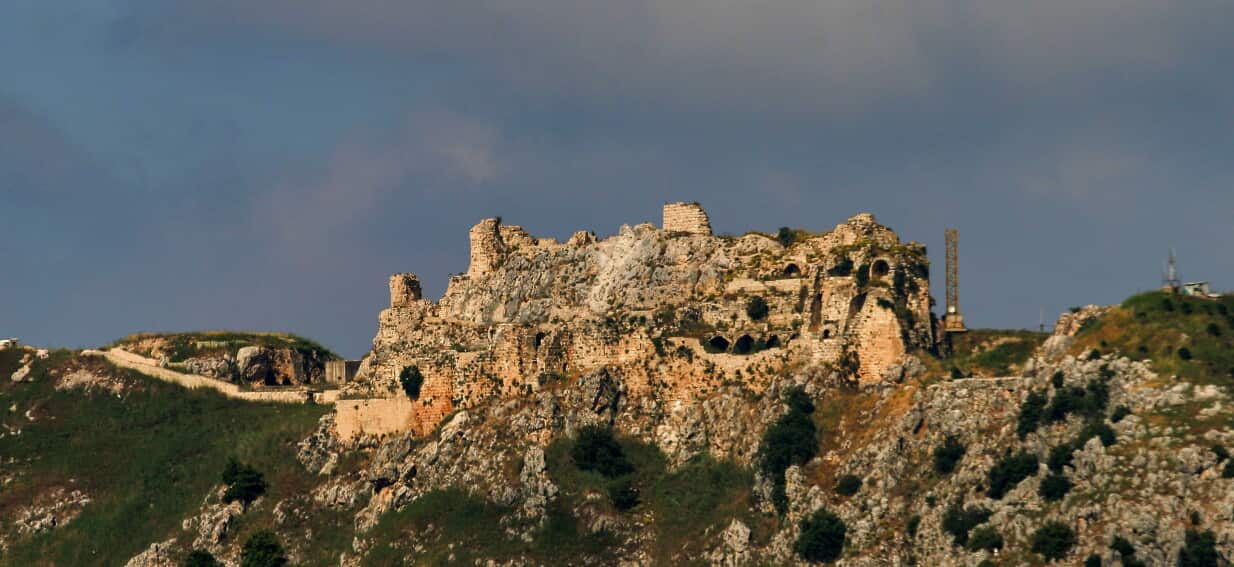
The wind off the Litani River does not care about borders. It sweeps up the jagged cliffs of southern Lebanon, howling past sheer limestone drops until it strikes the ancient, battered stones of Beaufort Castle. If you stand on the highest rampart on a clear afternoon, the view is dizzying. To the south, the rolling hills of Galilee shimmer in the heat. To the east, the snow-capped peak of Mount Hermon stands watch.
For nine hundred years, whoever held this rock held the keys to the region.
But stones do not fight wars. People do. And when we talk about geopolitical chess pieces, military strongholds, and strategic buffer zones, we often forget the sheer weight of human terror and triumph baked into the very mortar of the walls. Beaufort—known locally as Qalaat al-Shaqif, meaning the Castle of the High Rock—is not just an archaeological relic. It is a living, breathing scar on the landscape.
The recent escalation that saw Israeli forces once again seize control of this ancient site is not a new chapter. It is the continuation of a grueling, centuries-old cycle. To understand why a medieval fortress still dominates modern military strategy, you have to understand what it feels like to live in its shadow.
The Crusader’s Ghost and the Concrete Bunker
Step back to the late twelfth century. A stonemason, his hands calloused and caked with lime, looks out over the same precipice. He is building a fortress for Fulk, the Crusader King of Jerusalem. The task is monumental. They are carving a stronghold directly into the living rock, high enough to spot an approaching army days before it arrives.
To the Crusaders, Beaufort was an impregnable sanctuary. To Saladin, the legendary Muslim military leader, it was an intolerable thorn in the side of his empire. In 1189, Saladin laid siege to the castle. He captured the local Christian lord, Reginald of Sidon, and tortured him in full view of the garrison walls, demanding surrender. Reginald, agonizing in his chains, screamed up to his men in French, ordering them not to give up the fort.
That is the DNA of Beaufort. It is a place where human beings are pushed to the absolute brink of endurance for a few square meters of dirt.
Saladin eventually took the castle, only for it to change hands again. Regimes fell. Empires crumbled into dust. The Mamluks ruled it. The Ottomans conquered it. Fakhreddine, the Lebanese prince who sought autonomy from Istanbul, fortified it. The stone absorbed centuries of arrows, cannonballs, and musket fire.
Then came the twentieth century, and the arrows turned into heavy artillery.
When the Modern World Shattered the Stone
By the late 1970s, the Palestinian Liberation Organization (PLO) recognized the exact same thing King Fulk had realized eight centuries prior: if you control the High Rock, you control the theater of war.
The PLO transformed the medieval ruins into a heavily fortified bunker system. They dug into the old vaults, storing ammunition where Crusader knights once kept their horses. From this vantage point, artillery units could rain rockets down into northern Israeli towns. The castle had ceased to be an echo of history. It became a daily, terrifying reality for families living just across the border.
Imagine being a civilian in the Israeli town of Kiryat Shmona in 1981. You look up at the distant silhouette of the castle on the ridge. You know that someone up there is watching your streets through binoculars. You know that at any moment, a whistle in the sky means you have seconds to dive into a bomb shelter. The ancient fortress became a symbol of existential dread.
But the view from the other side was equally grim. For the Lebanese villagers living in Arnoun, the town nestled directly beneath the castle’s shadow, Beaufort was a lightning rod for destruction. Israeli jets routinely bombed the ridge. The thunder of airstrikes shook the teacups in local living rooms. Windows shattered. Children grew up knowing the difference between the whistle of an incoming shell and the dull thud of a direct hit on stone.
The human cost was mounting long before the official invasions began.
The Blood on the Ramparts: 1982
On June 6, 1982, Israel launched Operation Peace for Galilee. Beaufort Castle was objective number one.
The battle for the fortress that night was brutal, chaotic, and fought at point-blank range. Israeli Golani Brigade commandos advanced up the steep, rocky terrain under the cover of darkness. The PLO fighters inside the castle knew every nook, cranny, and subterranean tunnel.
What followed was a nightmare of hand-to-end combat inside medieval stone corridors. Grenades bounced off walls built by Crusaders. M16s clashed with Kalashnikovs in pitch-black vaults. By the time the sun rose over the Litani River, the Israeli military had taken the fort, but the cost was etched in blood. Six Israeli soldiers, including their beloved commander, Guni Harnik, lay dead. The Palestinian defenders were killed almost to a man.
The political fallout was immediate. Prime Minister Menachem Begin visited the site the next day, famously declaring that the battle had been won "without losses"—a catastrophic miscommunication or political deflection that deeply wounded the families of the fallen soldiers. It was a stark reminder that in the arena of war, the truth is often the first thing to be buried beneath the rubble.
For the next eighteen years, Israel didn't leave.
They built a massive concrete outpost right on top of the ancient ruins. Beaufort became a symbol of the costly, grinding occupation of southern Lebanon. For a generation of Israeli conscripts, serving at "the Beaufort" was synonymous with dread. It was a target for Hezbollah roadside bombs and mortar attacks.
The mothers of those soldiers formed a protest movement back home, their grief and anxiety fueling the political pressure that eventually led to Israel’s unilateral withdrawal from Lebanon in May 2000. Before the last Israeli tank rolled down the hill, engineers packed the modern concrete bunkers with explosives and blew them up, trying to deny the position to the enemy. The blast shook the ancient Crusader foundations, but the medieval stone survived.
It always survives.
The Illusion of Victory
When Hezbollah fighters rushed up the hill in May 2000 to plant their yellow flags on the ruined parapets, it felt like a final act. The castle was declared a monument to resistance. Tourists flocked from Beirut to stand where the commandos had stood, to look down into Israel, to feel the intoxicating rush of captured high ground.
For a couple of decades, Beaufort became a place of memory. UNESCO-backed restoration projects attempted to stabilize the crumbling walls. Families had picnics in the dry moat. Children played hide-and-seek in the vaults where men had bled out in the dark.
But history in this part of the world is a wheel that never stops turning.
The latest seizure of Beaufort by Israeli forces is a grim echo of 1982. The military calculus has not changed. The technology of war has evolved—drones now buzz over the ramparts where archers once stood, and satellite-guided missiles hit targets with precision that Saladin could never have dreamed of—but the geography remains stubborn. The high ground is still the high ground.
The Weight of the High Rock
It is easy to look at a map and see a dot labeled "Beaufort Castle" as a strategic asset. It is easy to write a headline about a military advance and treat it like a move in a board game.
But if you look closer, you see the human fingerprints on the stone. You see the Lebanese farmer in Arnoun who just wants to harvest his olives without looking up to see gun barrels pointed at his home. You see the young soldier, terrified, writing a letter home by the glow of a tactical flashlight, wondering if he will become just another ghost trapped in the mortar.
We treat history as something that happened in the past, a story told in textbooks with neat beginnings and definitive endings. Beaufort proves that history is an active volcano. The stone absorbs the blood, the sun bakes it dry, and then the next generation arrives to spill more.
As the wind continues to howl through the breached walls of Qalaat al-Shaqif tonight, the flag flying from its highest point may have changed once again, but the true master of the castle remains the same: an insatiable, nine-hundred-year-old hunger for the high ground that has never quite been satisfied.