Dust does not merely settle; it accumulates history.
In April 2015, the earth beneath Kathmandu and its surrounding valleys convulsed. A 7.8 magnitude earthquake shattered centuries of living memory in seconds. Temples that had weathered monsoons, empires, and the slow erosion of centuries simply collapsed into grey powder. Among the hardest hit was Lalitpur, the ancient city of artisans, where intricate wood carvings and brick courtyards crumbled into heaps of rubble.
For many outside observers, the disaster was a news cycle that blinked out when the next tragedy claimed the headlines. But for the people whose ancestors carved those pillars, the destruction was an amputation.
Consider a hypothetical stone mason named Ramesh, standing in the spring of 2015 amidst the wreckage of a centuries-old shrine in Patan Durbar Square. To a casual tourist, he looks at a pile of broken rocks. To Ramesh, he looks at the fractured jawbone of his city's identity. Every brick carries the thumbprint of a woodworker who lived three hundred years ago. When the temple fell, the lineage broke.
Rebuilding heritage is rarely just about stacking stones back in place. It is a dialogue with ghosts.
Years later, a quiet transformation began to take shape across the valley. Through a renewed partnership between India and Nepal, hands reached across borders to lift the fallen debris. This was not merely a transaction of foreign aid or political maneuvering. It was an act of cultural emergency surgery.
Restoring a UNESCO World Heritage site requires a specific kind of stubbornness. You cannot simply order modern concrete blocks from a catalog. You have to source the exact type of clay, fire it in traditional kilns, and carve Sal wood with iron chisels shaped by hand, exactly as master builders did during the Malla dynasty.
Walk through Lalitpur today, and you will hear the rhythmic clack-clack of mallets hitting chisels.
Young apprentices sit beside elders, learning geometry that was never written down in textbooks. It was passed eye to eye, breath to breath. When the restoration projects kicked into gear, funding from international and bilateral agreements—particularly from India’s steadfast commitment to post-earthquake reconstruction—provided the financial skeleton. But the soul of the work belonged entirely to the local craftsmen.
Silence. Then, the scrape of a trowel.
There is an invisible stake in projects like these. Globalization makes the world flat, frictionless, and terrifyingly uniform. Glass towers rise in Mumbai, London, and New York, looking indistinguishable from one another. In this rush toward the generic, ancient cities like Lalitpur act as cultural anchors. If they lose their physical fabric, humanity loses its navigational charts. We forget how to build things meant to last for centuries rather than decades.
The revival of these heritage sites is a rebuke to disposable culture.
Diplomacy is often measured in trade deficits, military pacts, and joint communiques. But true cross-border cooperation leaves its footprint in lime mortar and carved struts. When Indian conservation architects and Nepali master builders sat together in dusty courtyards, blueprints unrolled across wooden tables, they were practicing a different kind of diplomacy. They were negotiating with time itself.
Mistakes were made along the way. Bureaucracy stalled shipments of specialized timber. Monsoons threatened exposed foundations. There were moments of profound frustration when the sheer scale of the ruin felt insurmountable. Admitting that doubt is essential, because perfection is an AI fantasy. Real construction is messy, sweaty, and filled with human error corrected through stubborn perseverance.
Yet, step by step, the courtyards emerged from the dust.
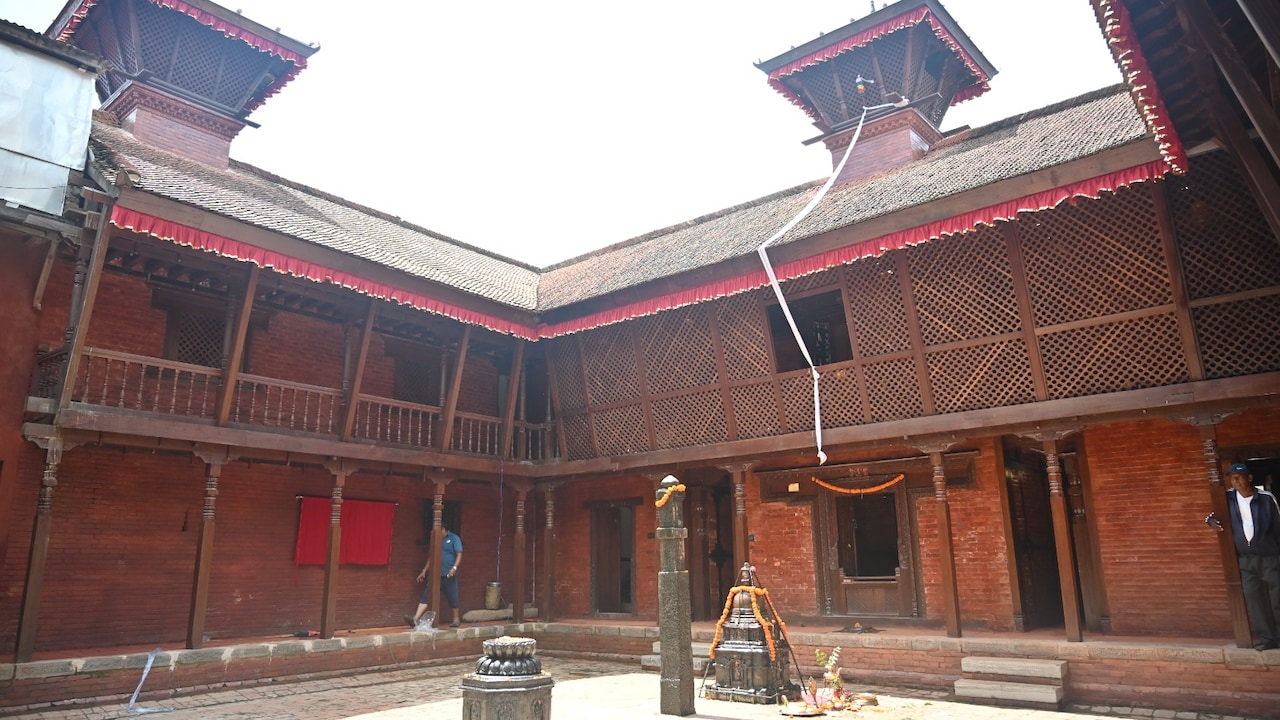
The roof struts of the Char Narayan Temple were hoisted back into place, gleaming with fresh oil and intricate deities. Ponds that had run dry filled with clean water. Pigeons returned to nest in the newly aligned eaves.
When a traveler visits Lalitpur now, they might see only the picturesque beauty of restored brickwork. They might snap a quick photo for social media and move on to the next cafe. But beneath the surface lies a quiet triumph of memory over erasure.
The earth will shake again. That is a geological certainty. Monsoons will beat down mercilessly upon the bricks. Wood will weather, and iron will rust.
That is not the point.
The point is that when the world broke, people refused to leave it in pieces. They picked up the dust, remembered the shape of the past, and built something capable of facing tomorrow.
An old craftsman wipes the sweat from his brow, places a final brick into the wet mortar, and listens to the quiet hum of a city that refused to die.