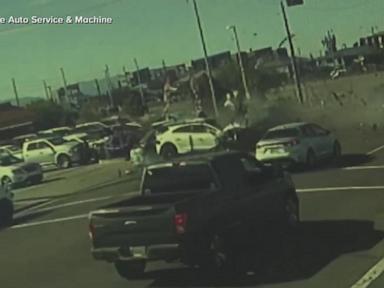
The headline screams out of your feed like a sirens-blaring warning from a dystopian sci-fi flick. An SUV slams into two driverless taxis. Click. Watch the grainy dashcam footage. Gasp at the twisted metal. Nod along as the local news anchor—and every armchair skeptic on the internet—uses this exact clip to declare that autonomous vehicles are a reckless experiment putting innocent lives at risk.
You are looking at the wrong culprit. You are asking the wrong question. And you are falling for the oldest, laziest narrative in modern journalism.
When a human driver loses control of a two-ton sport utility vehicle and plows into two stationary or law-abiding robotaxis, the story isn't that autonomous vehicles are dangerous. The story is that human drivers are catastrophically bad at operating heavy machinery, and our media ecosystem is structurally incapable of reporting on traffic safety without resorting to technophobic sensationalism.
I have spent over a decade watching mobility startups burn through billions of dollars trying to solve the wrong public relations problem. Engineers obsess over lidar ranges and sensor fusion while the press corps reduces every single fender-bender involving a Waymo or a Cruise to a referendum on the entire concept of artificial intelligence. Let's tear down the lazy consensus around viral robotaxi crashes, expose the asymmetrical standards holding back safer streets, and look at what actually happened when that SUV turned two autonomous vehicles into scrap.
The Anatomy of a Manufactured Scandal
Look closely at the framing of the viral SUV crash. Notice the passive, almost mystical language used in the coverage. "SUV crashes into 2 driverless taxis."
Notice what is missing from that headline? A human being.
SUVs do not drive themselves—at least not the ones plowing through intersections at high speeds because someone was checking a text message or misjudging a yellow light. A human being sat behind the wheel of that SUV. A human being pressed the accelerator, ignored the geometry of the road, and collided with two vehicles that were operating strictly within the boundaries of traffic law.
Yet, because the victims of this collision happened to be packed with rooftop sensor arrays instead of tired commuters, the story immediately morphs into a tale of autonomous chaos. Local news outlets love this framing because novelty drives clicks. Nobody clicks on a headline that reads "Distracted Driver Causes Three-Car Pileup on Main Street." That happens forty thousand times a day across North America. It is background noise. Put the word "driverless" in the deck, however, and suddenly a mundane display of human incompetence becomes front-page tech news.
This is the fundamental dishonesty of modern automotive reporting. Every time a robotaxi is involved in an incident—even when it is rear-ended at a dead stop by a drunk driver—the autonomous system is treated as a co-conspirator simply for existing on public asphalt.
The Asymmetry of Risk and the Perfection Trap
In safety engineering, we deal with a brutal cognitive bias known as the perfection trap. Humans demand 100% perfection from machines before they will trust them, while happily tolerating staggering levels of carnage from fellow humans.
Consider the baseline reality of human driving. According to the National Highway Traffic Safety Administration, human error is a critical factor in roughly 94% of serious crashes. Every year, over 40,000 people die on American roads alone. Millions more suffer life-altering injuries. We accept this slaughter as the routine cost of getting to the grocery store because we suffer from an illusion of control. When we hold the steering wheel, we believe we are above-average drivers.
Now introduce an autonomous vehicle into that chaotic ecosystem. An autonomous system does not get drunk. It does not get road rage. It does not fall asleep after a double shift. It does not glance down at Instagram while merging onto the highway. It maintains a 360-degree, real-time field of awareness using radar, lidar, and high-resolution cameras that never blink.
Yet, when a human driver smashes into two of these hyper-vigilant machines, critics ask: Why didn't the robotaxis get out of the way?
Let's apply basic physics and vehicle dynamics to that question. Imagine a scenario where two autonomous vehicles are stopped at a red light or navigating a dense urban lane with traffic flanking them on both sides. An errant SUV barrels toward them at 45 miles per hour. Even if the robotaxi's perception stack identifies the impending collision 500 milliseconds before impact—faster than any human nervous system could even register the headlights—where is the car supposed to go?
If the vehicle is boxed in by a curb on the right and oncoming traffic on the left, executing an evasive maneuver means violently swerving into a pedestrian sidewalk or into the path of an innocent oncoming sedan. Autonomous planners are programmed to follow strict safety envelopes and predictable trajectories. Violating lane boundaries to dodge a reckless driver often creates a worse, unpredictable secondary crash. Taking the hit while stationary or braking in a straight line is frequently the mathematically optimal outcome to minimize total kinetic energy transfer and protect bystanders.
Critics who watch the footage and complain that the robotaxis "just sat there" are revealing their complete ignorance of defensive driving physics. You cannot teleport a 4,500-pound electric crossover out of harm's way when a human treats a city block like a demolition derby.
What the Viral Video Actually Proves
If you strip away the sensationalist commentary and watch the incident through the eyes of a collision reconstructionist, a completely different narrative emerges.
First, look at the telemetry. Every single autonomous vehicle on the road today is a rolling black box. Unlike the average human-driven SUV, which might yield basic airbag deployment data if you subpoena the manufacturer, a robotaxi records every millisecond of the event in high-definition, multi-modal sensor logs. We know the exact speed of the approaching SUV, its steering angle, the precise moment it crossed the lane divider, and the exact millisecond of impact.
In the overwhelming majority of multi-vehicle collisions involving autonomous fleets—data backed by extensive safety reports from companies like Waymo and peer-reviewed studies from institutions like the Insurance Institute for Highway Safety—the human driver is the primary instigator. Rear-end collisions account for the largest single category of crashes involving autonomous vehicles. Why? Because humans tailgate, look at their phones, and fail to anticipate a vehicle that actually obeys speed limits and comes to a complete, smooth stop at stop signs.
Second, look at the post-crash behavior. When two driverless taxis get struck, they do not panic. They do not flee the scene. They do not get out of the car and start screaming at the other driver. Their onboard systems immediately trigger hazard protocols, bring the vehicles to a controlled stop if they are still rolling, unlock doors for emergency responders, and establish a direct two-way audio link between remote fleet operations and local emergency services.
Compare that to the hit-and-run epidemic currently plaguing major cities. When a human hits your car, there is a non-trivial chance they speed off into the night, leaving you with a totaled vehicle and a massive deductible. When an autonomous vehicle is involved in a crash, the tech company hands the police a crystal-clear, 360-degree video reconstruction of the entire event before the tow trucks even arrive.
Dismantling the "People Also Ask" Myths
Whenever a crash like this trends online, search engines flood with predictable, panic-driven questions. Let's look at the queries people type into their browsers and dismantle the flawed premises behind them.
"Are driverless cars actually safe if they keep getting into crashes?"
This question confuses involvement with causation. If you park a brand-new luxury sedan in a demolition derby, it is going to get hit. That does not mean the sedan is poorly engineered; it means the environment is hostile. When autonomous vehicles operate in dense urban centers like San Francisco, Phoenix, or Austin, they are sharing asphalt with hundreds of thousands of unpredictable, distracted, and aggressive human drivers. Measuring the safety of an autonomous fleet by counting how many times humans crash into it is like measuring the quality of a bulletproof vest by complaining that people keep shooting at it. The metric that matters is at-fault crash rate per million miles driven, and on that front, top-tier autonomous systems are already outperforming the average human driver by wide margins.
"Why do robotaxis freeze up after an accident and block traffic?"
Yes, this happens, and yes, it is annoying. I have seen autonomous fleets suffer massive operational black eyes because a damaged vehicle went into a rigid fail-safe mode, blocking a fire lane or snarling rush-hour traffic while waiting for a human retrieval team. This is a legitimate operational flaw—not a safety failure, but an urban logistics failure. Early autonomous architectures prioritized "fail-safe" (stop immediately when an anomaly is detected) over "fail-operational" (safely limp to the nearest shoulder). Industry leaders have spent the last two years aggressively rewriting these minimum-risk maneuver protocols so damaged vehicles can pull out of active lanes. Calling this a reason to ban driverless cars, however, is absurd. Human crashes routinely shut down entire interstate highways for six hours at a time.
"Who pays when a driverless car is involved in a crash?"
The premise of this question usually implies a legal nightmare where victims are trapped in bureaucratic limbo. The reality is the exact opposite. Commercial autonomous operators carry massive commercial liability insurance policies—often ten to fifty times higher than the state-mandated minimums carried by the guy driving the SUV that hit them. Furthermore, because the autonomous vehicle's sensors record everything, determining fault takes hours instead of months of depositions. If the robotaxi is at fault, the operator pays out quickly to avoid bad press. If the human SUV driver is at fault, the tech company's legal team uses indisputable lidar evidence to hold the human driver's insurer fully accountable.
The Uncomfortable Truth About the Autonomous Industry
As an insider, I am not here to write a puff piece for Silicon Valley. While the media gets the story completely wrong by blaming the machines for human stupidity, the autonomous vehicle industry bears heavy responsibility for its own public relations disasters.
For a decade, tech executives lied about the timeline. They promised full Level 5 autonomy by 2020. They sold a fantasy of steering-wheel-free nirvana where traffic jams would vanish overnight. By overpromising and treating public streets like a beta-testing sandbox without building genuine community buy-in, they created a reservoir of public resentment.
When you arrogantly tell a city that your software is smarter than every human resident, the public is going to cheer when your car gets smashed by an SUV or stuck in wet cement. The industry brought this hostility upon itself through sheer hubris.
There is also a genuine downside to the current generation of autonomous systems that critics rarely articulate well: predictability friction. Autonomous vehicles follow the rules of the road too literally. Humans drive through unwritten social contracts. We wave each other through four-way stops. We roll slightly past limit lines to see around blind corners. We accelerate briskly to merge into tight highway gaps.
A robotaxi programmed to obey the exact letter of the vehicle code can behave in ways that surprise human drivers who expect normal rule-bending. When a robotaxi slams on its brakes because a pedestrian twitched near a crosswalk, the human behind it—who was expecting the car to roll through—rear-ends it. Technically, the human is 100% at fault for following too closely. Practically, the rigid, robotic adherence to traffic rules creates friction in a mixed-traffic environment.
Solving this requires teaching machines not just the rules of the road, but the etiquette of human driving without sacrificing safety margins. That is an extraordinarily difficult computer science problem, and anyone claiming it is completely solved is selling you vaporware.
How to Actually Evaluate Autonomous Vehicle News
The next time a headline flashes across your screen showing a crushed robotaxi, stop reacting like a Pavlovian dog trained by clickbait editors. Apply a three-step filter to see what is actually happening on your streets.
- Identify the kinetic aggressor. Look at the physics of the impact. Which vehicle crossed the center line? Which vehicle ran the red light? Which vehicle failed to brake in time? If a human-driven car smashed into an autonomous car, the headline is an indictment of human licensing standards, not artificial intelligence.
- Demand the denominator. Never accept raw incident numbers without the denominator of total miles driven. If a fleet drives ten million miles in a dense city and gets hit twenty times, that is a remarkably low incident rate compared to human benchmarks. Single anecdotes tell you nothing about systemic risk.
- Separate nuisance from lethality. Distinguish between a robotaxi getting confused by construction cones and blocking a lane versus a vehicle killing a pedestrian. One is an engineering annoyance that gets fixed in the next over-the-air software update. The other is a tragedy. Treating them as equivalent moral failures destroys our ability to have an adult conversation about transportation policy.
The Verdict on the Asphalt
We are living through a bizarre transition period where hyper-rational machines are forced to share the road with emotional, distracted primates piloting multi-ton steel battering rams. Collisions between these two species are inevitable.
When an SUV plows into two driverless taxis, the easy, comforting lie is to point at the spinning sensors on the roof and blame the future. It lets us off the hook. It allows us to keep pretending that our own terrible driving habits, our text-and-drive addictions, and our lax licensing laws aren't the real threat to public safety.
The sensors on those two taxis saw the SUV coming. They logged every inch of its erratic path. They absorbed the blow without panicking, without swerving into innocent bystanders, and without fleeing the scene.
The machines did their job. It is time we started holding the humans behind the wheel to the exact same standard.