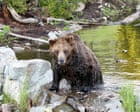
Every time a wire service pushes out a headline reading "One dead and another missing in suspected grizzly bear attack in Canada," the exact same media theater begins. Local outlets print stock photos of bared teeth. Comment sections fill up with demands for immediate culls, trophy hunt reinstatements, or the opposite extreme—romanticized nonsense about "gentle giants" who only ever act in pure self-defense.
Both camps are dead wrong.
The lazy consensus around fatal bear encounters in the Canadian Rockies and British Columbia interior relies on a comforting lie: that these tragedies are freak acts of nature, random lightning strikes in the timber. They are not. When you strip away the sensationalism of breaking news alerts, most fatal grizzly encounters in North America follow a depressingly predictable script written by human hubris, broken municipal waste management, and an outdoor recreation industry that sells wilderness like a theme park.
If you want to survive the Canadian backcountry—or understand why people keep dying in it—you need to stop looking at the bear and start auditing the systems that put two humans in its crosshairs.
The Lie of the "Unprovoked" Attack
Wire copy loves the word suspected and quickly pivots to unprovoked. Wildlife biologists hate both terms because they obscure the actual mechanics of ursid behavior.
A grizzly bear (Ursus arctos horribilis) does not wake up in Jasper, Banff, or the Kootenays looking to hunt humans. We are noisy, upright, smell like synthetic detergents, and carry very little usable fat compared to an elk calf or a spawning salmon. To a grizzly, a human is an unpredictable nuisance—until we make ourselves impossible to ignore or accidentally trigger an evolutionary tripwire.
Stephen Herrero, the University of Calgary biologist who literally wrote the book on this (Bear Attacks: Their Causes and Avoidance), spent decades dissecting every recorded encounter in North America. His data dismantled the monster myth half a century ago, yet modern newsrooms still refuse to read it. Herrero’s research established that roughly 70% of fatal grizzly encounters involve a female defending her cubs, a bear defending a high-value food source (like a buried ungulate carcass), or a sudden surprise encounter at close range.
The remaining percentage—the predatory attacks that terrify campers—are overwhelmingly linked to two factors: food conditioning and habituation.
And neither of those is the bear's fault.
When a news report mentions a fatal mauling near a popular trailhead, a backcountry lodge, or a forestry road, the real story happened six months earlier. It happened when a weekend camper left a cooler out overnight. It happened when a rural municipality delayed switching to bear-proof dumpsters to save forty grand on its annual budget. It happened when an orchard owner in British Columbia left rotting windfall apples on the ground because picking them wasn't cost-effective.
Once a grizzly associates humans with a 4,000-calorie reward, its risk calculus changes permanently. A wild grizzly avoids people. A food-conditioned grizzly investigates them. When you combine an investigation with a panicked hiker who runs, screams, or reaches for a phone instead of bear spray, the outcome is mathematically baked in.
The Outdoor Industry’s Deadly Marketing Problem
I have spent years working alongside backcountry guides, park wardens, and wilderness risk consultants across Alberta and British Columbia. You want to know what keeps those people awake at night? It isn't the bears. It's the Instagram-ification of lethal terrain.
Over the last decade, tourism boards and outdoor apparel brands have aggressively marketed the Canadian wilderness as an accessible wellness retreat. The messaging is sanitized: buy the right GORE-TEX shell, download an offline trail map, pack some trail mix, and go "reconnect."
What the marketing leaves out is that the Bow Valley, the Skeena region, and the Northern Rockies are active predator-prey ecosystems where apex carnivores operate on razor-thin caloric margins.
Consider the seasonal reality of a Canadian grizzly. Depending on elevation and latitude, a grizzly has between five and seven months out of the year to consume enough calories to survive a five-month winter denning period—and, for pregnant sows, to gestate and nurse cubs while asleep. During late summer and autumn, a grizzly enters hyperphagia, a state of relentless, near-obsessive eating where the animal needs upwards of 20,000 calories a day.
In September and October, bears are hyper-focused on buffaloberries, whitebark pine nuts, roots, and scavenging gut piles left behind by big-game hunters. Their heads are down. Their ears are tuned to wind and rustling brush.
Meanwhile, peak autumn foliage draws tens of thousands of hikers onto the exact same elevation bands where bears are gorging before snowfall. Add in trail runners wearing noise-canceling earbuds—a phenomenon wardens now see daily on singletrack trails—and you have created a high-speed collision course. A silent human moving at seven miles an hour around a blind corner in dense alder brush is indistinguishable from a charging rival or a startled prey animal. By the time the bear registers what you are, it has already committed to a defensive charge.
Why Bear Spray Beats Every Firearm on the Market
Whenever a fatality hits the news cycle in Canada, the comment sections immediately ignite into a predictable proxy war over firearms laws. Critics argue that if hikers were allowed to carry handguns in national parks—which is strictly illegal under Canadian federal law—nobody would die.
That argument sounds tough at a keyboard. In the dirt, at thirty feet, with a 600-pound boar closing the distance at 35 miles per hour, it is suicidal nonsense.
Let’s look at the actual data, not action-movie fantasies. Tom Smith, a wildlife sciences professor at Brigham Young University, conducted a landmark comparative study analyzing 269 bear-human encounters in Alaska involving firearms versus 83 encounters involving bear spray.
The results were not even close:
- Firearms: People carrying guns suffered injury in roughly 50% of encounters where they actually managed to use the weapon. Even worse, firearm discharge frequently failed to stop the charge before contact, or the shooter missed entirely under extreme adrenaline dump.
- Bear Spray: Individuals who deployed capsaicin-based bear deterrent escaped uninjured in 98% of close-range encounters.
The physics explain why. A charging grizzly’s head is bobbing violently, its thick skull is angled downward, and its vital organs are shielded behind heavy bone and dense muscle. To stop a charge with a bullet, you have to hit a brain the size of a grapefruit moving at highway speeds while your fine motor skills are dissolving from an adrenaline spike.
Bear spray does not require precision. It deploys an expanding, pressurized cloud of concentrated oleoresin capsicum (1% to 2% major capsaicinoids) out to 25 or 30 feet. The bear runs straight through an invisible wall of chemical fire that instantly inflames its eyes, mucous membranes, and respiratory tract. It cannot see. It cannot breathe properly. Its sensory apparatus—the very thing it relies on to fight—is temporarily shut down.
Yet look at what actually happens in the field. Wardens routinely find hikers carrying bear spray buried inside the main compartment of a zippered backpack—right next to their extra socks and sandwich. If your canister is not in a quick-draw hip holster or chest rig, you do not have bear spray. You have an expensive paperweight you will never touch during the 1.8 seconds it takes a bear to cross twenty yards.
The Flawed Premise Behind "People Also Ask"
When tragedies like this break, search engines flood with panicked, poorly framed questions from people trying to assess their own risk. Most of those questions are built on dangerous assumptions.
"How can I outrun or climb away from a grizzly bear?"
You cannot. Stop asking how to outrun an animal that routinely sprints at 35 miles per hour over deadfall, steep scree, and waist-deep river currents. Usain Bolt peaked at roughly 27.8 miles per hour on a flat, rubberized track in spikes. Running triggers a predator’s chase instinct. Even a bear that was merely bluff-charging to clear space will pursue a fleeing target.
As for climbing: adult grizzlies are not great tree climbers compared to black bears, largely because of their long, straight claws and heavy body mass. However, an athletic sub-adult grizzly can easily climb 15 to 20 feet up a spruce tree with low branches, and a large adult can reach 12 feet simply by standing on its hind legs. Unless you are a trained arborist with a 30-foot head start, trying to climb a tree guarantees the bear grabs you by the ankle halfway up.
"Should I play dead or fight back?"
This binary question gets people killed because it ignores context. You have to read the bear’s intent before you choose a tactic.
- Defensive Attack (The vast majority): The bear is huffing, jaw-popping, salivating, ears pinned back, charging because you surprised it or got too close to cubs or a carcass. Here, you play dead. Drop flat on your stomach, hands clasped behind your neck, legs spread wide so the bear cannot easily flip you over. Stay completely still and silent even after the bear stops biting and walks away. Grizzlies frequently linger nearby for several minutes to confirm the threat is neutralized.
- Predatory Attack (Rare, silent, stalking): The bear is not vocalizing or bluffing. Its head is up, ears forward, watching you intently, circling or approaching steadily without signs of stress. Or, a bear breaks into your tent at night. Here, playing dead is suicide. You are being treated as food. You fight back with absolute, unrestrained violence—rocks, trekking poles, knives, fists aimed directly at the eyes and snout.
"Why doesn't the government just relocate problem bears?"
Because relocation is largely a public relations theater that shifts the problem onto someone else’s back porch.
A grizzly’s home range can span hundreds of square miles. Biologists have documented relocated grizzlies traveling over 150 miles across mountain passes and rivers in a matter of weeks to return to the exact valley where they were trapped. Worse, if you dump a food-conditioned bear into unfamiliar territory already occupied by dominant resident males, the newcomer gets driven into marginal terrain—which almost always means highway corridors, campgrounds, and ranches.
When wildlife officers destroy a bear after a fatal attack, animal rights groups erupt in fury. What they ignore is that a bear that has killed and fed on a human has crossed a behavioral threshold from which there is no rehabilitation. Putting it down is not vengeance; it is basic containment.
The Uncomfortable Truth About Coexistence
Here is where the contrarian view cuts both ways. If you think the solution is turning the Canadian wilderness into a sanitized, zero-risk zone, you are delusional. And if you think we can protect grizzlies without aggressively policing human stupidity, you are equally blind.
True coexistence requires admitting that grizzlies and humans cannot share every square kilometer on equal terms—and the compromise has to come from our side of the fence, because the bear doesn't read park brochures.
That means enforcing brutal, uncompromising rules on ourselves:
- Mandatory Bear-Safe Infrastructure Everywhere: Not just inside National Park boundaries, where Parks Canada enforces strict "bare campsite" rules, but across adjacent provincial Crown land, logging camps, and gateway towns. A bear doesn't know where Banff ends and Canmore begins.
- Real Penalties for Attractant Violations: Leaving garbage, pet food, or coolers accessible in grizzly country shouldn't result in a polite warning ticket. It should carry crippling fines that pay directly for wildlife enforcement officers. Every unsecured dumpster is a loaded gun aimed at both a bear and a future hiker.
- Seasonal Trail Closures With Teeth: When buffaloberries peak in a specific drainage or an avalanche chute draws twenty bears to feed on spring greens, shut the trail down completely. Not a "bear warning" sign that hikers ignore while snapping selfies—a hard closure backed by heavy fines.
- Honest Risk Education: Stop telling tourists that wildlife encounters are magical spiritual moments. Tell them the truth: you are walking through the dining room of an apex carnivore that can crush a bowling ball in its jaws, and your survival depends entirely on discipline, noise, wind direction, and having a canister of capsaicin strapped to your sternum.
The Trade-Off Nobody Wants to Admit
There is an undeniable downside to treating grizzly country with this level of rigor: it ruins the fantasy.
Strict seasonal closures mean you might fly across the world to hike a famous ridge in Alberta and find the trailhead locked with yellow tape. Heavy-handed attractant enforcement breeds resentment among rural residents who feel lectured by urban bureaucrats. Requiring groups of four or more on high-risk trails—a rule Parks Canada already enforces in certain zones—kills the romantic ideal of the solitary wanderer finding peace alone in the mountains.
You lose convenience. You lose spontaneity. You accept that nature is not obligated to accommodate your vacation itinerary.
Until newsrooms, tourism boards, and backcountry travelers accept that reality, nothing will change. Every autumn, another emergency beacon will trigger in the Canadian timber. Another search-and-rescue team will hike into the dark with heavy rifles and body bags. And another headline will blame the bear for acting like a bear in the only home it has left.
Put the bear spray on your chest, leave your earbuds in your truck, and stop pretending the wilderness is safe.