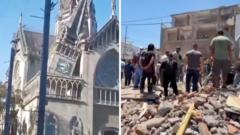
Every time the ground shifts in South America, the media template rolls out on autopilot. Cameras zoom in on pulverized brick, anchors gasp over dramatic footage of shaking walls, and the immediate narrative solidifies into a predictable script of helpless tragedy. Mother Nature strikes again. The earth shakes, buildings crumble, and we are told to bow before the raw, uncontrollable fury of tectonic plates.
It is a convenient lie. The earth does not kill people. Bad construction does.
When a magnitude 6.0 earthquake hits Colombia and structures turn to powder while neighboring buildings stand completely unbothered, you are not watching a natural disaster. You are watching a structural audit of corruption, corner-cutting, and institutional negligence. We treat seismic events like unpredictable lightning strikes from the gods, absolving municipal planners, rogue contractors, and lax building inspectors of every ounce of blame.
Time to drop the sympathetic act. The footage of crumbling facades in Bogotá or the Andean interior does not point to an unavoidable act of God. It points straight to a man-made failure of engineering and oversight.
The Lazy Consensus Of Seismic Fatalities
The standard reporting playbook follows a tired formula. Panic. Aftershocks. Rescue workers sifting through rubble. Statistics on the Richter scale. Experts wheeled onto morning broadcasts to remind everyone that the Andean region sits atop the Pacific Ring of Fire, implying that collapsing masonry is simply the price of admission for living there.
This is intellectual laziness.
Japan sits on one of the most violent tectonic boundaries on the planet. Earthquakes that would flatten entire neighborhoods in other parts of the world regularly rock Tokyo, resulting in little more than spilled coffee and delayed subway lines. Why? Because Japan treats seismic resilience as a non-negotiable physical law, whereas developing markets in Latin America often treat building codes as optional guidelines suggested by wet-ink bureaucrats.
When a Colombian apartment block pancakes during a moderate tremor, the autopsy almost always reveals the same structural sins. Substandard rebar. Unreinforced masonry. Concrete mixes watered down to pad contractor margins. Structural alterations made by apartment owners who decided their living room needed an open-plan layout more than it needed a load-bearing wall.
Yet, when the dust clears, nobody points a finger at the civil engineer who signed off on substandard materials. Instead, cameras pan back to weeping citizens clutching broken drywall, thanking heaven that things were not worse. This misplaced gratitude is precisely why bad buildings keep getting built.
Anatomy Of A Structural Crime
Let us look at how the typical urban expansion actually happens across much of Colombia's rapidly growing secondary and tertiary cities.
Informal construction and rapid urbanization have outpaced municipal enforcement for decades. Millions of citizens live in structures built without architectural blueprints, engineering calculations, or geotechnical surveys. These are not malicious slums; they are family homes built floor by floor as remittances arrive or small business savings accumulate. A ground floor goes up. A few years later, a second floor is stacked on top. Then a third.
The columns were never designed to carry three stories. The foundation was poured for a single-family bungalow. When a tremor rolls through, those upper floors act like wrecking balls attached to toothpicks.
To call this a natural disaster is an insult to actual natural disasters. It is an engineered catastrophe waiting for a trigger.
The Colombian government has modern seismic resistance norms, specifically the NSR-10 code. On paper, the rules are rigorous. They mandate ductile frames, proper energy dissipation, and strict material standards. But paper does not hold up a roof. In practice, municipal oversight is often underfunded, understaffed, and susceptible to institutional shortcuts. Inspectors look the other way. Bribes change hands. Permits are rubber-stamped.
When a building collapses while structures fifty meters away remain entirely intact, you are looking at the physical receipt of a municipal bribe.
The Economic Incentive To Cut Corners
Why do developers risk lives to shave percentages off construction costs? Because the economic incentives reward speed and cheap materials over structural longevity, and the legal consequences for catastrophic failure are remarkably toothless.
Imagine a scenario where a mid-tier developer in Medellín saves fifty thousand dollars by substituting high-grade structural steel with cheaper, non-compliant imports and reducing cement density in critical columns. That money goes straight into executive bonuses or the down payment for the next project.
Now, roll the dice. Most years, nothing happens. The building stands. The units sell. The developer cashes out and moves to a new corporate entity.
If an earthquake hits ten years later and the building pancakes, the original corporate shell has long been dissolved. The developer is shielded by limited liability structures. The civil lawsuits drag on for decades through a sclerotic judicial system. Nobody goes to prison. The victims receive meager payouts that barely cover funeral expenses, let alone a new home.
The math is brutal. For the bad actor, the expected value of cutting corners is positive. The risk is externalized onto the families sleeping on the third floor.
Until we pierce corporate veils, seize personal assets of negligent developers, and hand out criminal negligence sentences that stick, contractors will continue to gamble with human lives. Stop blaming the fault lines. Blame the balance sheet.
How To Fix Urban Vulnerability
If we want to stop writing obituaries for concrete victims, we have to completely invert how we approach disaster preparedness and urban planning.
First, stop funding post-disaster relief as the primary response mechanism. International aid and government funds pour in after buildings fall, rewarding a cycle of reactive charity. That money needs to shift upstream into pre-disaster structural retrofitting and aggressive enforcement.
Second, municipal governments must implement mandatory, random structural audits on buildings over twenty years old, completely independent of local political influence. If a building fails its seismic audit, the owner—whether private or corporate—should face immediate fines and mandatory evacuation until remediation is complete.
Third, insurance markets need to wake up. Property insurance in earthquake-prone regions must be tied directly to structural integrity ratings, not just geographic location. If your building meets modern seismic standards, your premiums should drop. If your building was thrown together with cheap materials and zero engineering oversight, insurance should either be financially punitive or entirely unavailable. Let the market price out bad construction.
Finally, everyday citizens need a radical shift in how they buy and rent property. For generations, real estate marketing has focused on granite countertops, balcony views, and neighborhood proximity to trendy coffee shops. Nobody asks for the structural calculation package. Nobody checks the rebar density reports before signing a lease.
That needs to change. Treat structural engineering credentials with the same obsession that people currently reserve for aesthetic finishes. If a landlord or developer refuses to show you the seismic compliance certification, walk away. Let unreinforced concrete rot on the market.
The Real Crisis
The ground beneath Colombia will keep shaking. Tectonic plates do not negotiate, and subduction zones do not care about political cycles or economic hardships. The Andean geography is fixed.
What is not fixed is our collective willingness to accept shoddy construction as an inevitable tragedy. Every time we watch footage of a building collapsing on live television and sigh about the unpredictability of nature, we give bad builders another free pass.
The rubble does not lie. It tells a precise story about who cut corners, who looked the other way, and who pocketed the difference. Stop blaming the earth for doing what it has done for millions of years. Start holding the people who pour the concrete accountable for the graves they build.