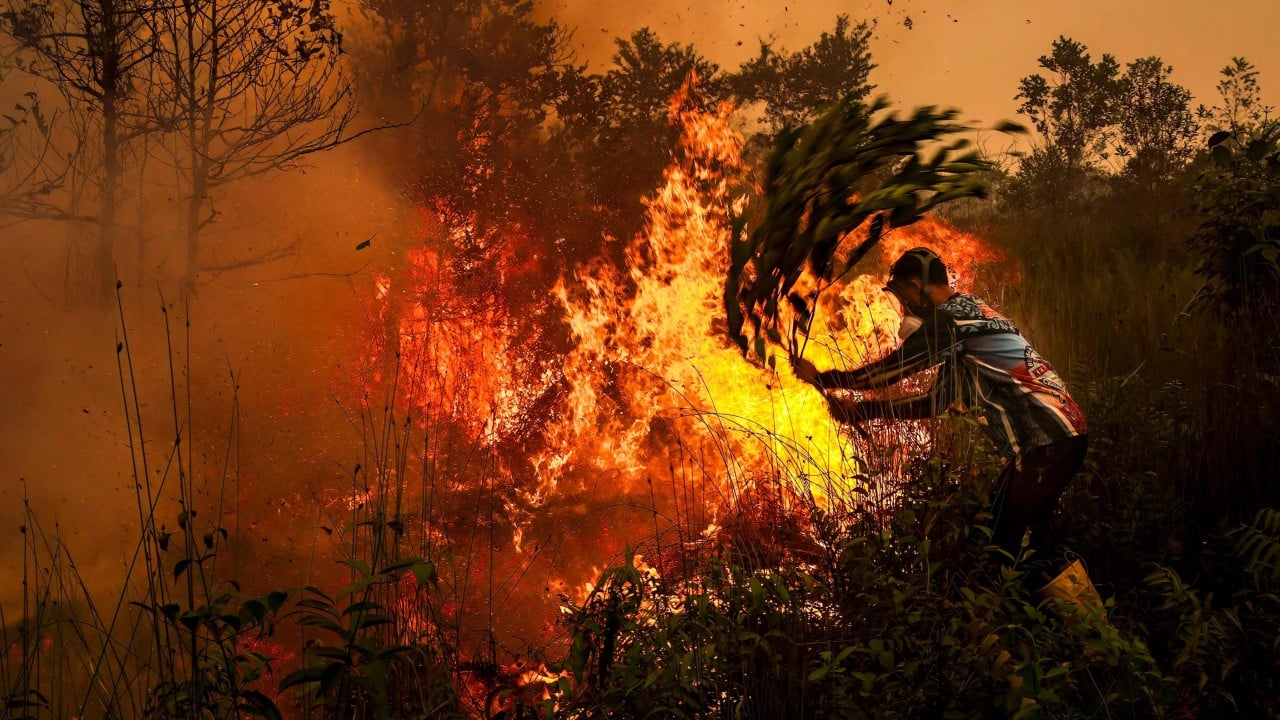
Every September, the international press dust off the same tired script. Haze blankets Southeast Asia, air quality monitors bleed into the purple zone, and headlines tally the premature deaths—over 3,500 in a single month—like a tragic weather report nobody could have prevented.
Then comes the lazy consensus. Journalists point a collective finger at "greedy palm oil conglomerates" and "rogue smallholder farmers" armed with matches. Environmental NGOs demand boycotts. Western consumers feel righteous swapping palm oil for sunflower oil in their grocery carts.
Everyone feels better. And the peatlands keep burning.
I have spent fifteen years auditing supply chains, concession maps, and environmental compliance frameworks across Sumatra and Kalimantan. I have watched multinational corporations blow tens of millions of dollars on satellite monitoring systems, zero-burning pledges, and certification schemes that look magnificent in glossy ESG reports while doing almost nothing to stop the smoke.
The standard narrative about Indonesia’s wildfire smoke crisis is not just incomplete. It is dangerously backward. If you want to understand why thousands of people choke to death every dry season, stop looking at the farmers holding the matches and start looking at the hydrological engineering disasters, perverse land-tenure laws, and Western green-financing schemes that turned a tropical rainforest into a giant box of tinder.
The Myth of the "Forest Fire"
First, fix your vocabulary. Indonesia does not have a forest fire problem. It has a peatland drainage problem.
When you hear "wildfire," you probably picture California or the Australian bush—flames racing through dry tree canopies, fueled by wind and deadwood. That is not what kills 3,500 people in September. In fact, in Sumatra and Kalimantan, you rarely see towering walls of flame at all.
You see ground fires.
Deep beneath the surface of Indonesia’s coastal lowlands lies tropical peat—ancient layers of waterlogged, partially decayed organic matter up to twenty meters thick. In its natural state, peatland is a swamp. It is roughly 90 percent water. You could take a blowtorch to an intact, undrained peat swamp in the middle of a drought, and nothing would happen. It simply cannot burn.
To make that land usable for agriculture—whether for industrial pulpwood, palm oil, or government-sponsored food estates—engineers dig massive networks of drainage canals. These canals lower the water table, drying out the top meter of organic soil. Once drained, peat becomes dry, spongy, and insanely flammable.
When a spark hits drained peat, the fire doesn't spread upward; it burrows downward. It smolders underground at low temperatures, starved of oxygen, producing incomplete combustion. That incomplete combustion is what generates the thick, toxic, particulate-heavy haze rich in PM2.5, carbon monoxide, and polycyclic aromatic hydrocarbons.
You cannot put out a peat fire with water bombers. Dropping water from a helicopter onto a burning peat dome is like trying to extinguish a subterranean coal seam fire with a garden hose. The water runs off the hydrophobic, baked-crust surface while the fire keeps chewing through ancient carbon deposits three feet underground until the monsoon rains finally arrive in November.
Why Boycotting Palm Oil Actually Makes the Smoke Worse
Whenever the death toll hits the news, the reflexive "People Also Ask" response from Western audiences is predictable: Should we boycott palm oil to stop the fires?
No. Unless your goal is to accelerate deforestation and trigger even worse fires.
Here is the math that boycott advocates routinely ignore. Oil palm is the most land-efficient vegetable oil crop on Earth. One hectare of oil palm yields roughly four to five times more oil than a hectare of rapeseed, sunflower, or soy. Global demand for vegetable oil is inelastic; humans need cooking fat, soap, and processed food ingredients. If you choke off demand for Indonesian palm oil, the market doesn't shrink. It shifts to soy in Brazil or sunflower in Eastern Europe, requiring up to five times as much cleared land to produce the exact same volume of oil.
Even worse, look at what happens on the ground in Indonesia when Western buyers impose blanket bans or drop high-risk suppliers.
Major publicly traded agribusinesses—the ones terrified of losing contracts with Unilever, Nestlé, or Procter & Gamble—actually have the capital to maintain water gates, fund fire brigades, and comply with the Roundtable on Sustainable Palm Oil (RSPO) standards. When Western pressure forces those companies to divest from troubled concessions, who buys the land?
Local operators with zero exposure to Western consumer boycotts. Domestic conglomerates selling into local biodiesel mandates or opaque regional markets. They don't care about RSPO certification. They don't maintain the canal locks.
I have walked concessions in Riau province where a major international firm spent millions building expensive timber-and-concrete dams to keep the peat wet, only to abandon the periphery under NGO pressure. Within eighteen months, local speculators moved into the unguarded buffer zones, punched fresh drainage ditches through the dams, and burned the scrub to claim land rights.
The Perverse Economics of Fire-Driven Land Grabbing
To understand why fires start in the first place, you have to follow the money—and the land titles.
Under Indonesian agrarian law, clearing land by fire is illegal, carrying hefty prison sentences and corporate fines. On paper, the enforcement regime is strict. On the ground, fire remains the cheapest, fastest way to establish de facto ownership and boost land value.
Consider the economics from the perspective of a mid-level land broker or a local smallholder operating on the margins of a degraded concession:
- Manual clearing costs money. Hiring heavy machinery—excavators and bulldozers—to clear a single hectare of dense secondary scrub and fallen timber costs upwards of $800 to $1,200. Most smallholders don't have that cash.
- Fire is free. A jerrycan of diesel and a box of matches costs less than five dollars.
- Ash is fertilizer. Tropical peat soils are naturally acidic, with a pH often below 4.0. Almost nothing grows well in raw peat without massive applications of agricultural lime to neutralize the acidity. Burning the surface vegetation leaves behind a layer of alkaline wood ash that temporarily raises the soil pH and injects potassium and phosphorus directly into the ground.
- Fire triples land value. Unclaimed, scrub-covered peatland has minimal market value. Once cleared and planted with a few rows of young oil palm seedlings, that exact same plot becomes an income-generating asset whose price per hectare jumps threefold overnight.
Blaming "ignorant farmers" misses the cold rationality of the transaction. They aren't burning the land because they don't know fire causes smoke. They are burning it because the market rewards cleared land, the soil requires ash to yield a crop without expensive inputs, and the probability of getting caught—let alone prosecuted—is near zero once the smoke obscures satellite visibility.
The Carbon-Offset Shell Game
Here is where the Western hypocrisy turns toxic.
While European and North American commentators lecture Jakarta about environmental stewardship, Western corporations and financial institutions are pouring billions into voluntary carbon markets and "nature-based solutions" tied to Indonesian peatlands.
In theory, paying to preserve and rewet peatlands is brilliant. Tropical peat holds staggering amounts of carbon—more per hectare than the Amazon rainforest. Keeping that carbon locked in the mud is one of the cheapest climate mitigation strategies available.
In practice, the carbon-offset rush has created a new wave of green land-grabbing and bureaucratic paralysis.
Several years ago, I reviewed a massive peatland restoration and carbon-credit project in Central Kalimantan. On paper, it was a triumph of modern climate finance. International consultants flew in, mapped the carbon stocks, and sold millions of dollars in offsets to Western tech and aviation giants looking to boast "net-zero" milestones.
There was just one problem. The project boundaries overlapped with dozens of traditional village territories whose residents had relied on fishing, rattan harvesting, and small-scale farming in those wetlands for generations. The carbon developers restricted access to protect their credit yields, cutting off local livelihoods without providing viable economic alternatives.
What happened next was entirely predictable. Resentful locals, locked out of their own backyards so a tech company in California could claim carbon neutrality, quietly breached the canal blocks during the peak of the dry season. Two weeks later, the protected carbon sink went up in smoke. The corporations had already claimed their PR victory; the nearby towns breathed the PM2.5.
You cannot lock up millions of hectares of land for Western carbon accounting while leaving the people living next to it broke.
Why "Zero-Burning" Policies Are Theater
Every major agribusiness and government ministry in Southeast Asia now boasts a strict "Zero-Burning Policy." They publish interactive fire-hotspot dashboards. They deploy drones. They sign memorandums of understanding.
It is mostly theater.
Hotspot satellites like NASA’s VIIRS and MODIS are fantastic tools for tracking active fires, but they have a fatal flaw when applied to peatlands: by the time a thermal anomaly registers from space, the fire has already penetrated the peat layer. You are watching the symptom, not the cause.
Worse, zero-burning mandates without viable mechanical or chemical alternatives simply push burning underground—literally and figuratively. Instead of conducting controlled burns early in the dry season when the peat is still damp and fire breaks can contain the spread, operators wait until the dead of night during the driest weeks of September to light fires quickly, hoping to clear the land before the monsoon hits and before inspectors arrive.
Controlled, low-intensity surface burning used to be an established agricultural management tool across the tropics. By banning fire outright without subsidizing mechanical clearing or agricultural lime for smallholders, policymakers eliminated regulated, manageable burns and replaced them with clandestine, catastrophic ones.
What Actually Works (And Why Nobody Wants to Pay for It)
If you want to stop 3,500 people from dying every September, stop funding awareness campaigns and boycott drives. The physics of peat fires are brutally simple: wet peat cannot burn.
Solving this crisis comes down to three unglamorous, expensive engineering and legal interventions:
- Full-Hydrological Rewetting, Not Token Dams. You cannot rewet half a peat dome. A peat dome functions like a single giant sponge; if one company blocks its canals while the neighbor two kilometers away keeps draining theirs for cassava or acacia plantations, water still bleeds out of the entire dome. Rewetting only works when enforced across entire hydrological units—from river to river—forcing neighboring concessions, state forests, and village lands onto a single mandatory water-table minimum of 40 centimeters below the surface.
- Paludiculture Over Conventional Drainage Crops. Oil palm and acacia hate wet feet. If you raise the water table to safe, fire-proof levels, standard industrial crops drown and rot. The solution is shifting agricultural subsidies toward paludiculture—cultivating native swamp species like illipe nut, sago, jelutung (a latex-producing tree), and swamp timber that thrive in saturated soil. Right now, global supply chains have zero interest in building processing infrastructure for sago or illipe butter because palm oil is cheaper and already standardized.
- Front-Loaded Cash for Smallholders. Expecting subsistence farmers to buy agricultural lime and rent excavators on credit is a fantasy. If multinational buyers and carbon financiers want fire-free supply chains, they need to stop spending millions on Western auditors and compliance consultants and put direct cash grants and heavy machinery pools into rural villages before the dry season starts in June.
To be clear, this approach comes with painful trade-offs. Enforcing strict hydrological water tables across entire peat domes will wipe out millions of hectares of marginal agricultural land. Thousands of smallholders and estate workers will lose productive acreage, food and vegetable oil production in the region will dip, and raw material prices for global consumer goods will rise.
That is the reality nobody in the sustainability industry wants to admit. You can have cheap, endlessly abundant vegetable oil and cheap carbon offsets, or you can have clean air in September. You cannot have both.
Until Western consumers and corporations stop treating Indonesia’s haze as a morality play about evil palm oil barons—and start paying the actual hydrological and economic price required to keep a swamp wet—September will keep returning with the exact same body count.


