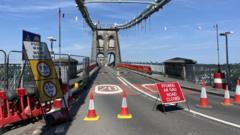
A bridge shuts down three times in forty-eight hours because overweight vehicles triggered the sensors. The local news runs a frantic segment. The Department of Transportation issues a stern press release. The public loses its collective mind, shaking its fist at "reckless truck drivers" who cannot read a road sign.
It is a comforting narrative. It gives everyone a clear villain.
It is also completely wrong.
When a piece of infrastructure repeatedly fails to handle the realities of modern commerce, blaming the end-user is a cowardly opt-out. The lazy consensus screams for stiffer fines, bigger warning signs, and longer driver suspensions. But after twenty years analyzing logistics bottlenecks and infrastructure engineering, I can tell you the uncomfortable truth: recurrent bridge closures are not a driver compliance issue. They are an engineering and bureaucratic failure masquerading as a public safety crisis.
The Illusion of Smart Infrastructure
Modern civil engineering loves to slap sensors on a ninety-year-old piece of steel and call it "smart infrastructure."
Let us look at how these systems actually operate. A bridge is retrofitted with weigh-in-motion (WIM) sensors or automated laser height-detectors. A truck approaches. The truck exceeds the static limit established during the Eisenhower administration. The sensor triggers, the gates drop, the lights flash, and traffic grinds to a halt for three hours while state troopers inspect the undercarriage.
The system worked, right? The bridge did not collapse.
Wrong. The system failed fundamentally.
Infrastructure should facilitate movement, not paralyze it. A defensive design that relies on total shut-downs to prevent catastrophe is not "smart"—it is a confession of structural obsolescence. If a asset must close three times in two days, the operational protocol itself is broken. We have built digital tripwires instead of resilient pathways.
Imagine a software application that crashes your entire operating system every time a user types a typo. You would not fire the user. You would fire the developer. Yet, when a bridge halts thousands of commuters because a local delivery truck was grossing 82,000 pounds instead of 80,000, we treat it like an act of god or a criminal mastermind at work.
The Anatomy of the 80,000-Pound Lie
Why are these trucks "overweight" in the first place? To understand this, you have to look at the Federal Bridge Gross Weight Formula, known colloquially as Bridge Formula B.
$$W = 500 \left[ \frac{LN}{N-1} + 12N + 36 \right]$$
This mathematical calculation determines the maximum weight any set of axles on a commercial vehicle can carry. It was designed to protect older bridges from stress.
Here is the problem: the economy grew up, but the formula stayed behind.
Supply chains run on razor-thin margins. Consumer demand dictates that freight moves in high volumes. Shippers pack containers to the absolute limit because the global logistics network demands it. A driver picking up a sealed intermodal container from a rail yard often has zero control over how that load was distributed inside the box. They roll onto the highway, their onboard telematics indicate they are legal for interstate travel, but then they hit a localized municipal weight restriction that drops from 80,000 pounds to 50,000 pounds without adequate warning or a viable detour route.
We have created a patchwork quilt of conflicting local, state, and federal weight regulations. Then we act shocked when a driver gets trapped in the web.
The True Cost of Infrastructure Closures
When a bridge shuts down, the economic damage ripples far beyond the river crossing.
| Metric | Immediate Impact | Long-Term Fallout |
|---|---|---|
| Supply Chain Velocity | Idle freight, missed delivery windows | Increased spot-market freight rates |
| Municipal Wear and Tear | Heavy trucks forced onto residential detours | Rapid degradation of unrated local roads |
| Emissions | Miles of stop-and-go idling traffic | Spikes in localized particulate matter |
| Economic Productivity | Thousands of lost commuter hours | Relocation of logistics hubs away from the region |
Dismantling the "People Also Ask" Flawed Logic
Go look at any search engine queries regarding bridge closures. The premises of the questions themselves show how thoroughly the public has been misled.
"Why don't truck drivers just read the weight limit signs?"
This question assumes a level of visibility and routing support that simply does not exist. Truck-specific GPS systems are notoriously buggy and expensive. Many independent owner-operators are priced out, relying on standard consumer apps that route them down restricted roads.
Furthermore, municipal signage is often placed at the point of no return. Once a 53-foot tractor-trailer turns onto a narrow approach road and sees the 15-ton limit sign, there is no physical way to turn around. They cannot back up into a busy intersection. Their only option is to roll the dice and cross, or stop dead and block traffic anyway. The sign did not fix the problem; it just documented the trap.
"Should we increase fines for overweight vehicles?"
Increasing fines is the ultimate bureaucratic band-aid. It generates revenue for the county, but it does absolutely nothing to change the physical reality of the freight corridor.
I have watched logistics firms absorb millions of dollars in civil penalties as a standard cost of doing business. Why? Because paying a $1,500 fine is cheaper than rerouting a fleet 150 miles around a broken bottleneck every single day. If the penalty does not deter the behavior, it is not a deterrent—it is a tax. And taxes do not strengthen steel beams.
The Reality: We Build Fragile Things
Let us talk about the trade-offs of my stance. If we do not restrict these vehicles, don't the bridges wear out faster?
Yes, they do. Fatigue damage on steel and concrete scales exponentially with axle weight. That is basic physics.
But here is the hard choice nobody wants to face: we either spend the capital to build high-capacity, heavy-haul infrastructure that matches our actual economic output, or we accept the slow decay of our cities. The current approach tries to choose a third option that does not exist—maintaining a vibrant economy while forcing it to move over fragile, historical monuments.
We are terrified of big-ticket infrastructure spending. We would rather spend $500,000 on an automated gate system that shuts down a bridge three times a week than spend $50 million to replace the span with one that can actually handle modern industrial life. It is fiscal cowardice.
Fix the Asset, Stop Chasing the Driver
If you want to stop bridge closures, stop looking at the drivers. Change the deployment of the technology and the design of the network.
- Move Sensors Five Miles Back: Placing a weigh-in-motion sensor fifty feet from a bridge deck is an exercise in futility. Move the detection zone miles upstream, integrated with automated, dynamic detour signage that gives heavy vehicles a physical escape route before they enter the choke point.
- Mandate Open-Source Freight Routing Data: Municipalities must stop hiding weight restrictions in obscure PDF maps on outdated government websites. Force every city to feed local weight and height restrictions into a standardized, open-source API that integrates directly into every commercial and consumer navigation app on earth.
- Build for Reality, Not Nostalgia: When an asset fails repeatedly, it has outlived its utility. De-classify it as a commercial route entirely and restrict it to light passenger vehicles with physical barriers, or tear it down and rebuild it to handle the actual weights of twenty-first-century commerce.
Stop treating infrastructure like a fragile museum piece that the public is privileged to use. It is a tool. If the tool breaks every time it is put to work, the tool is garbage.


