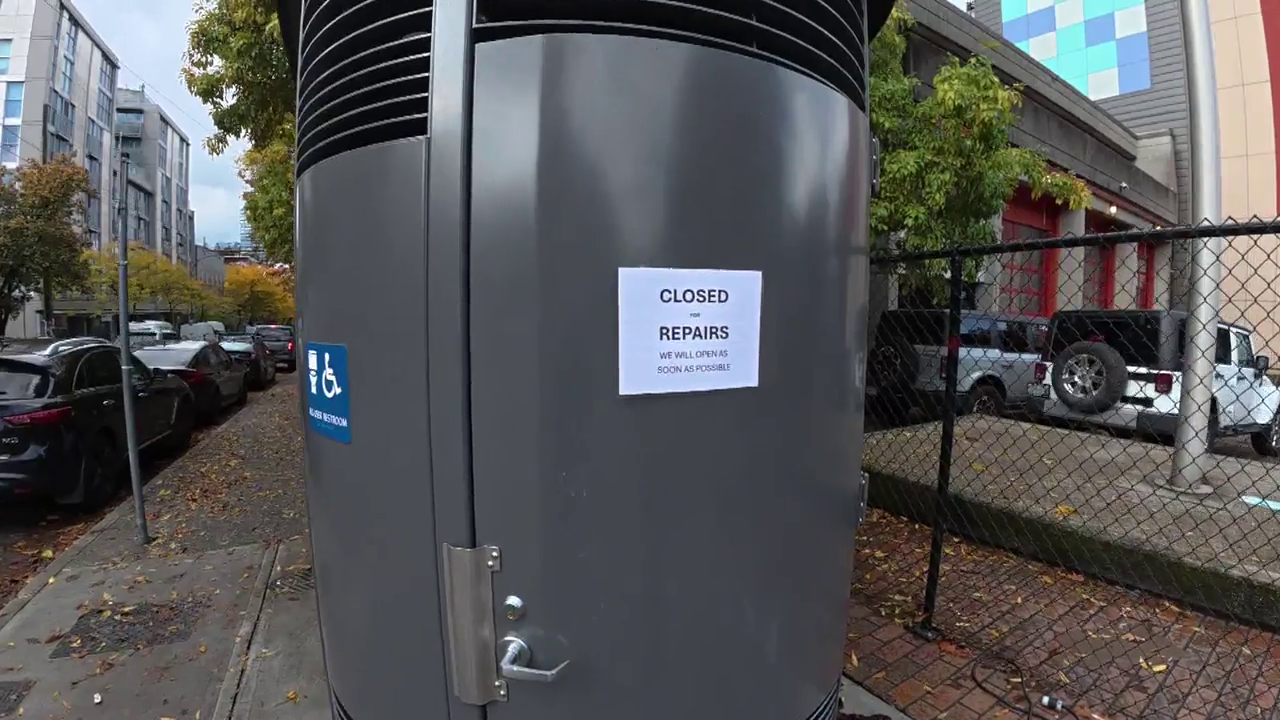
Municipal bureaucrats love a shiny silver bullet. When a heavily publicized, half-million-dollar automated public toilet in Vancouver’s Downtown Eastside breaks down shortly after its grand unveiling, the local press instantly smells blood. They write breathless, snarky headlines mocking the broken "indestructible" stall. Taxpayers fume over wasted public funds. City officials scramble to blame manufacturing defects, supply chain delays, or extreme vandalism.
Everyone is looking at the wrong problem.
The failure of the Downtown Eastside automated washroom—and virtually every other "vandal-proof" public facility deployed in high-stress urban corridors across North America—has nothing to do with weak stainless steel or faulty sensors. It is the inevitable result of a deeply flawed municipal fantasy. Cities keep trying to engineer their way out of complex social crises using industrial hardware. You cannot bolt a piece of heavy-duty plumbing to a sidewalk, call it indestructible, and expect it to survive an environment where basic human services have completely collapsed.
The Myth of the Indestructible Box
Let us define what cities actually buy when they purchase an Automated Public Toilet (APT). These units, popularized by European manufacturers like JCDecaux and Wall AG before being adapted for North American streets by companies like Exeloo and Portland Loo, are marvels of defensive architecture. They feature 14-gauge marine-grade stainless steel, automated high-pressure floor sanitization cycles, infrared occupancy sensors, hydraulic door locks, and remote telemetry.
On paper, they are tanks. In reality, they are fragile ecosystems of delicate electronics masquerading as bunkers.
I have watched municipalities across the Pacific Northwest and California blow millions of dollars on these hyper-engineered pods over the last decade. Every single procurement pitch follows the exact same script. A city council faces public outrage over human waste on sidewalks. Rather than funding round-the-clock staffed hygiene centers, they opt for a capital expenditure—a one-time hardware purchase that looks great in a press release and avoids ongoing union labor costs.
They buy the lie that automation replaces supervision.
When you put a self-cleaning, automated box in a neighborhood experiencing acute poverty, untreated severe mental illness, and a toxic street drug supply, the hardware immediately faces pressures it was never built to endure. The Portland Loo, designed by Evan Madden in Oregon specifically to deter crime through louvered slats and bare-bones plumbing, works reasonably well in moderately trafficked tourist districts. Why? Because it strips away the electronics. There are no automated wash cycles to jam. There are no motorized doors to force off their tracks.
Contrast that with fully automated units. The moment someone jams a heavy object into a sliding door track, stuffs non-dissolvable fabric down a vacuum-assisted drain, or triggers an emergency override repeatedly, the onboard programmable logic controller (PLC) faults out. The machine goes offline to protect itself. It is not destroyed. It is paralyzed by its own safety protocols.
Why Municipal Procurement Sets Infrastructure Up to Fail
To understand why these facilities break down immediately, you have to look at the mechanics of municipal budgeting. Cities operate on a strict divide between Capital Expenditures (CapEx) and Operational Expenditures (OpEx).
- CapEx is easy to get approved. Politicians love ribbon cuttings. Federal grants and infrastructure bonds cover the massive upfront cost of buying and installing a $500,000 automated toilet.
- OpEx is political poison. Paying two full-time attendants $65,000 a year plus benefits to staff, clean, and monitor that toilet costs roughly $200,000 annually, forever.
Because city councils refuse to commit to permanent OpEx, they over-invest in CapEx. They buy a machine packed with sensors, self-cleaning nozzles, and automated timers, praying that technology will do the job of a human attendant.
This is where the math falls apart. An automated wash cycle requires clean water intake, heated drying elements, chemical disinfection dispensers, and unobstructed drainage. If a user leaves a backpack, a shopping cart, or debris inside the stall, the automated wash cycle either aborts or floods the mechanical room. If an individual overdoses inside and fails to trip the motion sensors—or conversely, trips the occupancy timer while unconscious—emergency responders have to breach the heavy-duty doors, often damaging the locking mechanisms in the process.
The media covers the resulting "Out of Service" sign as an engineering failure. It is not. It is a management failure disguised as a maintenance ticket.
Dismantling the Public Toilet Debate
When these headlines hit the news cycle, taxpayers and commentators inevitably ask the exact same questions. Almost all of them are rooted in false premises.
Why do cities spend half a million dollars on a single toilet?
They aren't buying a toilet. They are buying deep trenching, civil engineering, commercial-grade sewer tie-ins, frost-proof water lines, dedicated electrical transformers, and heavy-duty crane installation in dense urban utility corridors. The fiberglass or steel box itself is often less than half the total project cost. Digging up a century-old downtown street to connect new plumbing without hitting fiber-optic cables or gas mains is brutally expensive.
Why don't they just make the materials stronger?
Strength is irrelevant when the failure points are sensory and mechanical. You can build the walls out of three-inch armor plate, and the unit will still go out of service the second someone pours concrete, grease, or clothing into the trapway, or smashes an infrared sensor lens. Hardening the shell does nothing to protect the plumbing or the circuitry.
Should cities just stop building public washrooms in high-crime areas?
Removing washrooms does not stop human biology. When a city closes a public toilet to save on maintenance costs, they do not eliminate the waste. They simply transfer the cleanup costs from the sanitation department to private business owners, transit authorities, and emergency rooms. You pay for it either way. You either pay for a functional toilet, or you pay for biohazard street cleaning and outbreak control.
The Urban Design Blind Spot
Jane Jacobs, the legendary urbanist who revolutionized how we understand city streets in The Death and Life of Great American Cities, coined the concept of "eyes on the street." Safety and order in public spaces do not come from locks, bars, or automated surveillance. They come from continuous human presence and social accountability.
Modern municipal planners have completely forgotten this principle. They treat public hygiene infrastructure like vending machines. Drop them on a corner, walk away, and expect them to dispense sanitation smoothly.
In high-stress neighborhoods like Vancouver’s Downtown Eastside, San Francisco’s Tenderloin, or Los Angeles’s Skid Row, an unattended enclosed room is not perceived merely as a bathroom. In an environment characterized by extreme scarcity, it immediately becomes a shelter from the elements, a private space to consume substances away from police view, a storage locker, or a place to wash clothes.
When a single piece of infrastructure is forced to absorb the failures of the housing system, the healthcare system, and the addiction treatment system simultaneously, it breaks. Blaming the toilet for breaking under that weight is like blaming an umbrella for snapping in a hurricane.
What Actually Works on the Street
If automated steel bunkers fail, what is the alternative? Look at the cities that have actually solved public sanitation in chaotic environments without burning millions on broken robotics.
Consider the Pit Stop program launched in San Francisco. Instead of relying solely on unstaffed automated bunkers, the city deployed mobile and permanent washroom stations staffed by paid attendants during operating hours. The attendants greet users, enforce time limits, monitor for medical emergencies, restock supplies, and wipe down surfaces between every single use.
The results were immediate and undeniable:
- Vandalism plummeted to near zero because nobody smashes a sink when another human being is standing ten feet away watching the door.
- Overdose fatalities inside the stalls dropped dramatically because attendants check on occupants who exceed the time limit.
- Mechanical downtime vanished because needles, trash, and clothing were kept out of the plumbing before they could cause blockages.
- Street-level human waste dropped significantly in the surrounding blocks because the facilities were actually open, clean, and safe to use.
Another proven model is decentralized, stripped-down hardware paired with rapid-response mobile crews. If a city insists on unstaffed 24/7 access, it must abandon automation entirely. No motorized doors. No self-cleaning cycles. No delicate sensors. Use manual heavy-duty flush valves, open-air louvers at the top and bottom for natural ventilation and sightlines, exterior handwashing stations so people don't lock themselves inside just to wash their hands, and a dedicated mobile pressure-washing crew that visits the unit every three hours.
The Uncomfortable Trade-Offs
Taking a contrarian stance means admitting the flaws in your own solution. Staffed washrooms and hyper-frequent maintenance crews are not cheap, and they are not politically convenient.
First, labor costs are relentless. Funding staffed hygiene stations requires permanent, recurring municipal budget allocations. When tax revenues dip during an economic downturn, staffed programs are the first targets on the chopping block because cutting personnel yields immediate cash savings, whereas capital expenditures are already sunk costs.
Second, staffing these posts is grueling work. Attendants face verbal abuse, biohazards, and high-stress medical emergencies daily. Cities that underpay these workers or fail to provide adequate security and mental health support experience massive turnover, leading to unscheduled closures when shifts go unfilled.
Third, operating hours are limited. While an automated unit theoretically operates 24/7—until it breaks—staffed units usually close overnight to control payroll costs, leaving unhoused residents without options during the dead of night unless paired with overnight shelter access.
Even with these drawbacks, a toilet that is open and clean for 14 hours a day beats a half-million-dollar automated monument that sits locked behind yellow caution tape for eight months awaiting replacement parts from Europe.
Stop Buying Machines to Do Human Work
The next time a city council unveils a sleek, sensor-laden, "indestructible" public toilet in a struggling neighborhood, ignore the press release. Start a stopwatch. Within weeks, a sensor will fail, a drain will clog, or a door will jam, and the local news will run the exact same story of municipal incompetence.
Cities need to stop fetishizing industrial design as a substitute for basic civic management. Steel and software cannot manage human crisis. Until municipalities stop hiding behind capital budgets and start funding actual human presence on their streets, those shiny metal boxes will remain the most expensive paperweights in urban America.