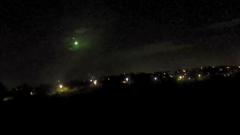
Your doorbell camera just "captured" a meteorite. Or so the local news anchor—who hasn't looked at a physics textbook since the tenth grade—wants you to believe.
The internet is currently drowning in grainy, low-bitrate doorbell footage of green flashes and white streaks. The headlines are predictable. They use words like "rare," "mysterious," and "celestial visitor." They are almost always wrong. If you see a light in the sky, the mathematical probability that you are looking at a meteorite is functionally zero.
Why? Because a meteorite is a rock that has already hit the ground. Until it impacts, it is a meteoroid (the rock in space) or a meteor (the light show). This isn't pedantry. This is the baseline for understanding why the current obsession with "space rocks" is actually a symptom of our inability to distinguish orbital junk from actual cosmic events.
The Dashcam Delusion
We live in the most surveilled era in human history. With millions of Ring cameras, Teslas, and dashboard units recording 24/7, we are seeing more "fireballs" than ever. This creates an availability heuristic: because we see more videos of them, we assume they are happening more often.
They aren't.
What has changed is our threshold for wonder. We’ve traded astronomical rigor for viral clips. Most of these "suspected meteorites" are actually bolides—extremely bright meteors that explode in the atmosphere. But here is the bitter truth that enthusiasts hate: 90% to 95% of the material in a bolide vaporizes long before it ever gets close to your backyard.
When you see a brilliant green flash on a Twitter feed, you aren't seeing a rock. You are seeing the atmospheric friction superheating gases. If the object was small enough to create that specific flash, it likely turned into dust five miles up. You aren't hunting for a space rock; you’re hunting for soot.
The Chemistry of the "Green Flash" Myth
The media loves the green glow. They claim it’s a sign of "rare minerals" or "alien composition."
Nonsense.
The green hue in a meteor trail is usually just the excitation of atmospheric oxygen or the ablation of nickel and magnesium. It’s basic chemistry, not a sign of a massive, intact payload heading for a crash site.
Breaking Down the Physics of Impact
To actually survive the descent and become a meteorite, an object has to survive a brutal gauntlet.
- Entry Velocity: Objects hit our atmosphere at speeds between $11\text{ km/s}$ and $72\text{ km/s}$. For perspective, a bullet travels at about $0.7\text{ km/s}$.
- Ram Pressure: It isn't just "friction." The air in front of the rock is compressed so violently that it turns into a plasma shield.
- Dark Flight: If a rock survives the thermal stress, it stops glowing at an altitude of about 15-20 kilometers. It then falls at terminal velocity, invisible to the cameras that were "tracking" it.
If you see a bright light go all the way to the horizon, it didn't land "just over the hill." It likely burnt up or maintained its trajectory far beyond your line of sight. The curvature of the Earth makes fools of amateur treasure hunters every single time.
Space Junk: The Great Imposter
Here is the perspective the "insider" community won't tell you: We are currently polluting Low Earth Orbit (LEO) at an exponential rate.
There are over 9,000 active satellites and hundreds of thousands of pieces of debris circling the planet. When a defunct Starlink satellite or a piece of an old Soviet rocket re-enters, it looks spectacular. It moves slower than a meteor. It breaks into multiple fragments. It glows for a longer duration.
To the untrained eye—and the "Breaking News" desk—it’s a meteorite. To those of us tracking orbital decay, it’s just more trash coming home to roost. The "meteorite caught on camera" is, more often than not, a piece of high-grade aluminum and solar paneling melting over the Pacific.
The Economics of the Hunt
I’ve seen "meteorite hunters" spend thousands of dollars on metal detectors and off-road gear based on a single video clip. They flock to "strewn fields" with the hope of finding a slice of the early solar system they can sell for $50 a gram.
They almost always come back with "meteor-wrongs"—terrestrial rocks like magnetite, hematite, or industrial slag that look vaguely melted.
The reality of the meteorite market is that the value is driven by provenance and classification. A rock found in a forest because you saw a light on your Ring camera has zero scientific value until it is analyzed by a lab and cleared by the Nomenclature Committee of the Meteoritical Society. Without that, you have a charred stone and a very expensive hobby.
Stop Asking "Where Did It Land?"
People always ask the wrong question. They see the flash and ask for coordinates.
The right question is: "What was the trajectory?" Unless you have triangulation from at least three different geographic points with synchronized timestamps, your video is scientifically useless. A single camera angle cannot provide depth or distance. That "fireball" could be a pebble ten miles away or a boulder a hundred miles away.
Why We Should Stop Celebrating Every Clip
By treating every atmospheric entry as a "suspected meteorite," we devalue actual science. We create a boy-who-cried-wolf scenario.
- Misinformation: It feeds the "conspiracy" pipeline where every satellite re-entry is labeled a UFO or a "hush-hush" government event.
- Scientific Illiteracy: It reinforces the idea that space is "crashing down" on us, rather than acknowledging the massive, mostly empty vacuum that it is.
- Resource Waste: Local police departments and fire crews are often dispatched to "smoke plumes" that don't exist because a witness misjudged the distance of a meteor by 200 miles.
The Actionable Truth
If you actually want to contribute to planetary science instead of just getting "likes" on a grainy video, stop posting to TikTok and start posting to the American Meteor Society (AMS) or the International Meteor Organization (IMO).
These organizations don't want your "shocked" reaction. They want:
- Your precise GPS coordinates.
- The exact time (to the second) from a synced clock.
- The azimuth and elevation of where the light started and ended.
If you can't provide that, you don't have a scientific discovery. You have a screen recording.
The next time you see a streak of light, don't run for your shovel. Realize that you are witnessing the destruction of matter—a tiny fragment of the cosmos being erased by our atmosphere. It is a moment of entropy, not a delivery service.
The rock is gone. Stop looking for it.