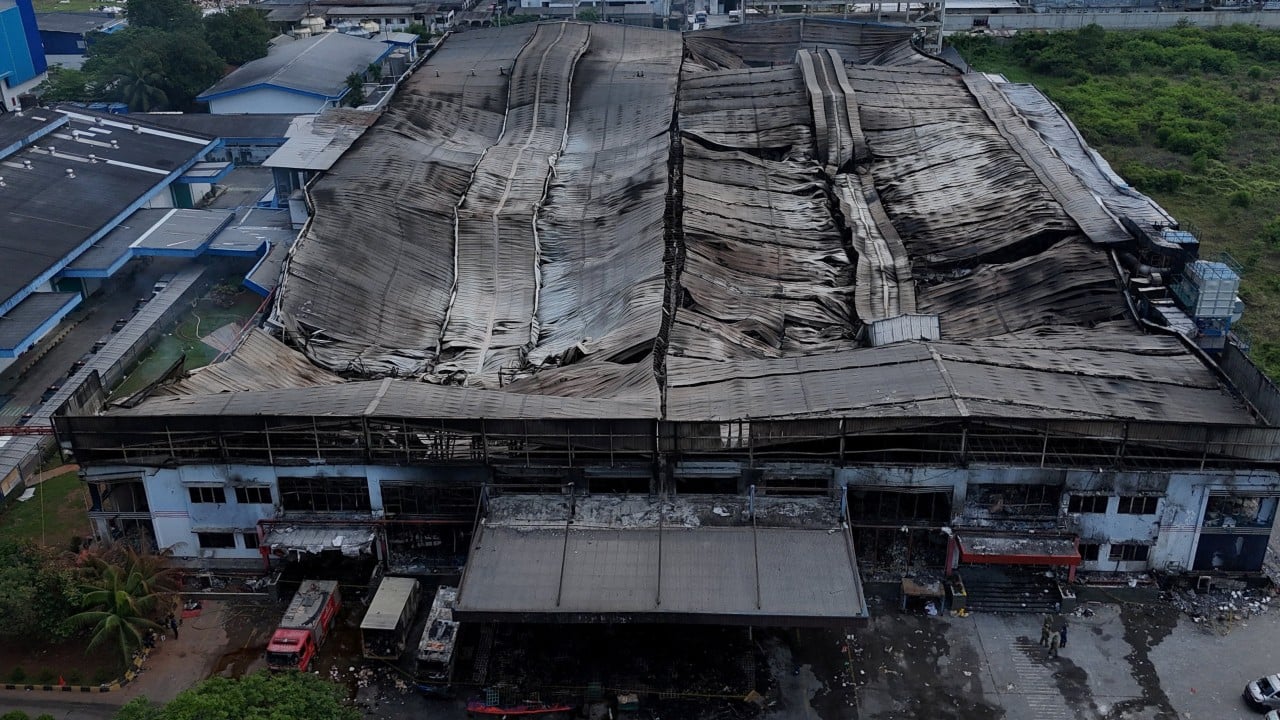
Twenty-four dead. Dozens missing. Smoke billowing over an Indonesian industrial zone while rescue crews pick through twisted steel.
Read any mainstream wire report covering the disaster and you will get the exact same formula. Officials express sorrow. Rescuers battle thick plumes. Investigators promise to look into the "cause" of the blaze—usually an electrical short circuit or a chemical flare-up. The public shakes its head at another tragic accident in a developing manufacturing hub, and within forty-eight hours, the news cycle moves on.
That narrative is a lie. Not a malicious lie, just a lazy one.
When a modern industrial facility burns down and traps dozens of workers inside, calling it an accident obscures the mechanics of how global manufacturing actually operates. Fires start because of sparks, faulty wiring, or volatile materials. Mass casualties happen because of spreadsheets. There is a massive difference between ignition and fatality, and the mainstream press consistently conflates the two to give corporate supply chains a free pass.
The Lie of the Unforeseeable Spark
Every industrial facility on earth deals with heat, friction, electrical loads, and flammable inputs. Sparking is an operational certainty over a long enough timeline. Treating the ignition source as the primary culprit is like blaming gravity when a poorly built bridge collapses.
I have walked hundreds of factory floors across Southeast Asia, from garment clusters in West Java to electronics assembly plants in Batam and chemical processors outside Surabaya. You can tell within four minutes whether a plant is built to survive a fire or built to maximize quarterly margin. You do not even need a clipboard. You just look at the exit doors and the ceiling.
In compliant facilities, exit doors swing outward, feature panic bars, and open onto unobstructed concrete aprons. Sprinkler risers are pressurized, tagged, and painted bright red so no forklift operator accidentally clips them.
In the shadow tier—the subcontracted plants that absorb overflow orders when Western or regional brands demand faster turnaround at lower unit costs—the physical reality is completely different. Emergency exits are padlocked from the outside to prevent inventory pilferage. Stairwells are stacked floor-to-ceiling with cardboard packaging and raw polymer bales because warehousing space cuts into production square footage.
When a fire breaks out in that environment, the people inside do not die from the initial flame. They die from flashover and toxic smoke inhalation within three minutes because the building was configured as a containment box rather than an escape funnel.
Why Supply Chain Audits Are Pure Theater
Whenever a high-casualty fire hits the headlines in Indonesia, Bangladesh, or Vietnam, Western procurement teams immediately point to their compliance frameworks. They pull out thick binders full of social audit certifications. They talk about zero-tolerance policies and third-party inspections.
I have seen multinational brands blow millions of dollars on these audit ecosystems while their Tier 2 and Tier 3 suppliers remained literal death traps.
Here is why the standard auditing model fails every single time:
- Announced Visits Guarantee Staging: Most compliance audits are scheduled weeks in advance. For forty-eight hours before the inspector arrives, the factory unlocks the fire doors, clears the aisles, hangs fresh fire extinguishers on the walls, and briefs workers on what to say. The morning after the inspector flies home, the padlocks go back on and the raw materials go back into the hallways.
- Checklist Compliance Over Engineering: Standard social auditors are trained to count fire extinguishers and measure aisle widths with a tape measure. They are rarely fire protection engineers. They do not test hydraulic pressure in standpipes. They do not verify whether the fire alarm panel is actually wired to an audible horn in the noisy stamping department. They check a box, collect their fee, and absolve the buyer of legal liability.
- The Price-Compliance Squeeze: A brand's sustainability team demands higher safety standards while its procurement team simultaneously demands a six percent year-over-year unit cost reduction. A factory owner operating on a four percent net margin cannot install a $400,000 automated deluge suppression system while cutting prices. Something has to give, and it is always the invisible infrastructure that only matters during a worst-case scenario.
What Everyone Gets Wrong About Indonesian Industrial Safety
If you search for answers after a major Indonesian factory disaster, you will see the same questions pop up repeatedly: Why didn't the government enforce safety laws? or Are Indonesian building codes too weak?
Both questions miss the mark entirely.
Indonesia does not suffer from a lack of laws. On paper, its occupational safety regulations—anchored by Law No. 1 of 1970 on Work Safety and supplemented by strict Ministry of Manpower decrees on fire prevention—are surprisingly thorough. They mandate compartmentalization, fire drills, dedicated safety officers, and clear egress routes.
The breakdown is not legislative. It is structural and economic.
First, look at inspection ratios. Indonesia has millions of registered enterprises and an industrial workforce numbering in the tens of millions, yet the pool of certified state labor inspectors sits in the low thousands. Even if every inspector worked eighty hours a week, they could not physically visit every high-risk facility once every five years. Enforcement is reactive by design; inspectors show up after the smoke clears, not before the wiring overheats.
Second, look at zoning and informal retrofitting. Many mid-sized factories in industrial corridors like Tangerang, Bekasi, or Sidoarjo did not start as purpose-built manufacturing plants. They started as basic storage warehouses—steel-frame sheds with single-skin metal roofs and minimal ventilation—that were later packed with heavy machinery, chemical vats, and hundreds of workers. Retrofitting a warehouse into a safe high-occupancy factory requires structural fireproofing, smoke extraction vents, and secondary stairwells. Most operators skip the structural work and simply run extension cords across the rafters.
The Anatomy of a Mass-Casualty Factory Blaze
To understand why twenty-four people perish in a single building while dozens more vanish into the rubble, stop thinking about fire as an event and start viewing it as a timeline. Industrial fire protection experts like those at the National Fire Protection Association (NFPA) measure survival in seconds, not hours.
Imagine a scenario where a standard lithium-ion battery assembly line or a solvent-based adhesive plant experiences a localized thermal runaway at 10:15 AM.
- 0:00 to 0:45 (Ignition and Detection): A spark ignites solvent vapors. In a properly engineered plant, UV/IR flame detectors trigger within milliseconds, dumping suppression agent onto the line and sounding a facility-wide evacuation horn. In a cost-cut facility, there are no automated detectors. Workers nearby try to fight the fire themselves with handheld extinguishers because they fear being docked pay or fired for halting the line.
- 0:45 to 2:30 (Smoke Stratification and Panic): Modern industrial materials—polyurethane foams, synthetic textiles, plastics, chemical solvents—do not burn clean. They release thick, black plumes laced with hydrogen cyanide and carbon monoxide. Within ninety seconds, visibility drops to zero. The ceiling layer banks down to floor level. Workers who do not know the secondary exit routes run toward the main entrance—the exact place where materials are often staged or where the fire originated.
- 2:30 to 4:00 (The Bottleneck): Workers reach the secondary exit only to find a steel shutter rolled down or a heavy bolt locked from the outside. Even if the door is unlocked, if it opens inward, the crush of twenty panicked people pressing against the door makes it physically impossible to pull open.
- 4:00 to 6:00 (Structural Failure): Unprotected structural steel loses roughly half its load-bearing strength at around 550 degrees Celsius. Without intumescent fireproofing paint or sprinkler cooling, the roof trusses warp and collapse inward, burying anyone trapped near the perimeter walls and turning a rescue operation into a body recovery mission.
Notice that in this entire six-minute sequence, the local fire department has not even arrived yet. By the time the first fire truck navigates congested industrial traffic and hooks up to a municipal hydrant—assuming the hydrant actually has water pressure—the outcome inside the building was already decided ten minutes earlier.
The Uncomfortable Math of Risk Transfer
Why does this keep happening? Because the global supply chain has perfected the art of risk transfer.
When a major corporation outsources manufacturing to a third-party contractor in an emerging market, it outsources the physical liability along with the labor. If a fire kills two dozen workers in an Illinois plant, the parent company faces catastrophic wrongful death lawsuits, federal OSHA penalties, criminal negligence probes, and immediate stock price destruction.
When the exact same fire happens in an Indonesian industrial park, the brand buying the finished goods issues a press release expressing deep concern, states that the facility was an "unauthorized subcontractor" or that an investigation is underway, and quietly shifts production orders to another vendor down the road. The factory owner faces local fines or a suspended business license, often re-incorporating under a new shell entity months later. The families of the dead receive a statutory payout from the national social security fund (BPJS Ketenagakerjaan) that barely covers a few years of lost wages.
Nobody at the top of the value chain pays a price steep enough to force systemic change.
How to Actually Fix Factory Fire Safety
If you run operations, manage procurement, or invest in manufacturing-heavy businesses, stop pretending that another round of standard compliance audits will protect your supply chain from becoming tomorrow's headline. Real fire prevention requires dismantling the incentives that create death traps in the first place.
1. Decouple Safety CapEx from Unit Pricing
If you require a supplier to install automated sprinklers, fire-rated separation walls, and monitored alarm systems, ring-fence that capital expenditure. Co-invest in the infrastructure directly or guarantee multi-year volume contracts tied specifically to verified engineering upgrades. When you force suppliers to fund safety out of razor-thin unit margins, they will fake the paperwork every time.
2. Hire Fire Protection Engineers, Not Social Auditors
Fire your standard compliance auditors when it comes to life safety. Hire licensed fire protection engineers (FPEs) to conduct unannounced, destructive-testing audits. Have them open the riser valves, test the backup diesel fire pumps under load, check the fire-rating stamps on doors, and time an unannounced evacuation drill with a stopwatch. If the entire floor cannot clear the building in under three minutes, shut down production until they can.
3. Mandate Open-Book Subcontracting
Most fatal fires occur in shadow facilities—the unapproved workshops that Tier 1 suppliers use when capacity maxes out. Stop penalizing Tier 1 suppliers for admitting they are at capacity. Instead, create a pre-vetted, pre-engineered pool of Tier 2 overflow facilities so suppliers do not have to hide where the work is actually being done.
4. Accept the Downside of Real Safety
Let us be completely honest about the trade-off here, because pretending safety is free is part of the problem. Enforcing genuine, western-grade fire engineering across developing manufacturing hubs will raise unit costs by three to eight percent. It will slow down lead times. It will force the closure of thousands of legacy workshops that cannot physically be retrofitted, displacing workers in the short term.
That is the real price of keeping people alive.
Stop Calling It a Tragedy
A tragedy is an earthquake, a lightning strike, or a sudden medical collapse. It is an event outside human control.
A factory fire where twenty-four human beings burn to death behind locked doors or under uninsulated steel roofs is not a tragedy. It is a predictable engineering failure driven by deliberate financial choices. Every shortcut—every padlocked exit, every skipped sprinkler inspection, every squeezed supplier margin—is a line item someone signed off on to save a fraction of a cent per unit.
Until the people writing the purchase orders are held legally and financially liable for the bodies pulled from the ash, rescuers will keep digging through the rubble, and the headlines will keep repeating themselves.