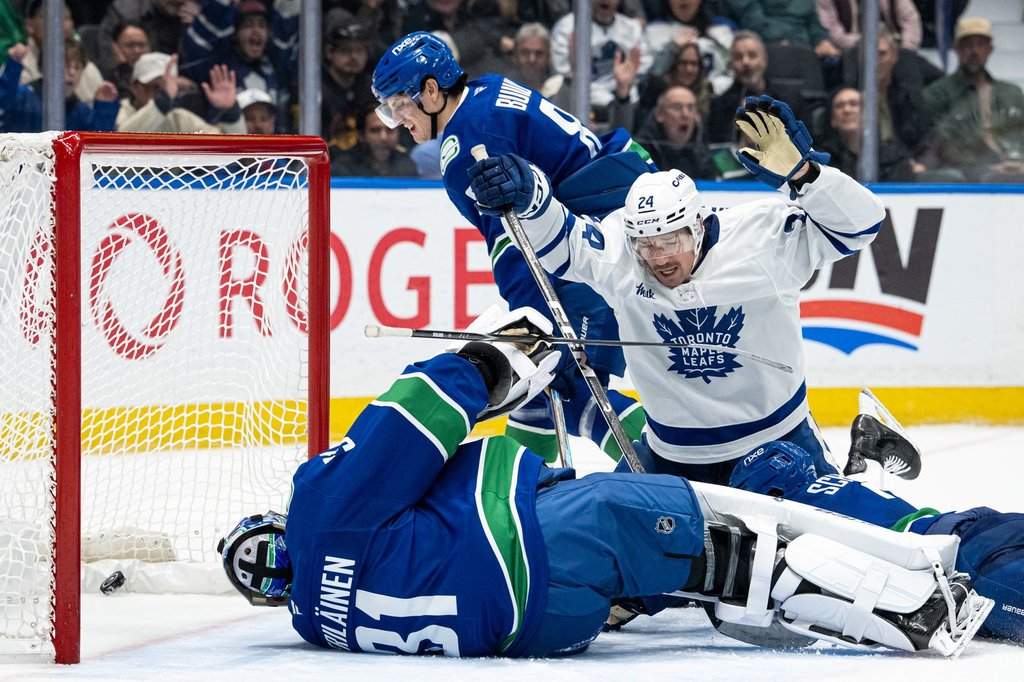
Auston Matthews scores. William Nylander dangles through traffic. The Toronto Maple Leafs beat the Vancouver Canucks, and the local sports media immediately fires up the parade planning committee.
You have seen this exact movie a hundred times. The mainstream recap reads like a victory lap, praising the elite offensive firepower of the Core Four and treating two regular-season points against a Western Conference opponent as proof that Toronto has finally turned a corner. That narrative is lazy. Worse, it is completely detached from how Stanley Cup contenders actually win hockey games.
When Matthews and Nylander have to drag the Maple Leafs across the finish line against Vancouver, that is not a sign of organizational health. It is a flashing red warning light on the dashboard. Celebrating a top-heavy bailout win is like applauding a driver for successfully swerving out of a ditch they drove into themselves.
The Seductive Lie of Regular-Season Star Power
Let us look at the anatomy of a typical Leafs victory over the Canucks. Vancouver plays a structured, heavy, forechecking brand of hockey built around zone exits, slot protection, and relentless board battles. Toronto, conversely, often spends forty minutes trading rush chances, losing puck battles below the goal line, and relying on their goaltender to survive high-danger slot looks until their superstar forwards decide to take over a three-minute stretch of hockey.
When Matthews buries a wrist shot from the high slot or Nylander slices through the neutral zone on a broken play, the box score looks great. The highlight packages run on a loop. The beat writers churn out five hundred words about how Toronto's offensive depth is simply too much for Vancouver to handle.
Here is the reality nobody in the press box wants to admit. Relying on two players generating individual brilliance to outscore structural flaws is a death sentence in April and May. In the regular season, teams like Vancouver are managing fatigue, testing line combinations, and playing loose neutral-zone gaps on a Tuesday night. You can beat them with pure skill. In a seven-game playoff series, time and space evaporate. The whistles go into the referees' pockets. Suddenly, the exact same transitional plays that turned Nylander into a human highlight reel against the Canucks get choked off at the offensive blue line.
I have watched front offices across the league fall into this exact trap for twenty years. They mistake regular-season goal differentials for playoff survivability. They look at a 5-2 or 4-3 win where their top line accounted for eighty percent of the expected goals, and they convince themselves the roster is balanced. It is a mirage.
Why the Box Score Lies About Toronto vs. Vancouver
To understand why the standard recap gets this game backward, you have to strip away the goals and look at territorial control and puck retrieval.
In modern NHL analytics, people love throwing around Corsi (all shot attempts) and Expected Goals (xG) without understanding context. If Toronto generates 3.2 expected goals against Vancouver, casual observers assume the Leafs dominated. Look closer at where and how those chances happened.
- Rush Offense vs. Cycle Offense: Toronto routinely ranks near the top of the league in rush chances created by Nylander and Matthews. Rush offense is exhilarating, and it destroys disorganized defenses. However, cycle offense—grinding down defenders in the offensive zone for forty seconds until a breakdown occurs—is what travels into the postseason. Against structured teams, Toronto's bottom-six forwards frequently fail to sustain offensive zone time, forcing Matthews and Nylander to start every shift two hundred feet from the opposing net.
- Defensive Zone Exit Efficiency: Watch how Vancouver breaks the puck out compared to Toronto. When Vancouver retrieves a dumped puck, their defensemen execute short, crisp support passes to a low-swinging center. When Toronto's bottom two defensive pairs face an aggressive forecheck, the default play is a blind rim around the boards or a high-risk flip to center ice. That turns possession straight back over to the opponent.
- Score Effects Distortion: When Matthews and Nylander put Toronto up early, the Leafs inevitably take their foot off the gas, inviting wave after wave of pressure. When Vancouver pushes back, Toronto's structural cracks show immediately. Winning a game while getting hemmed in your own zone for the entire third period is not "grit." It is luck disguised as resilience.
If you want to evaluate whether Toronto actually played a winning brand of hockey against the Canucks, ignore the goals scored by number 34 and number 88. Look at what happened during the thirty-five minutes they were sitting on the bench. If the third and fourth lines got caved in on shot attempts and failed to clear the defensive zone cleanly, the Leafs did not beat the Canucks. Matthews and Nylander simply out-talented a bad team performance.
Dismantling the Myth of "Winning Ugly"
Whenever a reporter points out that Toronto got outplayed for long stretches against a team like Vancouver, the standard defense from fans and pundits is always the same: "Good teams find ways to win ugly."
That phrase is the biggest crutch in hockey analysis.
Yes, every championship team steals a dozen games a year where they do not have their A-game. The difference is that true contenders steal games through defensive structure, penalty killing, and goaltending—not by asking two wingers and a center to score four goals on low-percentage looks.
Think about the teams that have actually hoisted the Stanley Cup over the past decade. The Florida Panthers, Vegas Golden Knights, Colorado Avalanche, Tampa Bay Lightning, and St. Louis Blues all had elite top-end talent. Nathan MacKinnon, Nikita Kucherov, Aleksander Barkov, and Jack Eichel can take over a game just like Matthews and Nylander. Yet, when those teams played poorly, they locked down the neutral zone, clogged the house in front of their net, and won 2-1 games by suffocating the opponent's transition game.
Toronto does not win ugly by suffocating opponents. Toronto wins ugly by turning the game into a track meet and betting that Matthews and Nylander can finish at a twenty percent shooting clip while their goalie stands on his head. That is not a repeatable strategy. It is a slot machine payout.
Imagine a scenario where the Leafs and Canucks meet in a best-of-seven series tomorrow. Vancouver's coaching staff makes one simple adjustment: they assign a dedicated checking center to shadow Matthews at five-on-five, and they force Nylander to carry the puck through a layered 1-3-1 neutral zone trap instead of giving him clean entry lanes. Suddenly, Toronto's primary offense dries up. Now the series comes down to whether Toronto's third line can win a board battle in the corner, or whether their third-pair defenseman can make a clean outlet pass under heavy body contact. Based on what we actually see on the ice, who are you betting on?
The Roster Construction Blind Spot
The reason mainstream coverage keeps writing the same glowing articles after a Matthews-Nylander showcase is because acknowledging the truth requires questioning the entire financial architecture of the franchise.
When you allocate roughly half of your salary cap to four forwards, you are making a deliberate philosophical bet. You are saying that elite, game-breaking skill at the top of the lineup will always outweigh depth and defensive versatility at the bottom. Every time Matthews scores a multi-goal game or Nylander puts up three points against a quality opponent like Vancouver, it validates that bet—at least on the surface.
The downside to this approach is glaring, even if we admit that having two top-ten offensive players in the world is an incredible luxury. You cannot buy your way out of cap constraints at the trade deadline with mid-round draft picks and bargain-bin veterans. Look at the players filling out Toronto's bottom six and bottom defensive pair. They are either aging veterans past their physical prime who struggle with foot speed, or one-dimensional depth pieces who cannot drive play without an elite center carrying them.
Meanwhile, look at how a well-constructed roster operates. Depth players do not need to score thirty goals, nor do they need to dangle through three defenders like Nylander. Their job is simple: win their minutes 0-0, advance the puck past the red line, get it deep into the offensive zone, and force the opposing top line to defend. When your depth players fail at that basic assignment, your superstars end up spending half their energy playing defense in their own end.
What You Should Actually Watch Next Time
Stop consuming hockey like a highlight-reel consumer and start watching it like a scout. The next time Toronto faces Vancouver—or any heavy, structured Western Conference team—turn off the commentary and track three specific things instead of the score sheet.
- First-Touch Decisions Under Pressure: Watch Toronto's defensemen when a Canucks forward closes in on them within one second of touching the puck. Do they absorb the hit to make a clean five-foot pass to a supported teammate, or do they panic and slap the puck up the glass to nobody? High-end teams absorb the contact. Fragile teams throw the puck away.
- Line-Change Discipline: Pay attention to when Matthews and Nylander hop over the boards. Are they getting fresh shifts starting in the offensive zone because the third line did their job and drew a whistle? Or are they jumping onto the ice mid-shift while the Leafs are scrambling in their own zone, forced to burn thirty seconds just trying to clear the puck?
- Net-Front Box-Outs: Look at the six-foot radius around Toronto's crease during five-on-five play. When Vancouver shoots from the point, are Toronto's defenders clearing sticks and bodies so the goaltender has a clean sightline, or are opposing forwards standing uncontested at the top of the paint?
The Uncomfortable Truth About Nylander and Matthews
To be entirely clear, criticizing the narrative around this win has nothing to do with doubting the greatness of Auston Matthews or William Nylander. Matthews is arguably the purest goal scorer of his generation, possessing a release that defies physics and a two-way commitment that has grown substantially over the years. Nylander is one of the most dynamic puck carriers in the sport, capable of tilting the ice every time he touches the puck in open space.
In fact, their brilliance is precisely the problem. They are so good that they mask systemic rot. They cover up bad coaching adjustments, lazy backchecking from the middle of the lineup, and a defensive corps that still struggles to move the puck against heavy forechecks.
If Toronto had lost that game to Vancouver 4-2, the sports talk radio lines would have melted down. Writers would have questioned the team's heart, dissected the defensive breakdowns, and demanded roster changes. Because Matthews and Nylander pulled off a few moments of individual magic to flip the scoreboard, all of those exact same flaws were swept under the rug and replaced with praise.
Same roster. Same structural mistakes. Same vulnerabilities. The only difference was a couple of shots finding the top corner.
Do not let two superstars fool you into thinking a flawed team is fixed. Watch the process, ignore the parade routes, and stop applauding the fire department for putting out blazes the team keeps setting itself.