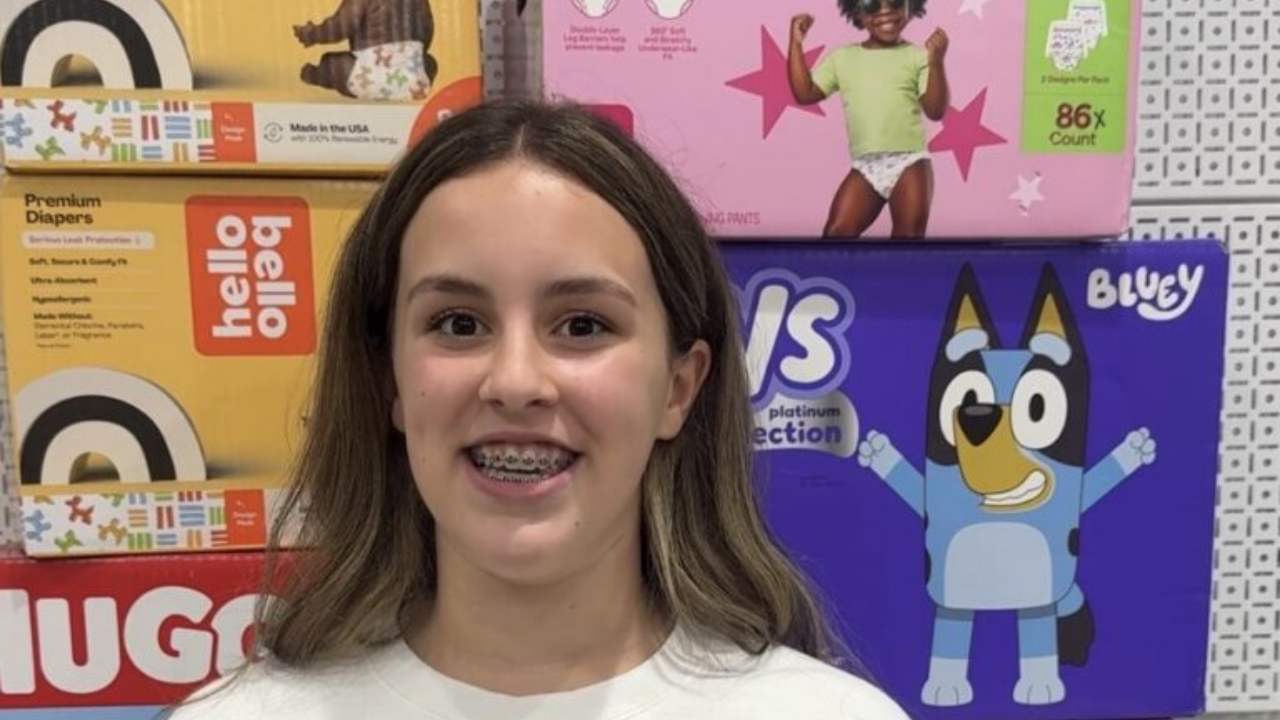
Thirty thousand diapers is a big number. It looks great in a local news segment. A young girl sees a Phoenix food bank run out of baby supplies, starts a drive, and five years later hands over thirty thousand units. Cue the warm music. Cue the applause.
Now stop clapping and ask the uncomfortable question. Why is a food bank running out of diapers in the first place, and why are we treating a child's collection bin like a structural solution? Don't forget to check out our earlier article on this related article.
Competitor coverage loves a tidy hero arc. The framing is predictable: kid notices a gap, kid rallies neighbors, 30,000 diapers show up, problem solved. That is the lazy consensus of civic storytelling. It turns a recurring supply-chain failure into an inspiring personal milestone. Worse, it trains communities to confuse episodic charity with reliable basic-needs infrastructure.
Diaper need is not a quirky side effect of poverty. It is a daily, non-negotiable physical requirement with zero substitutes. You cannot stretch a newborn diaper across two days the way someone might water down soup or skip a meal. When a distribution hub runs dry, families face immediate hygiene and health consequences, and front-line staff absorb the chaos. To read more about the history here, Reuters offers an in-depth breakdown.
I have spent years watching nonprofits, municipal planners, and corporate social responsibility teams burn serious budget on feel-good drives while ignoring inventory mechanics. I have seen organizations celebrate massive single-drop totals in November only to scramble for basic sizes in February. Volume without size distribution, storage discipline, or predictable replenishment is theater with cardboard boxes.
The Myth of the Hero Drive
Look closely at what a fifth annual drive actually proves. It proves sustained personal grit. Credit where it is due: keeping a project alive for five years takes stubborn follow-through. Most school and community collections die after year one once the novelty wears off.
Still, persistence does not fix broken economics. A food bank is built primarily around perishable and shelf-stable food flows, donor volatility, and tight warehouse footprints. Diapers are bulky, low-margin-per-cubic-foot items that eat up pallet space fast. One pallet of canned beans feeds far more households per square foot than one pallet of size-4 diapers. When budgets tighten or food donations spike, bulky non-food staples are often the first thing squeezed unless a dedicated funding stream ring-fences them.
When coverage treats a 30,000-unit annual handoff as a triumph, it quietly lowers expectations for permanent institutional funding. Public agencies and major donors get a free moral pass. Why negotiate multi-year procurement contracts or expand diaper bank partnerships when a determined kid in Arizona can do a yearly miracle?
Consider the mechanics of infant care. A baby goes through roughly six to twelve diapers a day in the first year, tapering slightly as solids increase, yet costing dozens of dollars a week at retail prices. Federal nutrition programs like SNAP and WIC explicitly exclude diapers. That statutory gap is well documented by researchers and anti-poverty organizations such as the National Diaper Bank Network, which has spent years compiling data on diaper need across U.S. households. When public benefits do not cover an essential item, charitable drives step into a hole carved by policy.
What People Actually Ask When a Drive Hits the News
Whenever a story like this circulates, the same questions pop up in comment sections and search bars. Most of them start from the wrong premise.
Why do food banks run out of diapers so often?
Because food banks are rarely funded as full-service infant-supply warehouses. Their core mandate, grant structures, and donor pipelines center on food. Diapers arrive mostly through inconsistent community drives, sporadic corporate surplus, or small discretionary budgets. When an unexpected wave of families shows up, shelves empty fast.
Isn't 30,000 diapers enough to make a real dent?
Do the math before celebrating. At eight diapers a day, 30,000 diapers equals 3,750 baby-days of coverage. Across a major metro area like Phoenix, where thousands of low-income families juggle rent, utilities, and childcare, 3,750 baby-days is a brief surge, not a year-round safety net. It helps right now. It does not end scarcity.
Should people still donate to youth-led drives?
Yes, with eyes wide open. Turning down practical help because the system is flawed would be pure cynicism. Donations put real supplies in real hands. Just do not mistake a donation drop for systemic progress, and do not stop pressing local leaders for year-round funding.
The Nuance Local Coverage Misses
Here is the part the standard story skips: aggregate unit counts hide operational friction.
Thirty thousand diapers sound uniform until you open the boxes. Infant care depends on weight bands, not calendar age. A family with a fast-growing six-month-old in size 3 cannot use a mountain of newborn diapers, even if the total count looks impressive on camera. Reverse logistics—sorting, repacking, storing, and redistributing mismatched sizes—takes staff hours that underfunded nonprofits rarely have to spare.
Imagine a scenario where a community hub receives 30,000 diapers in a single week: 18,000 in newborn and size 1, 9,000 in size 2, and only 3,000 in sizes 4 through 6. On paper, the hub just hit a record milestone. On the ground, older infants and toddlers still face shortages within ten days, while staff spend volunteer labor hauling excess small sizes to partner sites. The headline celebrates the total; the warehouse manager tracks the bottleneck.
That distinction matters. In supply chain operations, throughput is governed by the tightest constraint, not the loudest top-line number. A smaller, size-balanced delivery coordinated directly with a partner agency's real-time inventory list often outperforms a massive blind collection.
Battle Scars From Chasing Feel-Good Metrics
I have seen nonprofits brag about record toy, coat, and diaper drives while quietly cutting caseworker hours or letting warehouse leases lapse. Boards love round numbers for annual reports. Donors love photos of stacked pallets. Meanwhile, front-line workers deal with expiration dates, damp garage storage, and angry calls when promised stock never materializes.
Even in corporate philanthropy, the same trap repeats. A company sponsors a high-visibility community drive, posts a slick recap, and calls it community impact. Six months later, the partner agency is back to begging for basic operating cash because nobody wants to fund forklifts, shelving, or procurement coordinators.
Good intentions are cheap. Repeatable systems are expensive, boring, and hard to photograph.
What Actually Works Instead
If you care about getting diapers to families who need them—whether you are a parent, a donor, a school administrator, or a local official—stop treating drives as the finish line. Shift how you operate.
- Ask for the size and brand matrix before collecting. Call the receiving agency first. Find out which sizes are chronically short, whether open packages are accepted, and whether wipes or rash cream are higher priorities.
- Pair drives with unrestricted cash. Bulk wholesale purchasing and dedicated diaper bank partnerships stretch dollars further than retail-priced single packs bought on impulse. Even a modest cash match alongside a physical drive lets staff fill size gaps immediately.
- Build recurring pipelines, not just annual spikes. One big November drop creates a feast-or-famine curve. Quarterly commitments, recurring payroll deductions, or standing school-district partnerships keep inventory moving when cameras are gone.
- Separate praise from policy. Applaud the young organizer in Arizona for five years of hustle. Then ask why Phoenix families still rely on a teenager's collection bin to cover basic infant hygiene.
The Cost of Being Contrarian Here
Taking a hard line against youth charity stories carries a real downside. It can sound ungenerous, pedantic, or dismissive of a kid doing something genuinely admirable. Critics will say, "At least she did something while you complained."
Fair point. Cynicism without action is useless. Pointing out structural flaws does not make a 30,000-diaper delivery imaginary, and nobody handing a pack of diapers to a stressed parent cares about supply-chain theory in that moment.
The risk is not that we praise her effort. The risk is that we stop thinking once the applause starts.
Fix the Pipeline, Not Just the Headline
A fifth annual drive delivering 30,000 diapers is a testament to one person's refusal to quit. It is also an indictment of how casually communities leave basic infant needs to chance.
Celebrate the hustle. Then fund the infrastructure so no child has to run a supply chain.