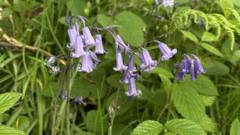
The annual ritual of "bluebell shaming" has begun. You’ve seen the headlines. You’ve read the frantic warnings from conservation charities. They want you to treat a patch of wild flowers like a crime scene under active investigation. They tell you that a single misplaced boot will trigger a decades-long ecological collapse. They treat the British public like a herd of mindless vandals.
It is a lie. Not a malicious one, perhaps, but a lie born of a "curator mindset" that views the natural world as a museum piece rather than a living, breathing system. If you liked this piece, you should check out: this related article.
By demanding we stay on the gravel paths and look but never touch, these organizations are actually accelerating the disconnect between humans and the land. They are turning nature into a fragile, untouchable commodity. In doing so, they are ensuring that the next generation won't care enough to save anything at all.
The Fragility Myth
The core of the competitor’s argument is that Hyacinthoides non-scripta—the native British bluebell—is so delicate that it cannot recover from being trodden on. They claim that because the leaves are soft, crushing them prevents the bulb from photosynthesizing, effectively "starving" the plant to death. For another angle on this development, see the recent coverage from ELLE.
Let’s dismantle this with some basic biology.
Plants are resilient. They have survived ice ages, tectonic shifts, and the arrival of invasive species. While it is true that localized compaction isn't ideal for a specific bulb's growth cycle for one season, the idea that a footpath through a wood is an ecological death sentence is hyperbole.
The real threat to bluebells isn't a hiker’s Vibram sole. It’s the Spanish Bluebell (Hyacinthoides hispanica). This invasive cousin is sturdier, more aggressive, and interbreeds with our native variety. While you’re busy worrying about where your toddler is standing, the actual genetic identity of the British woods is being erased by garden escapes.
We are focusing on the optics of foot traffic because it’s an easy target. It’s much harder to talk about the complex, boring reality of hybridisation or the lack of active coppicing in our woodlands.
The High Cost of the "Look but Don't Touch" Policy
When you tell people they are a threat to the environment simply by existing within it, you create a psychological barrier. I have spent years observing how people interact with green spaces. When a space is "managed" to the point of sterility—fenced off, signposted with warnings, monitored by tutting volunteers—people stop feeling a sense of ownership.
If you don't own it, you don't protect it.
By turning bluebell woods into "no-go zones," we are teaching children that nature is a high-definition screen they are allowed to watch but never enter. We are trading long-term stewardship for short-term aesthetic perfection.
The Museumification of the Wild
Imagine a scenario where we applied this logic to everything else in our lives. We wouldn't let people walk on grass in parks because it might stress the roots. We wouldn't let people swim in rivers because it might disturb the silt.
This is the "Museumification" of the British countryside. It is a sterile, middle-class obsession with keeping things looking "just so" for the Sunday afternoon stroll. It ignores the fact that woodlands were historically working environments. They were sites of industry, movement, and constant human interference. The bluebells didn't just survive; they thrived in those conditions.
The Logic of Controlled Disturbance
In ecology, there is a concept known as the Intermediate Disturbance Hypothesis. It suggests that local species diversity is maximized when ecological disturbance is neither too rare nor too frequent.
A woodland that is perfectly preserved in amber eventually becomes stagnant. A certain level of human presence—yes, even walking off the path—can create micro-habitats. It moves seeds. It breaks up the leaf litter.
The obsession with "trampling" is a distraction from the real killers:
- Over-shading: The decline of traditional coppicing means woods are becoming too dark, killing the floor flora.
- Nitrogen Runoff: Farming chemicals are changing the soil chemistry far more than your boots ever could.
- Deer Overpopulation: Muntjac and roe deer eat bluebells and everything else. They don't stay on the paths.
If you actually want to save the bluebells, stop shouting at photographers and start demanding a return to active woodland management. But that’s a harder conversation to have than "stay on the path."
The Counter-Intuitive Truth: We Need More Trampling
We don't need fewer people in the woods. We need more.
We need people who aren't afraid to get their hands dirty. We need a population that views the woods as their home, not a gallery. When we treat the countryside like a fragile Ming vase, we give ourselves permission to ignore the massive, structural threats to our environment because we feel we’ve "done our bit" by staying on the gravel.
It’s a cheap moral victory.
I’ve seen "protected" sites fall into total disrepair because the local community felt so alienated by restrictive rules that they stopped visiting. Once the people left, the fly-tippers moved in. Then the developers. A wood that is used is a wood that is defended.
Why the "Rules" Are Actually Classist
Let’s be honest about who these "urging" messages are for. They are directed at the "wrong" kind of visitor. The influencers. The city-dwellers. The people who don't know the unwritten rules of the countryside.
It’s a form of gatekeeping. By creating a complex set of "best practices" for visiting a forest, we make it clear that only the "initiated" are welcome. It’s an exclusionary tactic disguised as environmentalism.
If a bluebell wood cannot survive a few thousand people taking photos in it every April, then the ecosystem is already dead. It is a ghost of a forest. A healthy, resilient woodland should be able to withstand human interaction. If it can't, the problem isn't the boots—it's the management.
The Actionable Pivot: How to Actually Be a Steward
Instead of following the "look but don't touch" mantra, try a more radical approach to the countryside:
- Ignore the Fences (Mentally): Stop seeing yourself as an intruder. See yourself as a part of the ecosystem. This doesn't mean you should go out of your way to destroy things, but it means you should stop being afraid of the dirt.
- Focus on the Invaders: Learn to identify Spanish bluebells. If you see them in your garden, dig them up. Don't let them near the wild stuff. That is infinitely more helpful than staying on a path.
- Demand Coppicing: Join a local woodland trust and ask why they aren't thinning the canopy. Bluebells need light. They are a "pioneer" species that thrives after the canopy is opened up.
- Support Working Forests: Buy local charcoal and timber. Supporting a working forest ensures that the land remains productive and managed, which is the best protection for bluebells.
The Risks of Being Right
The downside to my approach is obvious: if everyone went rogue and started stomping through the undergrowth with zero regard, yes, you would see a temporary decline in flower density in high-traffic areas.
But I’ll take a temporary patch of bare earth over a permanent culture of environmental apathy any day.
We have spent forty years trying to save nature by keeping people away from it. It hasn't worked. Biodiversity is still plummeting. Climate change is still accelerating. Maybe it’s time to admit that "leave no trace" is a failing strategy.
We need to leave a trace. We need to be so deeply embedded in our local environments that the idea of "visiting" nature becomes absurd.
Stop worrying about the flowers. Start worrying about the fact that you feel like a stranger in your own landscape. If the price of a more connected, active, and protective public is a few crushed petals, it’s a bargain.
Get off the path. Get into the woods. If you crush a bluebell, let it be a reminder that you are a biological entity in a physical world, not a ghost haunting a museum.