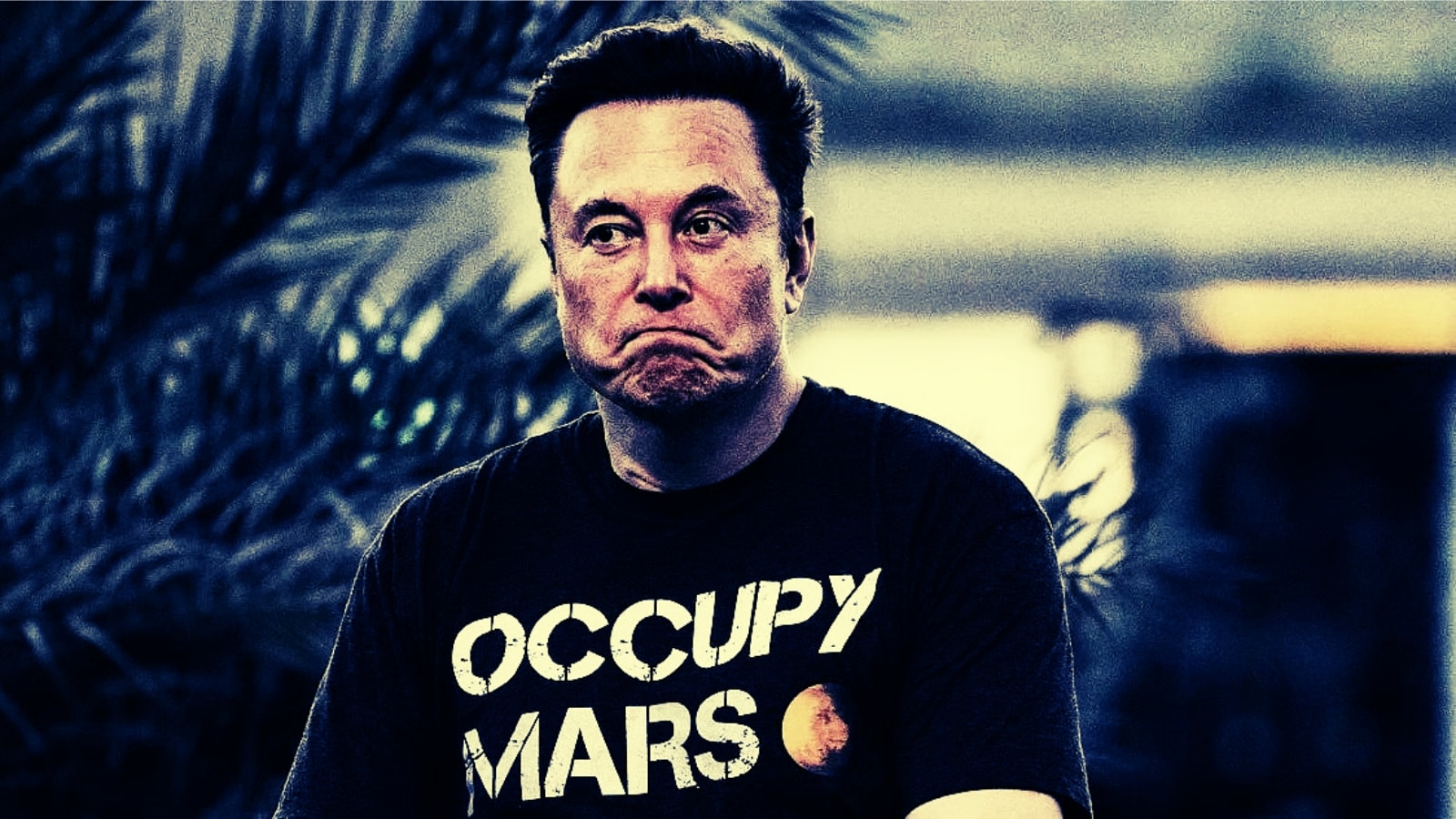
Every time Tesla misses a delivery target or SpaceX hits a regulatory wall, the exact same script plays out. Elon Musk logs onto X, fires off a punchline about "election-interfering space lasers," and watches the financial press dutifully transcribe the joke while his share prices quietly slip in the background.
It is the oldest trick in the corporate crisis playbook, yet Wall Street analysts and tech journalists fall for it every single week. They treat the meme as the story and the market dip as a footnote. That is completely backward.
When a CEO uses sci-fi absurdity to laugh off a valuation drop, you are not witnessing a charming billionaire being relatable. You are watching a deliberate, high-stakes smoke screen designed to keep retail investors looking at the clown while the circus tent catches fire.
The Anatomy of the "Space Laser" Smoke Screen
Let’s look at the mechanics of how financial media covers the Musk industrial complex. A standard business report sees a headline-grabbing tweet, pairs it with a two-percent dip in TSLA or a drop in secondary market valuations for SpaceX, and frames the whole thing as quirky volatility. The lazy consensus assumes that Musk’s chaotic posting is merely a side effect of his personality—a quirk you have to tolerate to get the genius.
That premise is fundamentally flawed.
In institutional finance, narrative control is a balance-sheet asset. I have sat in war rooms with crisis communications teams who charge fifty thousand dollars a month just to manufacture a fraction of the distraction Musk generates for free before his morning coffee. When an executive makes a ridiculous joke about orbital weaponry during a downturn, the algorithm rewards the absurdity. Engagement spikes. Journalists write stories about the joke. Suddenly, the top search results for the company’s ticker symbol are about sci-fi memes rather than shrinking gross margins, delayed product roadmaps, or evaporating government subsidies.
Notice the subtle sleight of hand in the competitor’s framing: bundling Tesla and SpaceX shares slipping together as if they are suffering from the same vague, cosmic mood swing. First, let’s correct a glaring factual sloppiness that plagues retail financial coverage: SpaceX is a privately held company. It does not have a public share price ticking down on the NASDAQ. When commentators say "SpaceX shares slip," they are referring to illiquid secondary market tenders—platforms like Forge or Hiive where accredited investors trade private equity blocks—or indirect exposure through funds like Baron Partners or the Destiny Tech100. Lumping a publicly traded automaker’s daily ticker movement in with private aerospace secondary valuations is lazy journalism that obscures what is actually hurting each business.
Why Tesla and SpaceX Are Slipping for Completely Different Reasons
If you want to understand why capital is rotating out of Musk’s orbit, you have to stop treating his companies as a single monolithic meme stock and start looking at their actual unit economics. They are facing entirely separate structural threats, neither of which can be solved with a good punchline.
Tesla’s Identity Crisis
Tesla’s valuation has never been anchored to the reality of selling cars. If it were, it would trade at a multiple closer to Toyota or Ford, not a hyper-growth software monopoly. For years, the bull case relied on a simple equation: massive delivery growth plus industry-leading automotive gross margins equals infinite cash to fund the AI future.
That equation is broken. Look at the fundamentals:
- Margin Compression: Global EV competition—led by ruthless, vertically integrated Chinese manufacturers like BYD—has forced Tesla into a protracted price war. You cannot cut vehicle prices repeatedly without gutting your operating leverage.
- The Autonomy Mirage: Every time the core auto business slows down, the narrative pivots to Full Self-Driving (FSD) and robotaxis. Yet regulatory approvals remain a patchwork nightmare, and pure-vision neural networks still face brutal edge-case liabilities that competitors using LiDAR sensor fusion avoid.
- Brand Alienation: In consumer discretionary markets, you do not willingly alienate your core demographic. Historically, high-income, environmentally conscious buyers fueled Tesla’s early adoption. Turning the brand into a polarizing political lightning rod creates measurable demand destruction in key coastal and European markets.
SpaceX’s Capital Trap
SpaceX is a genuine engineering marvel, dominating global launch cadence with the Falcon 9. Anyone denying their operational superiority in orbital payload delivery is blind. However, dominance in launch does not automatically guarantee infinite valuation growth.
SpaceX’s private valuation—hovering in the hundreds of billions—is priced for absolute perfection regarding two massive capital sinks: Starship and Starlink.
Starlink is generating real revenue, yes, but low-Earth orbit (LEO) satellite constellations are brutally capital-intensive. Satellites have a finite lifespan of roughly five years before they deorbit and burn up. That means SpaceX is locked into a perpetual, multi-billion-dollar hardware replacement cycle just to maintain existing bandwidth, all while fighting regulatory spectrum battles globally and watching Amazon’s Project Kuiper ramp up. Meanwhile, Starship delays push back the timeline for deploying the heavier V3 Starlink satellites needed to make the unit economics truly sing. When secondary market shares slip, it is not because of space laser jokes; it is because institutional buyers are doing the math on discounted cash flows and realizing the exit liquidity timeline is stretching out indefinitely.
Dismantling the "Musk Premium" Myth
If you search financial forums right now, you will see retail traders asking the same tired questions: "Is this dip a buying opportunity?" or "Does Elon’s tweeting actually hurt Tesla stock?"
Both questions miss the point entirely. Asking whether a tweet hurts the stock assumes the tweet is an external accident happening to the business. In reality, the volatility is the business model.
For over a decade, investors have talked about the "Musk Premium"—the idea that Elon’s sheer force of will adds billions in intangible value to whatever company he touches. As Aswath Damodaran, the NYU Stern finance professor widely known as the Dean of Valuation, has repeatedly pointed out when valuing Tesla, narrative is powerful, but eventually, every story has to tie back to numbers. You cannot pay the bills with total addressable market fantasies forever.
Today, we are witnessing the inversion of that thesis: the Musk Discount.
I have watched dozens of founder-led tech companies hit this exact inflection point. In the early stages, a chaotic, rule-breaking visionary is an asset. They bend reality, attract top engineering talent, and bulldoze bureaucratic obstacles. But once an enterprise reaches mature scale—hundreds of thousands of employees, global supply chains, trillions in collective market cap—that exact same behavior becomes an existential liability. Corporate governance stops being a boring compliance checklist and becomes a survival mechanism. When a board of directors acts like a fan club rather than a fiduciary check on executive power, institutional capital eventually demands a risk premium. That discount is what you are seeing priced into the market every time the shares slide.
How to Actually Read Market Signals in the Meme Era
To be completely transparent, betting against Musk’s companies has been a widow-maker trade for fifteen years. Short sellers have lost tens of billions trying to apply traditional value-investing metrics to a man who treats financial markets like a multiplayer video game. The downside of taking a hard-nosed, fundamentals-first approach to Musk’s empire is that you will frequently look wrong in the short term. Meme momentum can overwhelm balance-sheet reality for quarters, sometimes years, at a time.
If you are allocating capital—or even just trying to understand where the tech sector is actually heading—you have to strip away the theater. Stop reacting to the outrage cycle and adopt a ruthless filter for signal versus noise.
- Invert the News Cycle: Treat every viral executive joke as a flashing red warning light. When the public relations volume goes up, dig immediately into the latest 10-Q filing, regulatory docket, or supply chain report. Ask yourself: What boring, expensive problem is happening this week that they do not want on the front page?
- Track Free Cash Flow, Not Headline Revenue: Top-line revenue can be manipulated through aggressive price cuts, regulatory credit sales, and deferred revenue recognition from unreleased software features. Watch free cash flow after capital expenditures. If cash conversion is shrinking while capex is ballooning, the core engine is stalling.
- Separate Engineering Wins from Financial Viability: A rocket catching itself on mechanical arms is one of the coolest visual spectacles in human history. It is also completely irrelevant to your portfolio if the cost per kilogram to orbit doesn't clear the hurdle rate required to pay off the R&D debt. Admire the engineers; audit the accountants.
- Watch the Insiders, Not the X Feed: Ignore what executives say about the future of AI or Mars colonization. Watch Form 4 filings for insider selling and track executive turnover at the VP level. When seasoned operational leaders quietly exit while the CEO posts memes, believe the exits.
The financial press loves a circus because clowns sell clicks. They will happily write a thousand articles about space lasers, political feuds, and billionaire banter while completely missing the slow-motion restructuring of the global automotive and aerospace markets.
Stop being the audience for a magic trick designed to distract you from your own wallet. Mute the memes, open the balance sheet, and judge the empire by the only metric that survives when the applause stops: cold, hard cash.