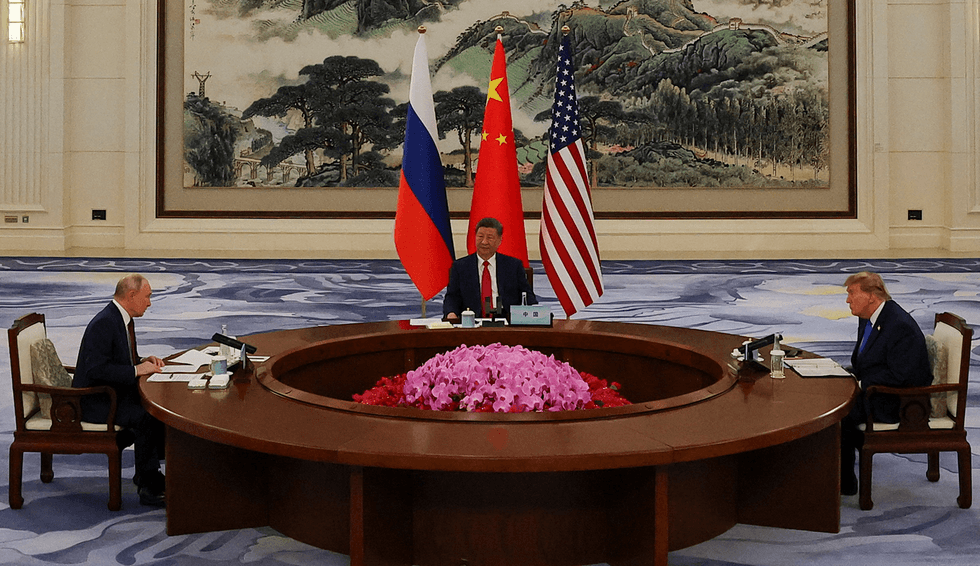
Every time an American president shares a stage with Xi Jinping, the foreign policy establishment faints on cue.
The latest panic is entirely predictable. A summit happens. A "G3" label gets slapped onto the headlines. Security pundits rush to television studios to wring their hands about how Donald Trump was outmaneuvered, outshined, and upstaged by Beijing’s stagecraft. You might also find this similar article interesting: Why Breaking News Coverage of Kyiv Missile Strikes Misses the Real War.
It is lazy analysis. Worse, it is completely backwards.
The mainstream media treats international summits like the Oscars. They score the event based on optics, handshakes, and who stood closest to the center of the group photo. By measuring diplomacy through aesthetics, these commentators miss the actual mechanics of power. When you look past the choreographed smiles and examine the structural realities of trade, capital flows, and security alliances, a very different picture emerges. As discussed in latest coverage by TIME, the effects are notable.
Xi did not upstage Trump. Beijing walked into a trap of its own making, trading short-term visual validation for long-term strategic concessions.
The Optics Trap in Modern Geopolitics
Foreign policy pundits love a good humiliation narrative. It sells subscriptions and drives cable news ratings. If an American leader breaks traditional diplomatic protocol—or lets a rival take the ceremonial spotlight—the consensus immediately declares a loss for Washington.
I have sat in enough high-stakes negotiation rooms across Washington and East Asia to recognize this exact dynamic. The loudest person in the room, or the one demanding the most flattering seating arrangement, is rarely the one holding the cards. Usually, they are compensating for severe domestic weakness.
Let us define what actual diplomatic dominance looks like. In international relations, coercive diplomacy—a concept famously mapped out by strategist Thomas Schelling—is not about winning a press conference. It is about altering an adversary’s behavior through credible threats and structural pressure while letting them save face at home.
When Beijing insists on grand ceremonial parity, they are playing to an audience of one: the domestic Chinese public and the internal factions of the Chinese Communist Party. Xi Jinping operates inside a rigid political system where perceived weakness can trigger elite pushback. He needs the photo op. He needs the media to say he stood tall alongside the American president and a third major power.
Trump, conversely, operates in a chaotic media ecosystem where traditional diplomatic dignity holds zero currency. By letting Beijing have the superficial pageantry of a "G3" framing, Washington paid nothing of substance while extracting attention and concessions where they actually matter.
Why the "G3" Label Is a Poison Pill for Beijing
The security experts panicking over the "G3" concept fundamentally misunderstand how multilateral groupings work.
For decades, Beijing has tried to sell the world on a multipolar order where American hegemony is dead and China acts as the benevolent champion of the Global South. That narrative is the bedrock of Chinese soft power. It is how Beijing recruits developing nations into its orbit.
The moment China accepts a "G3" label—putting itself in an exclusive, top-tier club alongside the United States and one other superpower—that entire narrative collapses.
Think about the diplomatic fallout from that single framing:
- Alienating the Developing World: Nations in Africa, Latin America, and Southeast Asia suddenly see Beijing not as their protector against Western dominance, but as a junior partner in a new global cartel.
- Spooking Regional Neighbors: Countries like India, Japan, and South Korea despise any arrangement that smells like great-power collusion over their heads. A G3 framework drives New Delhi and Tokyo straight back into tighter security cooperation with Washington.
- Locking in Accountability: You cannot claim to be a developing nation deserving of World Trade Organization exemptions while simultaneously bragging about sitting at the G3 head table.
Washington understands this contradiction. Letting Beijing bask in the glow of superpower parity forces China to own global problems it is wholly unequipped to solve.
Follow the Capital, Not the Cameras
If you want to know who won a summit, turn off the sound on the news broadcast and open a financial terminal.
Diplomacy is downstream from economics. A leader can project infinite strength on a red carpet, yet still govern an economy suffocating under structural debt, demographic collapse, and capital flight.
Look at the actual baseline realities heading into these high-level meetings:
- Trade Asymmetry: The United States remains the world’s consumer of last resort. China remains an export-driven manufacturing powerhouse with severe domestic overcapacity. When global demand slows, the exporter needs the buyer far more than the buyer needs the exporter.
- Technological Chokepoints: Despite massive state subsidies, Beijing still relies on Western and allied ecosystems for high-end semiconductor design, advanced lithography, and foundational AI architecture.
- Currency Reality: The US dollar still accounts for the overwhelming majority of global foreign exchange reserves and international trade invoicing. The yuan remains strictly controlled because Beijing knows that opening its capital account would trigger an immediate exodus of domestic wealth.
Imagine a scenario where two business partners meet to renegotiate a failing joint venture. Partner A demands the head of the table, brings a massive entourage, and hires a PR firm to announce they are now co-CEO. Partner B lets Partner A have the big chair, nods along during the photo shoot, and walks out with control over the supply chain, the intellectual property, and the bank accounts.
Which partner actually runs the company?
The security pundits crying foul over summit optics are cheering for Partner A. They are mistaking theater for ownership.
The Myth of the Master Strategist
There is a persistent, almost romantic obsession among Western commentators with the idea that Beijing plays four-dimensional chess while Washington plays checkers.
This myth survives because centralized authoritarian systems look decisive from the outside. There are no messy congressional hearings. There are no leaked memos contradicting the executive branch. Everything appears smooth, unified, and permanent.
In reality, centralized systems are brittle. Because dissent is punished, bad economic data gets buried until it becomes a crisis. Policy mistakes—like prolonged lockdowns or massive overinvestment in speculative real estate—get amplified rather than corrected early.
When Xi enters a summit with Trump, he is not operating from a position of effortless dominance. He is managing a historic slowdown in growth, a youth unemployment crisis so severe Beijing repeatedly altered how it measures the statistic, and a real estate sector that has wiped out trillions in household wealth.
Furthermore, Trump’s unpredictability—often derided by traditional diplomats as a fatal flaw—is precisely what disrupts Beijing’s preferred playbook. Chinese diplomacy relies on strict choreography, pre-scripted talking points, and incremental concessions stretched out over years of working-group meetings.
Trump blows up the script. He personalizes the relationship, bypasses the bureaucratic layers, and forces immediate transactional choices. For a system built on rigid hierarchy and risk aversion, dealing with an American president who ignores institutional guardrails is a nightmare.
Answering the Questions Pundits Refuse to Ask
When mainstream outlets cover these summits, they always steer the reader toward the same anxious questions. Let us dismantle them directly.
Did Trump weaken American alliances by entertaining a G3 framework?
No. Alliances are built on shared security interests and hard military deterrence, not summit vocabulary. Tokyo, Seoul, and Canberra do not care what nickname pundits give a diplomatic meeting. They care about freedom of navigation in the South China Sea, missile defense umbrellas, and intelligence sharing. As long as US carrier strike groups patrol the Indo-Pacific and defense treaties remain intact, allied capitals treat summit rhetoric as background noise.
Does Beijing gain permanent leverage from better summit optics?
Optics have a half-life of about seventy-two hours. Nobody remembers the seating chart from last year’s G20 summit, yet everyone feels the impact of tariffs, export controls, and investment restrictions. Leverage comes from pain tolerance—specifically, which economy can absorb more disruption before breaking. Right now, Washington holds a massive structural advantage in energy independence, food security, and capital market depth.
Why do security experts keep getting this wrong?
Because the traditional foreign policy establishment measures success by process rather than outcomes. If a summit produces a thirty-page joint communiqué full of diplomatic platitudes, the establishment calls it a triumph. If a summit bypasses the bureaucracy and looks messy on television, they call it a disaster. They have spent decades mistaking polite friction for stability.
The Real Risk Nobody Is Talking About
Admitting that Washington holds the upper hand does not mean the current strategy is flawless. There is a genuine downside to this transactional, optics-indifferent approach, and ignoring it is just as dangerous as falling for Beijing’s propaganda.
The real danger is strategic incoherence.
When diplomacy becomes entirely personalized between two leaders, long-term institutional follow-through suffers. You can extract major trade concessions or force a pause in aggressive military posturing during a high-stakes summit, only to watch those gains evaporate six months later because there is no bureaucratic machinery enforcing the terms.
Beijing excels at waiting out American political cycles. Chinese officials know that an American president has a four-year clock, while the Party plans in decades. If Washington trades structural enforcement mechanisms—like verifiable compliance inspections or permanent tariff schedules—for temporary headline wins, Beijing will happily sign the paper, take the photo op, and stall until the next election.
That is the critique serious analysts should be making. Instead, they are wasting ink complaining about body language and stage management.
How to Actually Read a Superpower Summit
If you want to cut through the noise the next time Washington and Beijing sit down together, ignore the commentary class and run a simple three-step audit on the results.
First, look at the unilateral actions taken thirty days before the meeting.
Powers rarely make major concessions at the table; they make them beforehand to buy a seat. Check whether export controls were quietly paused, whether military exercises were scaled back, or whether tariffs were adjusted prior to the handshakes. That tells you who wanted the meeting more.
Second, track the joint statements—or the lack of them.
When a summit ends without a formal joint communiqué, it means neither side compromised on core principles. When a summit produces vague language about "mutual respect" and "win-win cooperation," it means the meeting was pure theater designed to buy time.
Third, watch the capital markets and supply chain announcements in the following quarter.
Pay attention to where multinational corporations are building new factories. If companies continue shifting manufacturing capacity out of China and into Vietnam, India, Mexico, and the American Midwest regardless of how friendly the summit looked, then the underlying geopolitical reality has not changed by a single millimeter.
Stop Confusing Stagecraft With Power
The panic over Xi upstaging Trump at a "G3" summit is a textbook case of elite groupthink. It relies on an outdated view of diplomacy where politeness equals strength and ceremony dictates reality.
Beijing desperately needs the world to believe that its rise is inevitable and that American power is in terminal decline. Every time Western security experts hyperventilate over Chinese stagecraft, they do the Chinese Communist Party’s public relations work for free.
Power is not a photo op. Power is controlling the currencies, the technologies, the energy supplies, and the choke points that keep the modern world running. Until Beijing solves its structural economic rot and breaks free from Western technological dependencies, it can have all the red carpets it wants.
Washington still owns the building.