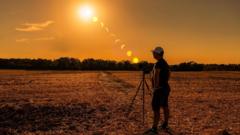
Every time the moon grazes the face of the sun, the internet undergoes a collective, synchronized stroke. Millions of people who could not name a single planet outside our solar system suddenly turn into passionate amateur astronomers, frantically scrolling through feeds to find the most heavily edited, over-saturated, high-exposure composite image of the celestial alignment.
The media feeds the frenzy with breathless headlines about stunning galleries that are worth seeing. They tell you that if you missed the August 12th solar eclipse, you missed a monumental visual spectacle.
They are lying to you.
Or worse, they are selling you a heavily processed digital fiction that bears zero resemblance to human reality. I have stood in the path of totality multiple times. I have watched hardened engineers and seasoned photographers drop expensive lenses in sheer panic, only to realize later that the photograph sitting on their sensor bears no emotional or visual resemblance to what actually transpired overhead.
The obsession with eclipse photography is a symptom of a broader cultural disease: our desperate need to consume an event through a screen rather than experience it with our senses. If you missed the August 12th solar eclipse, you did not miss a visual masterpiece. You missed a sensory shift. And looking at a dozen JPEGs on a glowing rectangle is the absolute worst way to understand what actually happened.
The Great Photographic Lie
Let us clear up the core misconception immediately. A photograph of a solar eclipse does not show you what you would see with your eyes.
When you look at a professional astrophotography shot of totality, you see a crisp, razor-sharp black disk suspended in the center of an intricate, glowing web of white coronal streamers stretching out millions of miles into space. The contrast is staggering. The details are immaculate.
Your eyes cannot do that.
The human eye operates on a logarithmic scale with a dynamic range that completely shatters when faced with the sudden, twilight drop in ambient light during totality. More importantly, the solar corona possesses an extreme brightness gradient. The inner corona near the solar limb is blindingly bright compared to the faint, wispy outer streamers. A camera handles this by taking long exposures, bracketing shots, and stacking them in software like Photoshop or specialized astrophotography packages to artificially compress dynamic range.
When you stare at the sun during totality with proper eye protection removed, you see a ghostly, ethereal pearl dangling in a deep indigo sky. It is soft. It is fleeting. It humbles you precisely because it resists capture.
When you look at a gallery of eclipse photos, you are looking at a digital composite constructed by algorithms and human editors who boosted saturation, layered exposures, and sharpened edges. You are not looking at the eclipse. You are looking at artifice. By chasing the photos, you are trading a profound, raw encounter with cosmic scale for a glossy postcard manufactured by someone else's editing suite.
What Actually Happens When the Sun Disappears
If the visual payout of a photograph is a fabrication, what is the actual value of an eclipse? It is physiological, atmospheric, and psychological.
When the moon blocks the solar disk, the drop in temperature is immediate. The wind dies down because the thermal convection currents driving surface winds abruptly shut off. Birds stop singing, confused by the sudden, premature twilight. Crickets start chirping. The horizon turns a strange, muddy 360-degree sunset orange because you are standing in the center of a localized shadow cone while illuminated atmosphere surrounds you on all sides.
This is the part that does not fit into a Instagram square.
I have watched companies and media outlets spend tens of thousands of dollars sending production crews to remote coordinates just to capture four seconds of 4K footage of a black circle. They return with footage that looks remarkably like every other eclipse video shot since 1999, while the people who stood next to them with their phones turned off experienced a primal, visceral jolt that reset their relationship with the cosmos.
The mechanics of the event are precise, beautiful, and entirely indifferent to your camera roll. The alignment of the sun, moon, and earth is a predictable dance dictated by orbital mechanics and Keplerian laws. We know down to the millisecond when it happens. But knowing the math does not ruin the magic; it enhances it. What ruins the magic is treating the math as an excuse to generate content.
The Cult of FOMO
The real engine driving the panic over missed celestial events is not scientific curiosity. It is the fear of missing out.
Social media platforms thrive on manufactured urgency. If an event is designated as stunning, you are conditioned to feel inadequate if you were paying attention to your taxes, your family, or a boring Tuesday afternoon meeting instead of staring at a cardboard pair of glasses.
Let us be brutally honest. A partial solar eclipse, or even totality, is a magnificent astronomical footnote. It lasts a few minutes. The Earth keeps spinning. The sun rises the next morning in the exact same way. The desperate race to curate the ultimate album of eclipse photos is an exercise in performative awe.
People post these images not to share scientific wonder, but to signal taste, mobility, and engagement with the universe. Look at where I was. Look at what I witnessed. Look at my high-end telephoto lens configuration.
Meanwhile, the people who actually understood the event sat in silence, watched the shadows sharpen under leafy trees through the pinhole effect of natural foliage, and felt the abrupt chill of the lunar shadow sweeping across the landscape at supersonic speeds.
They did not take a picture. They did not need to.
How to Actually Engage with Cosmic Scale
If you are tired of the algorithmic panic and want to engage with the universe on actual terms, you need to abandon the hunt for visual trophies.
First, stop buying gear for transient events. If you are not a dedicated astrophotographer who spends clear nights mastering tracking mounts, calibration frames, and signal-to-noise ratios, do not spend thousands of dollars on equipment for a two-minute window. You will spend the entire duration of totality looking at a small LCD screen, cursing your focus ring, and missing the actual sky.
Second, pay attention to the terrestrial changes instead of the sky. The shadow bands racing across the ground just before totality are a fascinating optical phenomenon caused by atmospheric refraction of light passing through narrow solar crescents. The sudden shift in animal behavior provides a living laboratory of evolutionary biology. These are phenomena you cannot easily download or screenshot. They require your physical presence.
Finally, accept the beauty of missing out. The universe is constantly putting on shows that require no human witness to retain their value. Millions of eclipses happened before humans invented cameras, and millions more will happen after our digital infrastructure turns to dust.
Put down the telephoto lens. Close the photo galleries. Go outside when nothing special is happening, look up at an ordinary star-filled sky, and realize that the most profound moments of cosmic awareness happen when there is no camera around to ruin them.