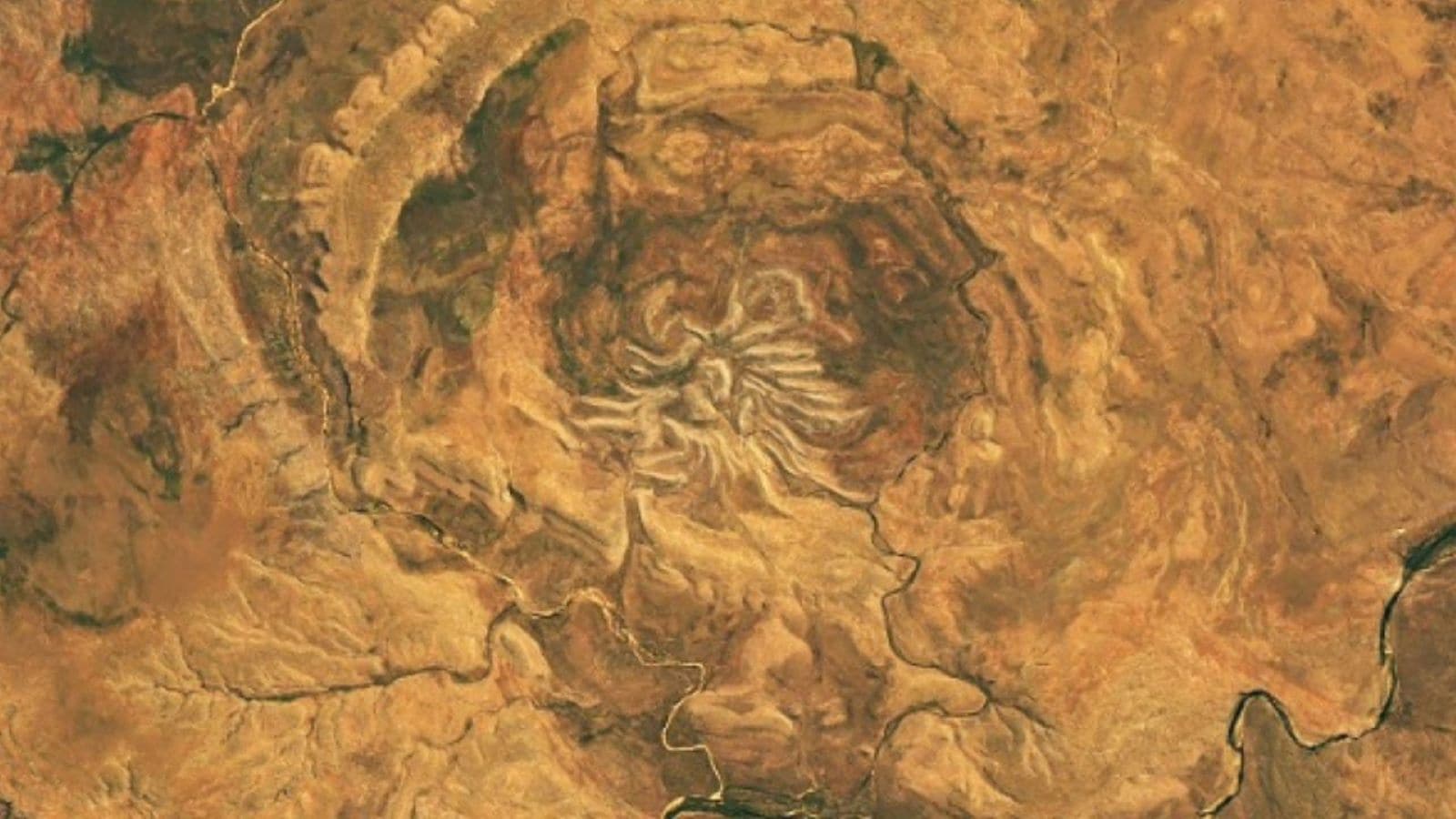
Every few months, the internet loses its collective mind over a satellite photo of a scar on Earth's crust that supposedly resembles an arachnid, a monster, or an alien artifact. This week, the hype machine is feasting on a supposed giant spider structure carved into the Australian outback, captured from orbit by NASA instruments. The headline writers drool. The social media algorithms amplify. Millions of people stare at a two-dimensional JPEG and whisper about pareidolia and cosmic coincidences.
It is completely missing the point. Don't forget to check out our recent article on this related article.
I have spent two decades analyzing remote sensing data, looking at the raw telemetry pouring down from orbital platforms, and watching pop-science outlets turn complex planetary mechanics into cheap science fiction. We treat Earth and its celestial neighbors like art galleries filled with spooky coincidences. We look for faces on Mars, hearts on Pluto, and spiders in Western Australia. Meanwhile, we completely ignore the brutal, unyielding physics writing the history of our planet in blood and stone.
The lazy consensus in the mainstream coverage of these impact structures is that they are cool tourist attractions for your Twitter feed, rare anomalies plucked from the cosmic void. That is dead wrong. These scars are not anomalies. They are the baseline operating system of our solar system. Earth is not a static rock that occasionally gets grazed; it is a survivor of a perpetual artillery barrage. To read more about the background of this, MIT Technology Review provides an informative summary.
Let us dismantle the mythology right now.
The Lazy Myth of the Cosmic Arachnid
Look past the sensationalist aerial photography. The feature in question is a heavily eroded impact structure, weathered down by millions of years of wind, rain, and tectonic shuffling. The web-like patterns radiating from the center? They are not legs spun by some celestial arachnid. They are structural fracturing, fault lines, and shock-wave reflections frozen in mineral composition.
When a multi-ton asteroid strikes the crust at twenty kilometers per second, it does not leave a neat little dent like a pebble in mud. It detonates with the kinetic energy of thousands of thermonuclear warheads instantaneously. The rock doesn't just break; it behaves like a liquid for a fraction of a second. It splashes upward, rebounds in the center, and sends massive shock rings rippling outward.
When people call it a spider, they are domesticating a cataclysm. They are taking an event that could vaporize a major metropolitan area in a heartbeat and turning it into a cute roadside attraction for an afternoon news cycle.
I’ve seen junior researchers burn months trying to categorize superficial visual patterns in satellite imagery while ignoring the subterranean gravity anomalies hidden right beneath them. We get distracted by what the dirt looks like from four hundred miles up, and we completely miss what the physics proves happened underneath.
The Physics They Refuse to Explain
Let’s talk about how these structures actually form, without the sci-fi gloss.
When an impactor hits, three distinct stages occur: contact and compression, excavation, and modification. The mainstream articles love the excavation stage because that is where you get the dramatic crater bowl. But the real story—the part that actually matters for understanding planetary defense and crustal evolution—happens during the modification stage.
The transient cavity collapses under its own weight. The hot, shocked bedrock slumps inward. Central uplifts push miles of deep crustal material right up to the surface. That is where your so-called spider legs come from. They are structural grabens and radial fractures created when the crushed Earth rebounds and settles.
[Incoming Impact] ---> [Instantaneous Vaporization] ---> [Transient Cavity] ---> [Gravitational Collapse & Radial Fracturing]
If you look at the gravity data for these Australian sites, you don't see a spider. You see a circular gravity low surrounded by high-density ring structures where dense mantle material was thrust upward or fractured rocks reduced the bulk density of the upper crust.
Geophysicists map these variations using gravimeters and magnetic resonance imaging from space. They don't look at pretty RGB color composites and say, "Hey, that looks like a bug." They look at micro-milligal drops in local gravity and calculate projectile mass, entry angle, and kinetic yield.
Stop asking if it looks like something from a horror movie. Start asking what the ejecta blanket tells us about the bombardment rate during the late heavy bombardment period.
The Real Danger We Are Ignoring
Here is the uncomfortable truth that science communicators bury under cute headlines: Australia is a goldmine for ancient impacts precisely because it is an ancient, stable craton. While other parts of the world get constantly resurfaced by active plate tectonics, subduction zones, and aggressive mountain-building events, the Australian shield just sits there, preserving the scars of deep time like a geological diary.
And that diary is trying to tell us something urgent.
We look at a crater like this and think it’s ancient history—something that happened hundreds of millions of years ago, long before humans walked the earth, let alone built civilization. We view it with cozy detachment.
That detachment is lethal.
The impact rate over geological timescales is remarkably constant. Statistically speaking, the universe does not care about our quarterly earnings reports, our political elections, or our latest tech IPOs. A kinetic impactor large enough to devastate a continent does not need an invitation. It arrives unannounced, traveling at speeds that render our current early-warning detection timelines terrifyingly narrow.
When NASA points its satellites at these ancient scars, the mission is not to find internet-friendly shapes for morning broadcast segments. The mission is to calibrate our planetary defense models, refine our impact physics equations, and figure out how to deflect the next visitor before it turns our modern cities into tomorrow's tourist attractions for whatever species evolves after us.
The Counter-Intuitive Reality of Planetary Defense
Most people assume that if we spot a dangerous asteroid, we will just launch a massive nuclear payload to blow it to smithereens, exactly like the movies.
That is cinematic nonsense.
If you shatter a massive asteroid on a collision course with Earth without altering its momentum vector, you don't save the planet. You just turn a single catastrophic bullet into a shotgun blast of radioactive debris that rains down across the entire globe, wiping out the atmosphere's chemistry and ending life just as effectively.
Real planetary defense relies on subtle, agonizingly early trajectory nudges. It requires kinetic impactors—like the DART mission proved possible—hitting a target years or decades before an intersection point, altering its orbital velocity by mere millimeters per second. Over millions of miles, that tiny nudge means the asteroid misses Earth entirely and sails harmlessly off into the dark.
No explosions. No giant lasers. Just cold, calculating orbital mechanics applied early enough to matter.
Dismantling the Cosmic Spectacle
We need to grow up as a tech-literate, space-faring civilization. We need to stop treating the cosmos like a novelty shop that spits out funny shapes for our amusement.
The universe is a chaotic, high-energy laboratory where physics operates without mercy or sentimentality. That scar in the Australian outback is not a spider. It is a monument to our vulnerability, etched into the oldest stone on Earth.
Next time you see a headline about a satellite spotting an animal or a face or a spooky shape in the dirt, remember what is actually happening beneath the pixels.
The Earth is covered in bruises. Some are old. Some are waiting.
Stop looking at the pictures for the aesthetic. Look at them for the warning.