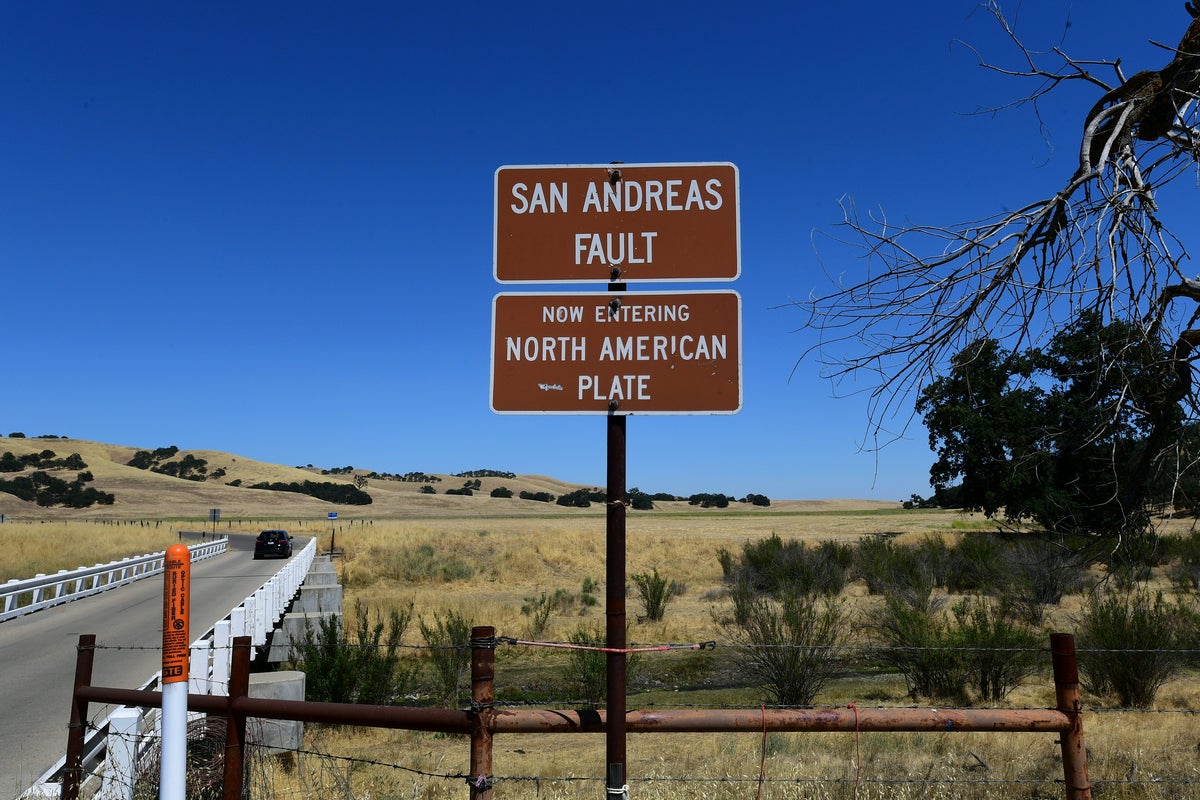
Every time a seismologist updates a statistical model, the media converts it into an apocalyptic countdown clock. The latest freak-out over Southern California’s San Andreas Fault allegedly reaching its "highest stress level in 1,000 years" is the perfect example. It feeds a lazy consensus that the earth operates like an old kitchen timer, ticking away predictably until it hits zero and drops Los Angeles into the ocean.
This panic is based on a fundamental misunderstanding of earthquake mechanics. The premise that a fault line builds stress linearly until it pops is a neat fiction we teach to middle schoolers. Real-world geophysics is messy, chaotic, and non-linear. The constant fixation on a single, looming monster fault blinds us to the real, immediate dangers right under our feet.
Stop checking the seismic hazard maps for the San Andreas. You are looking at the wrong threat.
The Flawed Logic of the Seismic Clock
The common narrative relies on the elastic rebound theory. The idea is simple: tectonic plates move at a constant rate, the fault gets stuck, stress builds up, and when it exceeds the rock strength, it snaps. Since the southern section of the San Andreas hasn't seen a massive rupture since the 1857 Fort Tejon earthquake, the media assumes it is overstuffed with tectonic energy, practically bursting at the seams.
This assumes the San Andreas exists in a vacuum. It does not.
The plate boundary in Southern California is not a clean, single line. It is a broad, complex network of dozens of interlocking faults known as the San Andreas Fault System. Imagine a massive, tangled web of rusty springs. When you pull on one spring, it doesn't just store energy until it breaks; it creeps, it deforms, and it transfers that load to twenty other springs nearby.
When researchers claim stress is at a millennial high, they are calculating a theoretical deficit based on plate tectonic speeds. They cannot actually drop a stress gauge ten miles into the brittle crust to read the absolute pressure. It is a mathematical estimate. In reality, the crust relaxes. It undergoes deep, quiet aseismic creep—fault movement that happens slowly and silently without triggering a single seismograph.
I have watched public policy officials sink millions of dollars into reinforcing infrastructure specifically along the San Andreas corridor, while entirely ignoring the blind thrust faults running directly underneath our densest urban centers. We are armoring our front door while leaving the basement windows wide open.
The Real Threat Is Closer Than You Think
If you want to know what actually destroys a city, look at the history books, not the sensationalized modeling papers. The San Andreas is a strike-slip fault. The plates slide past each other horizontally. It sits miles away from the urban core of Los Angeles, safely tucked into the mountains and the desert. While a magnitude 7.8 on the San Andreas will shake the entire basin violently, it is not the most destructive scenario available.
The real danger comes from blind thrust faults like the Puente Hills thrust or the Compton fault. These do not show up on the surface. They sit directly beneath the concrete skyscrapers, the highway interchanges, and the residential neighborhoods of the LA basin.
Consider the mechanics:
- San Andreas Fault: Located 30 to 50 miles away from downtown LA. The seismic waves have to travel through miles of solid rock, losing energy and high-frequency punch before they ever hit a building foundation.
- Puente Hills Thrust: Sits directly under downtown LA, extending into Orange County. A rupture here pushes the ground upward violently. The seismic energy goes straight up into the foundations of buildings with zero distance to attenuate.
When the Northridge earthquake struck in 1994, it wasn't on the San Andreas. It was an unrecognized blind thrust fault in the San Fernando Valley. It was a moderate magnitude 6.7, yet it caused over twenty billion dollars in damage. A magnitude 7.5 on the Puente Hills fault would rip through the heart of the city, potentially causing ten times the economic damage of a San Andreas event, despite releasing a fraction of the total energy.
By hyper-focusing on the "highest stress in 1,000 years" clickbait, we allow the public to believe that if they do not live right next to the San Andreas line, they are safe. It is a dangerous illusion.
Dismantling the "People Also Ask" Myths
The public framing around seismic risk is broken. Let’s correct the record on the questions people actually ask when these articles drop.
Can we predict when the Big One will happen?
No. Anyone claiming they can predict an earthquake based on stress accumulation or tidal forces is selling snake oil. Earthquakes are a critical-state phenomenon. The crust is constantly primed at a state of near-failure. A major rupture can be triggered by a microscopic shift in a tiny patch of rock, or that same shift can result in a harmless magnitude 1.0. There is no measurable difference in the crust right before a massive quake versus a minor tremor. Prediction is a pipe dream; early warning systems that give you a few seconds of notice after the rupture has already started are the best technology will ever offer.
Will California sink into the ocean?
This is Hollywood nonsense. The San Andreas is a horizontal slip boundary. Los Angeles is moving northwest toward San Francisco at about the speed your fingernails grow. In a few million years, LA will be a suburb of San Francisco. It is not tipping into the Pacific.
Does earthquake weather exist?
Absolutely not. Earthquakes originate miles below the surface where the ambient temperature and atmospheric pressure are completely insulated from whether it is hot, rainy, or windy outside. The earth does not care about the weather.
The Cost of the Wrong Strategy
Admitting that the San Andreas isn't our only problem has a distinct downside. It makes mitigation much harder and vastly more expensive.
If the San Andreas is the lone boogeyman, the solution is simple: retrofitting the specific aqueducts, gas lines, and power grids that cross that specific mountain pass. But when you accept the contrarian reality—that the entire Southern California crust is a fractured matrix of hidden faults—you realize that every single square mile of the urban landscape is vulnerable.
Our current building codes are designed around life safety, meaning the building is allowed to be completely ruined during a quake as long as it doesn't collapse on your head while you run out. That is a low bar. It means after a major local event, thousands of buildings will be red-tagged and completely uninhabitable. The city will survive the shaking, but it will die in the economic aftermath as businesses flee and housing stock evaporates.
Instead of tracking theoretical stress metrics on a distant fault line, we need to shift our focus to structural resilience across the entire basin.
- Stop looking at the calendar waiting for a 1,000-year event.
- Mandate non-ductile concrete retrofits for every commercial structure, regardless of proximity to the main fault lines.
- Upgrade municipal water systems to use flexible, earthquake-resistant pipes that can handle ground deformation from any direction.
The stress metric is a distraction designed to secure research grants and generate clicks. Tectonics do not care about our round numbers or our thousand-year milestones. The crust will break when and where it breaks.
Secure your bookshelves. Boltdown your water heaters. Stop reading the stress gauges and start looking at your foundations.