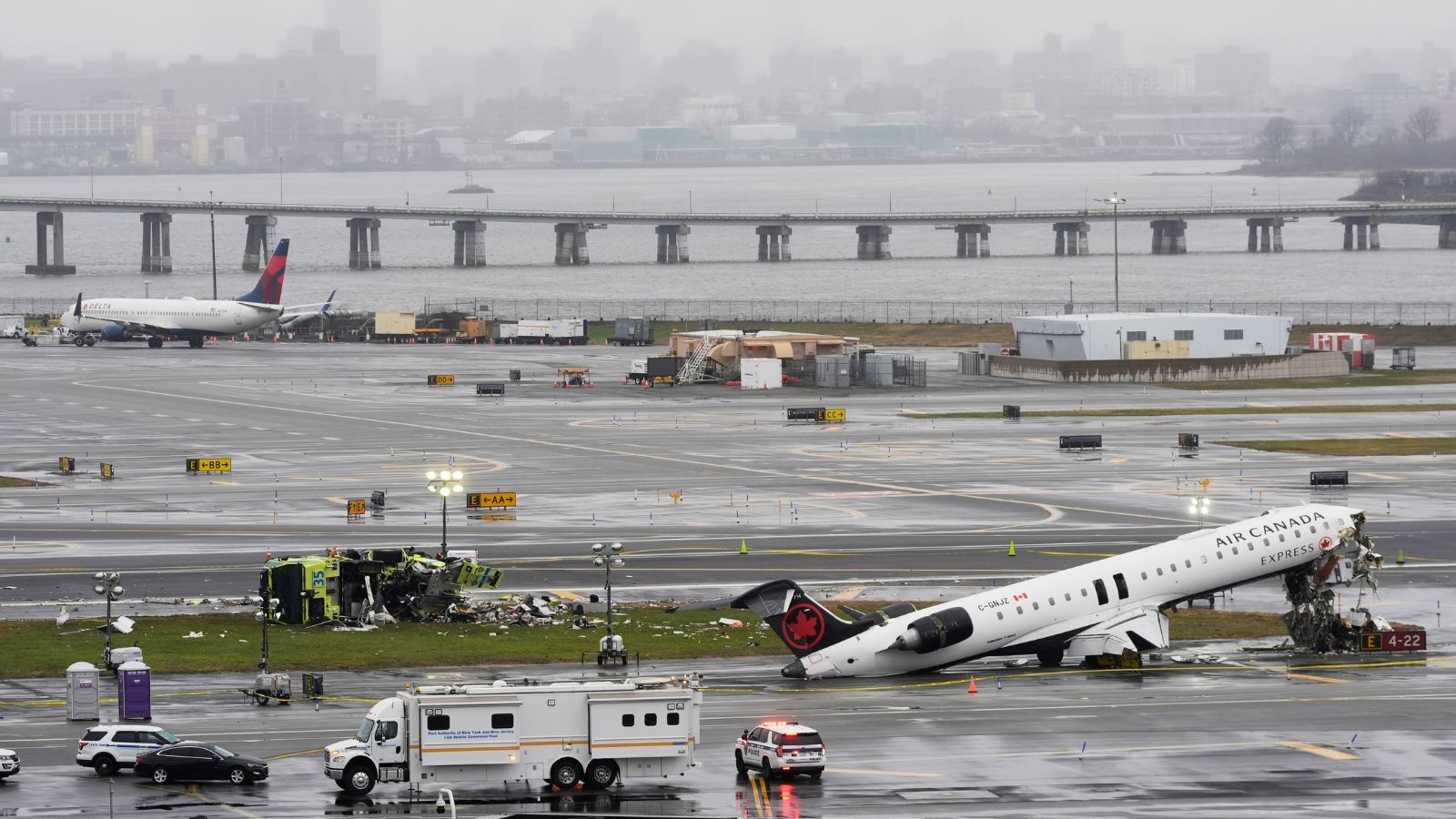
The news cycle loves a "collision" at LaGuardia. They want the shaky iPhone footage, the gasping passengers, and the slow-motion replay of a wingtip clipping a stabilizer. It makes for great clicks and even better evening news filler. But if you actually understand the physics of aviation and the archaic plumbing of American infrastructure, you know that the "horror" at LGA isn't the contact—it’s the fact that we still act surprised when it happens.
Mainstream media treats a tarmac clip like a near-death experience. It isn't. It’s a fender bender at five miles per hour involving machines designed to withstand bird strikes at $250$ knots and turbulence that would snap a skyscraper. The real scandal isn't the "moment of impact." The real scandal is the $100$ billion aviation ecosystem relying on human eyeballs and radio chatter to move multi-ton metal in a space designed for 1950s traffic levels.
The Myth of the Near-Miss
Every time two planes touch, the "People Also Ask" section of Google fills with queries like: How dangerous is a wingtip collision? The honest, brutal answer? For the passengers, it’s about as dangerous as a shopping cart hitting your bumper in a Costco parking lot. You aren't going to explode. The fuel tanks are nowhere near the extremities being clipped in these low-speed taxi maneuvers.
When a jet’s wingtip scrapes another, the primary casualty is the airline's quarterly earnings report and the pilot’s ego. The drama you see in the headlines is a projection of a general fear of flying, not a reflection of actual risk. We focus on these "accidents" because they are visible. They happen on the ground where we can film them. We ignore the systemic rot that causes them because explaining gate-flow bottlenecks doesn't sell ads.
Why LaGuardia is a Mathematical Certainty for Chaos
LaGuardia is not an airport; it is a Tetris game played with pieces that cost $100$ million each, managed by people who are overworked and tech that belongs in a museum.
If you’ve spent a decade in the industry, you’ve seen the "battle scars" of LGA. I’ve watched dispatchers try to squeeze wide-body movements into corridors that barely accommodate a regional jet. The geometry simply doesn’t work. The airport occupies about $680$ acres. For context, Denver International occupies $33,000$. Yet LGA handles over $30$ million passengers a year.
The "lazy consensus" says these collisions are the result of "pilot error." That is a convenient lie. If you put a Formula 1 car in a crowded school zone and tell the driver to go $40$ mph, eventually, a mirror is getting ripped off. It’s a failure of Environment, not Execution.
The Physics of the "Clip"
Let’s talk about wing flex and ground resonance. An aircraft wing is not a static piece of metal. It is a living, breathing cantilever. Depending on the fuel load, the tips can move significantly.
In a standard taxi environment:
- Total Span $(\sigma)$: The distance between wingtips.
- Safety Buffer $(\beta)$: The regulated distance between taxiway centerlines and obstacles.
At LaGuardia, $\beta$ is often a rounding error. When you factor in the heat-induced shimmer of the asphalt and the psychological fatigue of a pilot who has been sitting in a "penalty box" for two hours waiting for a gate, the margin for error evaporates. We are asking pilots to perform precision surgery with a sledgehammer.
The Ground Control Mafia and the Tech Gap
We have the technology to prevent every single ground collision tomorrow. It’s called ADS-B (Automatic Dependent Surveillance-Broadcast) combined with automated ground-collision avoidance systems (G-CAS).
So why aren't we using it to its full potential? Because the "Ground Control Mafia"—the entrenched interests in legacy air traffic control and airline operations—refuses to cede control to automated slot management.
They will tell you that "human intuition" is necessary for the complex dance of a busy ramp. That’s nonsense. A computer doesn't get "gate fever." A computer doesn't get distracted by a flight attendant asking about the manifest. A computer knows exactly where every wingtip is within three centimeters.
We are currently spending billions on "modernizing" airports by adding fancy iPads in the terminals and overpriced sushi bars. It’s a cosmetic fix for a structural hemorrhage. We should be spending that money on digitized tarmac grids that would make human "lookouts" obsolete.
Your Outrage is Misdirected
You’re asking: Is it safe to fly out of cramped airports?
You should be asking: Why am I paying a "security fee" and "facility charge" on every ticket if the airport hasn't updated its ground movement logic since the Nixon administration?
The "collision" isn't the problem. The delay is the problem. The inefficiency is the problem. The fact that your $300$ ticket includes a $20%$ chance of sitting on a taxiway for an hour because two planes are playing "chicken" for a gate is the real theft.
Stop watching the "moment of impact" videos. They are a distraction. They allow the FAA and the airlines to point at a single pilot or a single tug operator and say, "He messed up," rather than admitting the entire system is a congested, crumbling mess that functions only by the grace of luck and the occasional scrape of paint.
The Industry Secret: We Like the Drama
Airlines secretly love the "collision" narrative because it’s an "Act of God" or a "Safety Incident" that allows them to cancel flights without paying out the same compensation they would for a mechanical failure or a scheduling blunder. It’s the ultimate get-out-of-jail-free card.
If a flight is cancelled because the airline didn't staff enough pilots, they owe you. If a flight is cancelled because a wingtip got "clipped" on the taxiway, it's a "safety-first" protocol that gets them off the hook for your missed connection and your ruined vacation.
I’ve sat in the boardrooms where we look at "ground incidents" not as failures of safety, but as statistical externalities. We know the number of scrapes that will happen per $100,000$ movements. It’s baked into the insurance premiums. Your terror is their line item.
How to Actually Navigate This
If you want to avoid the LGA "bump," stop booking the last flight of the day. The "bottleneck effect" is cumulative. By $6:00$ PM, the tarmac at LaGuardia is a pressure cooker.
- Book the first bank of flights. The tarmac is clear. The controllers are fresh. The geometry hasn't been compromised by "creative parking" yet.
- Fly into Newark or JFK. Yes, they have their own problems, but they have the one thing LGA lacks: Space.
- Stop looking out the window for "danger." You won't see it coming. Look at the flight path on your screen. If you see your plane doing circles on the ground for $45$ minutes, that's when you should start complaining—not when you feel a slight jolt.
The obsession with "the moment of collision" is the hallmark of an amateur traveler. It’s the equivalent of worrying about a shark attack while you're drowning in two inches of water. The system is failing you long before the metal touches.
Next time you see a "breaking news" alert about a wingtip clip, turn off the TV. Go look at your ticket price. Look at the age of the terminal. Realize that you are being sold a narrative of "accidental tragedy" to cover up a reality of "profitable negligence."
The collision isn't an accident. It's the inevitable result of an industry that prizes "throughput" over infrastructure and "optics" over automation.
Demand a digital tarmac, or shut up about the scratches.