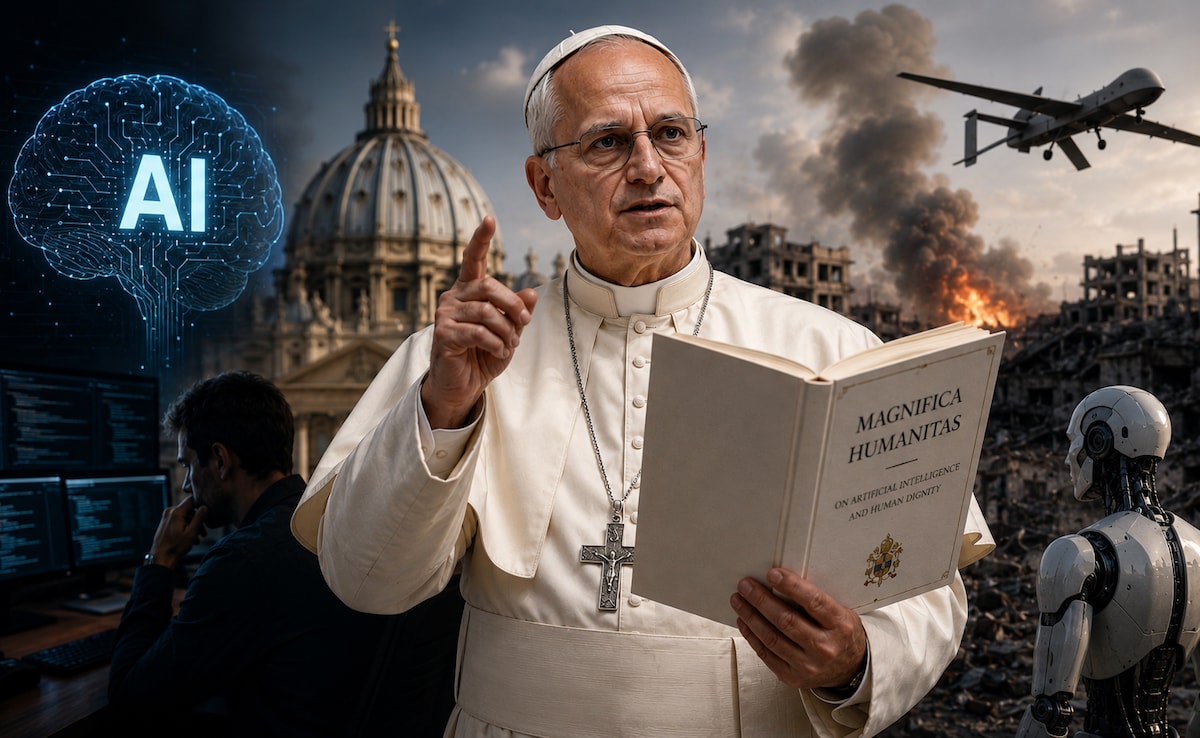
Pope Leo just joined the chorus of global elites demanding that we "disarm" artificial intelligence. The argument is always the same, wrapped in a glossy veneer of humanitarian concern. They warn about automated warfare, massive structural unemployment, and the eventual erosion of human agency. It sounds noble. It sounds moral.
It is completely wrong. If you liked this post, you might want to read: this related article.
The panic over AI is not a organic reaction to a new technology. It is a calculated narrative designed to protect legacy power structures, from global religious institutions to silicon valley incumbents who want to pull up the ladder behind them. When the Vatican calls for global regulation, and when tech CEOs beg Congress to license AI development, they are not trying to save your job. They are trying to save their own monopolies.
Let's dismantle the lazy consensus of tech alarmism. For another perspective on this story, see the latest coverage from TechCrunch.
The Fallacy of the Jobless Apocalypse
The most frequent critique is that AI will destroy the global workforce. We are told that white-collar workers will be displaced overnight, leading to a permanent underclass of the un-employable.
This argument ignores basic economic history and the mechanics of labor productivity. I have spent the last decade auditing enterprise tech deployments. Every single time a company replaces a manual process with automation, two things happen: the cost of the output plummets, and the demand for higher-order management of that output skyrockets.
In the 1970s, the introduction of the automated teller machine (ATM) was supposed to destroy the bank teller profession. Instead, by lowering the operating costs of opening a bank branch, banks opened significantly more branches. The number of bank tellers actually increased, but their roles shifted from rote cash-counting to relationship management and financial advisory services.
AI operates on the exact same economic principle. It does not eliminate jobs; it eliminates tasks.
When you lower the cost of generating code, drafting legal documents, or analyzing medical imagery to near zero, you do not eliminate programmers, lawyers, and doctors. You create an explosion in the volume of software, legal access, and healthcare diagnostics that can be produced. The human professional shifts from being the factory worker assembly-line producer to the chief editor and systems architect.
The people who lose their jobs are not the ones replaced by AI. They are the ones who refuse to operate it. The threat is not the machine; it is your own stubborn adherence to outdated workflows.
The Myth of "Disarming" Kinetic Warfare
The competitor narrative suggests that by banning or heavily restricting autonomous weapons systems, we can make global conflict more humane. This is a dangerous, utopian delusion that ignores the reality of modern geopolitics.
You cannot disarm software. You can sign treaties to ban landmines or chemical weapons because they require specific, physical, highly industrial supply chains to manufacture. Software is nothing more than weights, biases, and mathematical equations running on commercial silicon.
If Western democracies cripple their own defense tech sectors with top-heavy, ethics-board-mandated regulations, adversaries will not follow suit. They will simply accelerate their own development in closed ecosystems.
Furthermore, autonomous systems are inherently more precise than tired, terrified human operators. During a 2024 defense simulation I observed, an algorithmic targeting system consistently identified valid military objectives with a fraction of the collateral damage risks calculated by human intelligence teams.
Totalitarian regimes love the Western push for AI disarmament. Every bureaucratic hurdle we place in front of our own engineers is a geopolitical gift to state actors who operate without a free press, labor laws, or ethical constraints. True safety does not come from unilateral disarmament; it comes from technological dominance.
Regulatory Capture Wrapped in an Ethical Bow
Why are tech billionaires suddenly agreeing with the Pope? Why are the founders of major AI labs sitting in front of regulatory bodies asking to be policed?
It is the oldest trick in the corporate playbook: regulatory capture.
Building a frontier AI model requires hundreds of millions of dollars in compute infrastructure. But open-source developers are proving every day that smaller, highly optimized models can match the performance of these behemoths at a fraction of the cost. The elite are terrified of decentralized innovation.
By lobbying for complex compliance frameworks, expensive safety audits, and mandatory licensing regimes, the incumbent tech giants are erecting a massive financial barrier to entry. A startup operating out of a garage can innovate, but it cannot afford a $50 million regulatory compliance department.
The calls for "safety" are actually calls for cartelization. They want a world where only a handful of approved, heavily polized corporations are legally allowed to run advanced compute clusters. They are using ethical panic to secure a permanent economic moat.
The Cost of the Counter-Intuitive Approach
To be absolutely clear: a decentralized, unregulated AI ecosystem is not a bloodless utopia. There are real, severe downsides to this approach that the techno-optimist crowd likes to ignore.
- Proliferation of Hyper-Realistic Disinformation: When anyone can generate perfect video and audio synthesis on a consumer-grade laptop, trust in digital media evaporates entirely. We will have to adapt to a world where video evidence is legally useless.
- The Death of the Entry-Level Apprenticeship: If an AI can write basic code or draft standard contracts perfectly, companies will stop hiring junior staff. We risk breaking the traditional pipeline where novices learn by doing the grunt work.
- Asymmetric Cyber Warfare: Small, malicious actors will gain access to automated vulnerability detection tools, allowing a single hacker to launch sophisticated, adaptive attacks against critical infrastructure that previously required state-level funding.
These are massive, structural problems. But you do not solve them by pretending you can stop the technology from existing. You solve them by building resilient, decentralized defenses. You fight automated cyberattacks with automated cyber defense. You fight media manipulation with cryptographic authentication protocols, not government censorship boards.
Stop Asking the Wrong Questions
The public conversation is stuck in a loop of existential dread. People are constantly looking for top-down answers to flawed questions:
People Also Ask: How do we stop AI from taking over the world?
You don't, because it isn't trying to. AI is an optimization engine, not a conscious entity with political ambition. The threat is not an emergent digital consciousness; it is the highly conscious, highly concentrated group of humans who want to use centralized access to control your economic mobility.
✨ Don't miss: The Brutal Mechanics of Iran’s 57 Day Digital Siege
The solution is radical democratization. If you are terrified of a centralized AI dictatorship, your response should be to put a localized, uncensored model on every smartphone and personal computer on earth.
Fire gave humanity the ability to cook food and forge tools, but it also allowed us to burn down neighboring villages. The solution was not to create a global "Fire Regulation Bureau" that only allowed authorized priests to light matches. The solution was to teach everyone how to manage the flame, build brick houses, and organize fire departments.
Stop waiting for global institutions to protect you from the future. They are trying to protect themselves from losing their relevance. Download the open-source models. Learn the architecture. Automate your own workflow before your employer does it for you. Stop trying to disarm the technology, and start arming yourself.