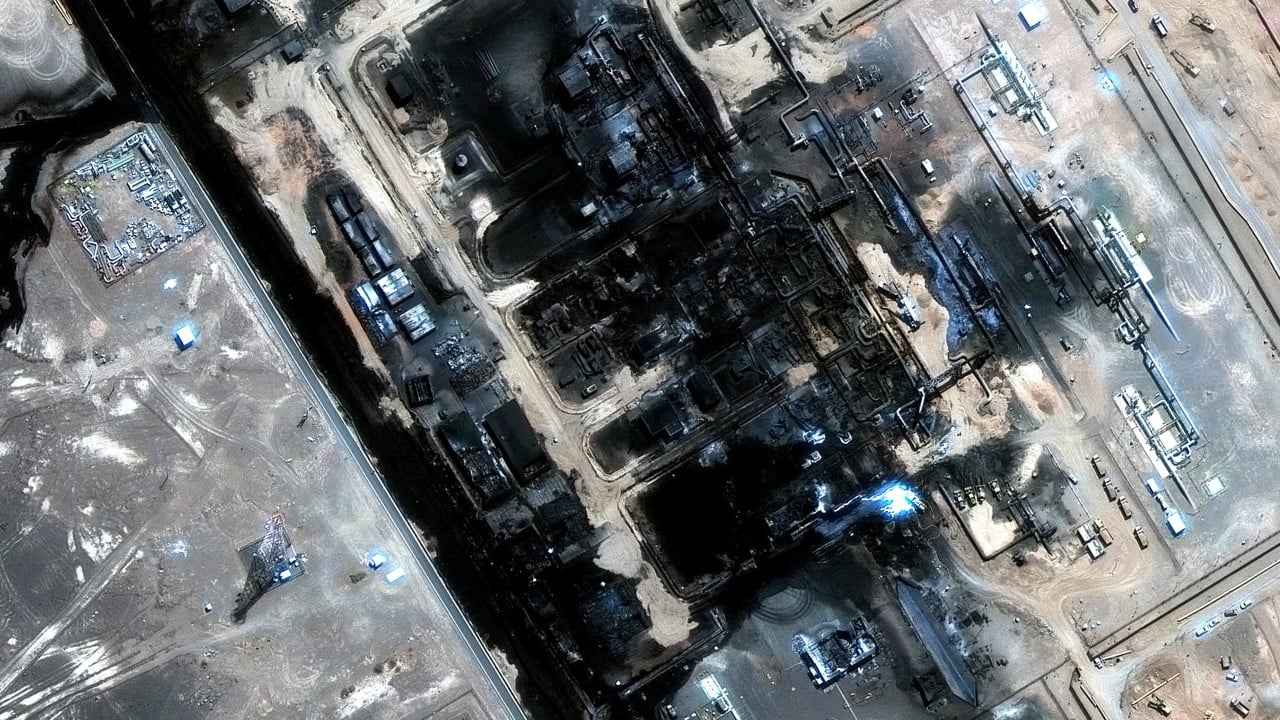
Every time a headline gasps about a Saudi oil pipeline closure, financial media anchors instantly hyperventilate over Asia's supposed economic fragility. Analysts roll out tired maps of maritime choke points, drawing red arrows across the Red Sea and the Persian Gulf, predicting sudden industrial apocalypse in Tokyo, Seoul, and Beijing. It is lazy, sensationalist journalism designed to juice oil futures and terrify retail investors who do not understand how modern energy plumbing actually functions.
I have spent years watching energy desks panic over every routine maintenance hiccup or geopolitical whisper in the Arabian Peninsula. The consensus narrative is simple, comforting, and completely wrong. It assumes Asian economies are fragile, static consumers sitting at the end of a single fragile straw, entirely dependent on Middle Eastern crude running through fixed concrete arteries.
That world died a decade ago.
The Architectural Fallacy of Single-Point Failure
Let us dismantle the primary delusion: the idea that a single pipeline shutdown in Saudi Arabia paralyzes Asian industrial output.
The East-West Pipeline, or Petroline, spans the Kingdom from Abqaiq to Yanbu, shifting millions of barrels daily away from the Strait of Hormuz to Red Sea ports. When analysts write breathless warnings about its closure, they treat oil as if it were water in a municipal utility pipe. They imagine a closed valve means factories instantly go dark from Yokohama to Shenzhen.
This ignores how global crude markets actually clear. Oil is not a static utility; it is a fungible, hyper-liquid commodity traded across a massive, multi-nodal matrix of supply channels.
If a pipeline incident halts Saudi shipments out of Yanbu, the global tanker market does not freeze. It recalibrates in minutes. Refiners in South Korea, Japan, India, and China do not sit around waiting for tanks to run dry. They tap into an immense, diversified global buffet of crudes that includes surging West Texas Intermediate exports, Brazilian pre-salt fields, West African sweet grades, and heavily discounted Russian Sokol and ESPO blends. Modern processing units are marvels of chemical engineering; crude distillation units can handle shifting assay slates with minor operational tweaks, shifting from heavy sour Middle Eastern grades to lighter sweet crudes with astonishing velocity.
The panic is manufactured by traders who profit from volatility, not structural analysts who understand supply elasticity and logistics substitution.
The Metric Everyone Misunderstands
The second foundational error in the mainstream narrative is the obsession with barrel-to-GDP ratios. Commentators look at Asia's rising energy imports and assume economic output is locked in a direct, unyielding chokehold with every drop of imported petroleum.
This is an outdated economic model. Asia's manufacturing powerhouses have spent the last fifteen years decoupling industrial expansion from primary oil consumption efficiency.
Take China, India, or South Korea. Their heavy industrial sectors have aggressively electrified, pivoted toward liquefied natural gas, expanded nuclear baseloads, and optimized petrochemical integration to squeeze vastly more economic value out of every barrel. When crude prices spike due to speculative headline-surfing about pipeline closures, the immediate reaction is not a sudden halt to factory production lines. It is a rapid margin squeeze absorbed by integrated refiners, followed by swift adjustments in product export quotas and domestic inventory drawdowns.
Asian economies are not brittle porcelain plates; they are hardened industrial engines with thick shock absorbers. Strategic petroleum reserves held by Beijing, Tokyo, and New Delhi dwarf historical disruption estimates. China's state-backed stockpiles alone represent a multi-hundred-million-barrel shock absorber that can bleed into the domestic refining system for months without a single new drop entering a port. India maintains equivalent emergency buffers designed explicitly to insulate its refining hub in Gujarat from sudden maritime or pipeline choke points.
When commentators warn that a pipeline outage puts economic resilience to the test, they are testing a system that has already passed this stress test multiple times over the past decade through silent, adaptive inventory management.
The Shadow Fleet and the Death of Choke Points
Imagine a scenario where geopolitical friction completely seals off traditional Middle Eastern maritime and pipeline transit lanes simultaneously. It sounds like an oil trader's wet dream of absolute catastrophe.
Even under this extreme stress test, Asia's energy security network has evolved past traditional vulnerabilities. The emergence of the global shadow fleet and opaque, non-Western trading architectures means that physical cargo can move independently of traditional Western insurance, flag states, and corporate disclosures.
When Western sanctions or regional conflicts disrupt conventional shipping lanes, the market does not stop moving. It goes underground, reorganizes, and finds alternative clearing houses. Russian Urals, Iranian heavy, and Venezuelan grades move freely across Asian waters aboard aging tankers that western intelligence agencies can barely track.
While compliance officers in New York clutch their pearls, refiners in independent Chinese refining hubs process these barrels with ruthless efficiency. The physical flow of hydrocarbons is far more resilient, fragmented, and chaotic than any bureaucratic pipeline map suggests. A pipeline closure merely forces barrels to find a different ticket, altering transit math by a few cents per barrel while leaving the ultimate destination untouched.
Why the Wrong Question Prevails
The real problem with the mainstream discourse is not just bad data; it is a fundamentally flawed question.
Analysts keep asking: "How will Asian countries survive a sudden cutoff of Saudi crude supplies?"
That is the wrong question entirely. The right question is: "Why do we continue to treat localized physical disruptions as systemic existential threats when the global refining matrix has engineered infinite redundancy?"
By framing the issue around a single supplier's infrastructure, commentators obscure the profound democratization of global energy. The era when a single regional pipeline could hold the Asian manufacturing miracle hostage ended when shale fracking turned the United States into a net energy exporter, when Latin American offshore production surged, and when Asian refiners built units capable of switching crude slates on a dime.
To claim that a Saudi pipeline closure tests Asian resilience is to fundamentally misunderstand how modern supply chains self-heal. These supply chains are decentralized, adaptive, and fueled by massive financial and logistical redundancy.
The Inconvenient Truth About My Own Argument
Every contrarian stance requires a moment of brutal honesty. If my argument is that pipeline closures are essentially background noise, why do oil prices still spike violently every time a pipe gets threatened?
Because financial markets trade on perception long before they trade on physical reality.
The vulnerability is not physical; it is psychological and financial. Algorithmic trading desks, derivative positions, and speculative hedge funds react to the word "pipeline" the way Pavlov's dogs reacted to the bell. The short-term price shock at the pump is very real, driven entirely by paper barrels traded on the ICE and NYMEX exchanges.
Refiners pay higher spot prices for a few weeks, inflation metrics twitch, and central bankers sweat. That is the actual damage. It is a financial tax imposed by market sentiment, not a physical deprivation of energy that starves Asian factories of diesel and gasoline.
Conflating a temporary paper-market price spasm with a structural threat to economic resilience is either intellectually lazy or deliberately misleading.
Stop looking at the maps of desert pipelines. Stop treating Asian industrial might as a fragile house of cards built on Saudi infrastructure. The machinery of global commerce has evolved past the point where a single bomb, valve failure, or regional dispute can break it.
The resilience was tested. It won. Move on.