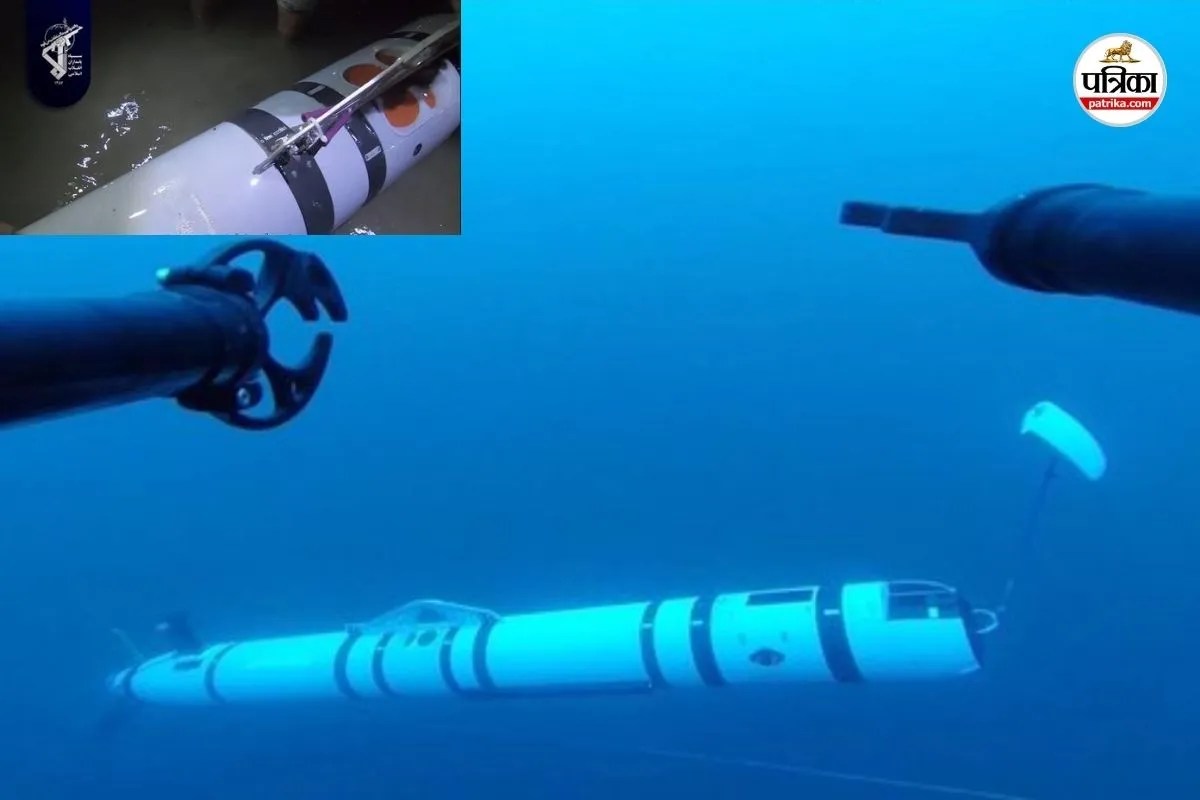
When Iran's Islamic Revolutionary Guard Corps intercepted a United States uncrewed underwater vehicle in the volatile waters of the Strait of Hormuz, it was not merely a maritime scuffle. It exposed the fragile underbelly of modern naval robotics operating in contested geopolitical chokepoints. These autonomous systems designed to gather oceanographic and tactical intelligence are increasingly becoming high-value trophies in a shadow war played out beneath the surface.
The incident is deceptively simple on the surface. A surface vessel operated by the IRGC spots an unattended metallic cylinder drifting or station-keeping in international yet sensitive waters, hoists it aboard, and broadcasts the capture across state media. Washington issues sharp statements about unlawful seizure and international maritime law. Naval analysts shrug. Yet this routine dynamic masks a profound transformation in how great powers project influence without triggering open kinetic conflict.
The Strait of Hormuz is the world's most critical energy choke point. Roughly a fifth of global petroleum consumption passes through its narrow shipping lanes daily. Beneath this heavy commercial traffic lies a dense acoustic and oceanographic environment. Temperature gradients, salinity layers, and bathymetric profiles dictate how submarines hide, how sonar waves bend, and how torpedoes track their targets. Controlling this data is equivalent to possessing an altitude map in aerial combat.
Uncrewed underwater vehicles act as the silent cartographers of this domain. Unlike airborne drones that stream high-definition video back to command centers thousands of miles away, underwater systems often operate in radio silence. They crawl along predetermined waypoints or drift passively with currents, recording acoustic signatures of passing warships, mapping underwater ridges, and measuring water column density. They are blind sensors gathering raw observations. When one falls into adversary hands, the loss extends far beyond the hardware cost of a fiberglass hull and commercial-off-the-shelf sensors.
The Architectural Flaws of Autonomous Reconnaissance
Deploying uncrewed assets in hostile waters introduces a severe strategic paradox. To be useful, they must operate close to adversary shores. To remain economical, they are built using accessible commercial components rather than hardened, classified military architecture. This compromise creates acute vulnerabilities.
A Saildrone Explorer or similar surface-and-subsurface drone relies on commercial satellite links for low-bandwidth status updates and GPS for navigation. Its acoustic sensors and oceanographic profiling instruments are sophisticated, but the security wrapping around its data storage is often optimized for operational convenience rather than anti-tamper resilience.
When IRGC personnel pull an oceanographic drone from the water, they do not just capture a floating buoy. They gain physical access to onboard data loggers, circuit boards, and calibration profiles. Iranian military engineers can examine the exact frequency bands monitored by the hydrophones. They can determine the sensitivity thresholds of the optical and acoustic gear. Most critically, they can reconstruct recent operational tracks, revealing which submarine transit routes or surface patrol patterns the United States Navy prioritizes in the Persian Gulf.
This is reverse engineering at its most intimate. Military technology does not always leap forward through brilliant breakthroughs; sometimes it advances simply because an adversary left a sensor package floating in a bathtub where anyone with a crane could fish it out.
International Law and the Gray Zone Sandbox
The legal framework governing uncrewed maritime systems is a mess of outdated nineteenth-century treaties and ambiguous modern interpretations. Under the United Nations Convention on the Law of the Sea, warships and government ships enjoy sovereign immunity. But does sovereign immunity extend to an uncrewed, un-manned fiberglass cylinder bobbing in the water without an active military escort within visual range?
Washington argues that these drones are naval units protected under international law, making their seizure an act of theft or unlawful interference with freedom of navigation. Tehran counters with a starkly different interpretation. From the perspective of the IRGC, any foreign uncrewed device operating within Iran's traditional sphere of influence or close to its territorial waters constitutes unauthorized surveillance and a direct threat to national security.
This legal vacuum is the exact playground for gray-zone conflict. Gray-zone tactics occupy the murky space between peace and war. They are designed to push boundaries just far enough to cause strategic annoyance and intelligence leakage, but not far enough to justify a retaliatory missile strike.
Capturing a drone is a low-risk, high-reward maneuver for Tehran. It signals domestic resilience to a domestic audience. It demonstrates operational reach to regional rivals. It forces the United States Navy into an awkward diplomatic posture where Washington must choose between escalating a crisis over a piece of uncrewed hardware or absorbing the loss quietly.
The Acoustic Battlefield of the Persian Gulf
To understand why these underwater drones matter so much, one must look at the physical reality of the Persian Gulf. It is a shallow, warm, and hyper-saline body of water. Acoustic propagation here is notoriously complex. Sound channels refract unpredictably, and background noise from commercial tankers, shrimp boats, and drilling rigs creates an absolute cacophony.
For a nuclear-powered submarine operating from outside the region, navigating the Gulf is a high-risk endeavor. The water is too shallow for traditional deep-water evasion tactics. Every propeller turn bounces off the muddy seabed and the sun-baked surface.
This is where uncrewed systems change the math. By deploying a constellation of small, persistent oceanographic drones, a navy can build a dynamic, real-time map of the acoustic environment. They measure how sound travels across specific basins at specific hours of the day. They record the unique acoustic signatures of local patrol craft.
When Iran captures a drone, it captures a piece of that acoustic map. More importantly, it signals to the United States that the underwater domain is not a sanctuary of invisible omniscience. The sensor network has blind spots, and those blind spots are policed by fast boats equipped with grappling hooks.
Operational Security in the Age of Cheap Sensors
The incident forces a reckoning within defense procurement circles. For years, the Pentagon has pushed toward a future dominated by attritable, low-cost autonomous systems. The logic is compelling. If a drone costs fifty thousand dollars instead of fifty million, losing one to rough seas or adversary capture is an operational rounding error rather than a congressional scandal.
Yet cost is only one metric of value. When an inexpensive drone carries sensors that have been fine-tuned over years of classified research, the economic cost of the hardware ceases to be the primary metric of concern. The intellectual property and tactical visibility embedded in the silicon and software dwarf the price of the hull.
Military planners now face an uncomfortable choice. They can continue deploying vulnerable uncrewed systems to gather vital data in contested chokepoints, accepting that a certain percentage will be harvested by adversaries. Or they can invest heavily in self-destruct mechanisms, heavy encryption, and zero-trust anti-tamper architectures that drive up the unit cost, defeating the original purpose of cheap, disposable autonomy.
There is no clean engineering fix for this dilemma. Physics and geopolitics are stubborn collaborators. As long as navies rely on physical instruments to sample the physical world, those instruments remain vulnerable to physical interception.
The Broader Message Across the Waves
The public theater of drone seizures in Hormuz is ultimately about deterrence and narrative control. Every time the IRGC parades a captured American underwater vehicle on state television, it sends a message that the waters of the Middle East are not an open laboratory for Western technology.
At the same time, the United States Navy continues its operations, recognizing that intelligence collection is an incremental game of accumulation rather than a series of decisive battles. Drones will continue to be deployed. Some will be intercepted. Data will be analyzed, reverse-engineered, patched, and redeployed in a continuous technological loop.
The underwater domain remains largely hidden from public view, governed by silent pressures and unseen acoustics. Yet the surface tensions above continue to dictate how nations fight for mastery over the dark water below, turning every drifting cylinder into a diplomatic proxy and a test of resolve in a crowded sea.