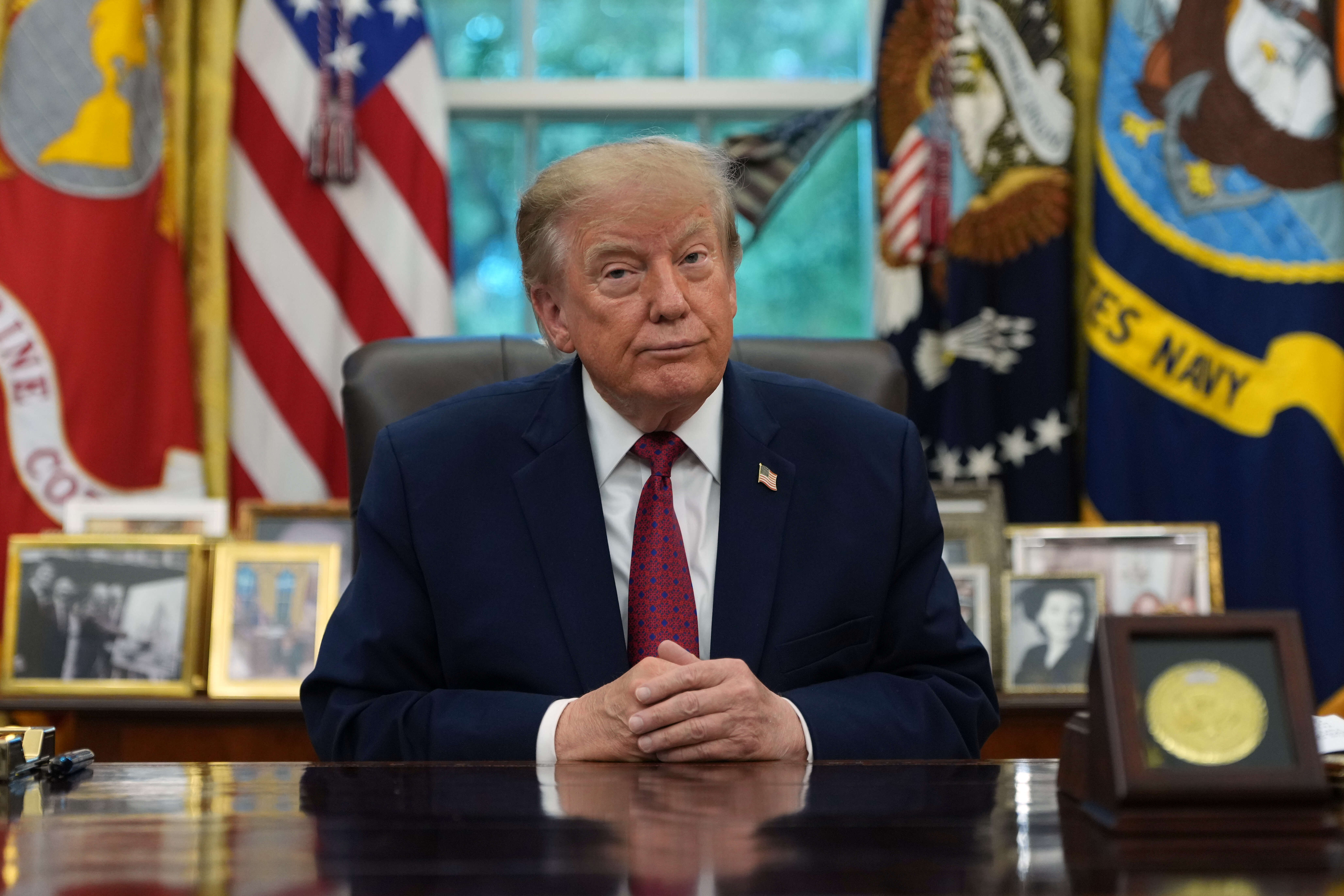
When Donald Trump tells reporters that adversaries will "know soon enough" whether the United States intends to destroy the remaining infrastructure of Iran, he is deploying a calculated doctrine of strategic ambiguity designed to force diplomatic concessions without committing American ground troops to a protracted war.
Most cable news pundits treat these off-the-cuff remarks as impulsive saber-rattling. They miss the underlying architecture. Having covered defense policy and Middle Eastern brinkmanship for thirty years, I have seen this exact playbook executed from the Situation Room to the press briefing podium. The phrasing is deliberate. By refusing to define what "destroying the rest of Iran" actually entails—whether it means decapitating the Islamic Revolutionary Guard Corps, obliterating energy export terminals at Kharg Island, or neutralizing hardened nuclear facilities—the White House forces Tehran’s military planners to prepare for every conceivable worst-case scenario simultaneously.
Uncertainty is an asymmetric weapon. When a conventional military superpower refuses to draw a clear red line, the weaker adversary cannot calculate the exact threshold of provocation. Tehran is left guessing which proxy strike, maritime seizure, or uranium enrichment milestone will trigger an overwhelming kinetic response.
The Mechanics of Escalation Dominance
To understand why this rhetoric carries weight in Tehran, you have to look at escalation dominance. In military theory, escalation dominance is the ability to increase the scope or intensity of a conflict in ways the adversary cannot match, thereby compelling them to back down.
The United States possesses an overwhelming conventional advantage in air and naval power. Stealth bombers, carrier strike groups, and precision-guided munitions allow Washington to threaten high-value targets inside Iranian borders with minimal risk to American personnel. When Trump hints at total destruction, he is reminding the Iranian leadership that their air defense networks cannot stop a coordinated campaign targeting their economic lifelines.
Consider a hypothetical example to see how this pressure operates inside a command bunker. Suppose Iranian commanders are weighing a retaliatory missile barrage against a regional base. If Washington states clearly that such a strike will result in the destruction of three specific radar sites, Tehran can absorb that cost, factor it into their budget, and proceed with the attack to save face domestically. However, if the American president simply says "you'll know soon enough" and implies the entire state apparatus is on the chopping block, the risk calculation breaks down. The potential cost becomes infinite. Rational actors, even ideologically driven ones, hesitate when survival of the regime itself is placed on the table.
Why Economic Chokepoints Matter More Than Bunker Busters
Media coverage overwhelmingly fixates on underground nuclear enrichment sites like Fordow and Natanz. Those facilities are heavily fortified beneath mountains of rock, requiring specialized ordnance like the Massive Ordnance Penetrator to damage. Yet military planners know that you do not need to collapse a mountain to bring a nation to its knees.
The real vulnerability of the Islamic Republic lies above ground, exposed to the open sky along the Persian Gulf.
- Oil Export Terminals: Roughly ninety percent of Iran’s crude oil exports pass through Kharg Island. A single night of precision strikes on pumping stations, loading jetties, and storage tanks would sever the regime's primary source of hard currency within hours.
- Refining Capacity: Despite sitting on massive oil reserves, Iran has historically struggled with domestic gasoline refining. Knocking out key refineries paralyzes internal transportation, sparks immediate fuel shortages, and ignites domestic unrest among a population already battered by inflation and currency devaluation.
- Electrical Grids and Port Infrastructure: Modern warfare targets the connective tissue of an economy. Disabling major power plants and container ports like Bandar Abbas halts commerce, disrupts water desalination, and forces the government to divert military resources toward internal policing.
When Trump speaks of destroying the rest of the country, defense analysts do not picture carpet bombing cities. They picture the systematic dismantling of the economic infrastructure that keeps the regime solvent. Without oil revenue, Tehran cannot pay the salaries of the Basij militia, fund Hezbollah in Lebanon, or supply weapons to the Houthis in Yemen. The external network collapses when the internal bank account hits zero.
The Historical Precedent of Madman Theory
This rhetorical style is not an invention of the modern era. It is a direct descendant of Richard Nixon’s Madman Theory, a Cold War strategy devised to convince North Vietnam and the Soviet Union that the American president was volatile enough to use disproportionate force if pushed.
Nixon explicitly instructed his chief of staff, H.R. Haldeman, to let the North Vietnamese believe he had reached a point where he might do anything to stop the war. The goal was to make unpredictability an asset. If adversaries believe the leader in the Oval Office is unconstrained by traditional diplomatic norms, bureaucratic caution, or international consensus, they become far more cautious about testing his resolve.
Trump has modernized this approach for the twenty-four-hour news cycle. Where Nixon used backchannel whispers and secret nuclear alerts, Trump uses unscripted press gaggles, social media posts, and offhand remarks on the tarmac. The delivery mechanism has changed, but the psychological objective remains identical. It shifts the burden of restraint onto the adversary.
The Gray Areas and Blind Spots of Brinkmanship
Coercive diplomacy carries severe structural risks, and pretending otherwise ignores decades of intelligence failures. The primary flaw in relying on ambiguous threats is the assumption that the adversary interprets the signal the way you intend.
In Tehran, decision-making is fractured among competing power centers, including the Supreme Leader’s office, the regular military, and the ideological hardliners within the Revolutionary Guard. What Washington intends as a deterrent warning can easily be misread by factions in Tehran as proof that an American attack is already inevitable. If hardliners conclude that war cannot be avoided regardless of their restraint, the logical military move is to strike first while their missile launchers are still intact.
Furthermore, threatening total destruction backs the Iranian leadership into a corner where capitulation looks like political suicide. Authoritarian regimes survive on the projection of strength. If accepting American terms means total humiliation in front of their domestic base and regional proxies, leaders often choose a destructive conflict over peaceful surrender.
There is also the problem of credibility erosion. Every time a leader issues an apocalyptic warning without following through after a minor provocation, the deterrent value of the language decays. Adversaries begin to test the boundaries with low-level cyberattacks, maritime harassment, or indirect proxy fire, betting that the threat of total destruction is a bluff designed for domestic political consumption rather than an operational war plan.
What Happens When the Rhetoric Meets Reality
If the diplomatic standoff deteriorates into open conflict, the consequences extend far beyond the borders of Iran. The Strait of Hormuz, a narrow waterway between Oman and Iran, serves as the transit route for roughly a fifth of the world’s petroleum liquids consumption.
Even a degraded Iranian military retains asymmetric capabilities capable of disrupting global commerce. Fast-attack craft, naval mines, coastal anti-ship cruise missiles, and swarms of low-cost drones do not require air superiority to make commercial shipping uninsurable. If tankers stop moving through the Gulf, global energy prices spike overnight, triggering inflationary shocks across Europe, Asia, and North America.
Regional allies also find themselves caught in the crossfire. Gulf Arab states hosting American military bases have spent years quietly hedging their bets, opening diplomatic channels with Tehran precisely because they know their own desalination plants and oil fields are within easy range of Iranian ballistic missiles. They recognize that in a full-scale exchange, Washington can project power from thousands of miles away, while Riyadh, Abu Dhabi, and Doha sit directly in the blast radius.
The phrase "you'll know soon enough" hangs over the region because it leaves every stakeholder suspended in a state of operational readiness. Aircraft carriers remain on station, air defense batteries stay at high alert, and diplomats scramble through backchannels in Muscat and Doha to find an off-ramp before a tactical miscalculation turns a war of words into an irreversible regional conflagration.