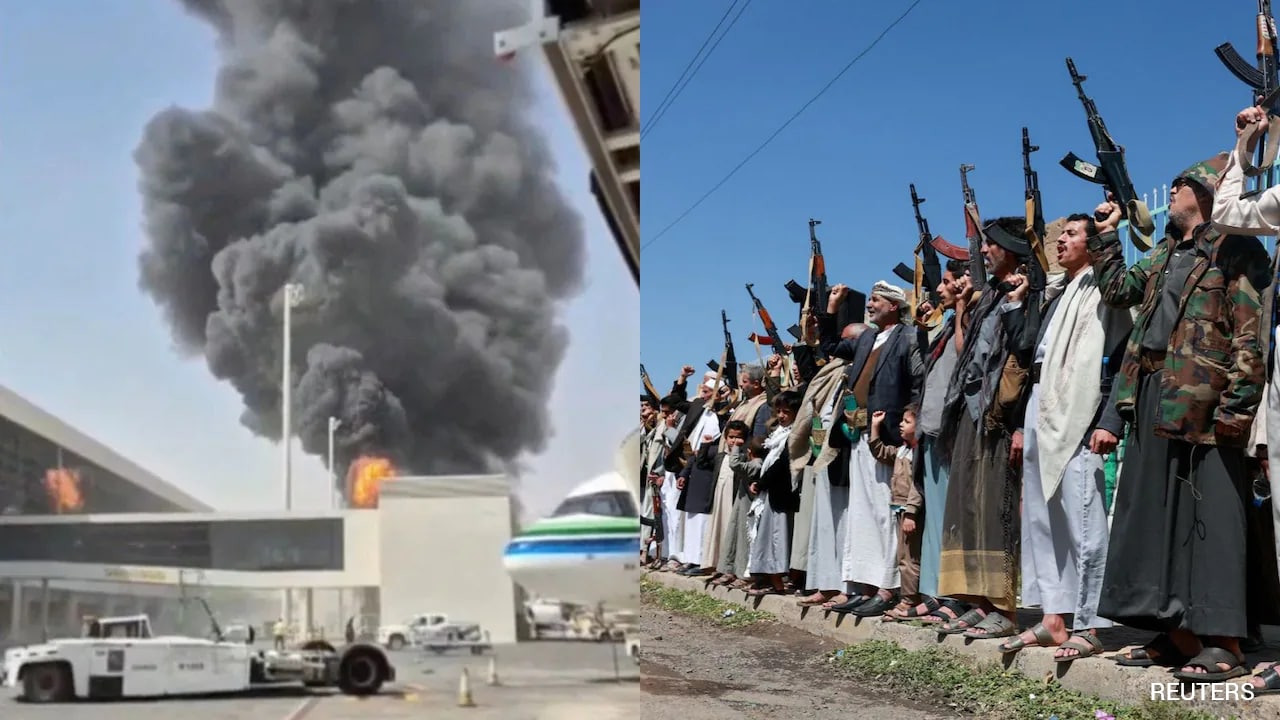
Geopolitical conflict is frequently evaluated through the emotional lens of rhetoric or the immediate shock of kinetic events. However, military engagements between state and non-state actors operating within asymmetrical power distributions are fundamentally matters of resource allocation, logistical constraint, and infrastructure vulnerability. When analyzing mutual aerial strikes targeting aviation facilities between regional powers and persistent insurgent forces, superficial reporting often reduces the friction to mutual retaliation. A rigorous, data-driven framework reveals a distinct logic of economic friction, supply chain strangulation, and deterrence signaling.
The Economic Cost Function of Aviation Infrastructure
Airports are not merely military targets or transport hubs; they are complex, capital-intensive nodes that concentrate economic activity, sovereign prestige, and logistics capability. When a military strategy targets an adversary's civil or dual-use aviation infrastructure, the objective is rarely immediate tactical annihilation. Rather, it is the manipulation of the target's operational cost function.
Dual-use facilities—airports servicing both commercial passenger traffic and military logistics—present a specific vulnerability profile. They require vast, open perimeters, continuous fuel storage depots, and specialized maintenance facilities that cannot easily be hardened without incurring prohibitive financial and logistical penalties.
The economic disruption operates through three distinct vectors:
- Capital Replacement Costs: Repairing radar installations, runway surfaces, and terminal architecture demands capital expenditure that strains fiscal reserves, particularly in conflict-weakened economies.
- Insurance and Risk Premiums: The mere threat of kinetic strikes exponentially increases hull insurance rates and risk surcharges for commercial carriers operating within the airspace, effectively imposing an economic blockade without the deployment of naval assets.
- Logistical Bottlenecks: Restricting the flow of high-value goods, technical components, and human capital degrades the administrative capacity of the state or governing authority to manage the broader theater of operations.
By shifting the focus from personnel attrition to infrastructure degradation, the attacking actor forces the defender to spend disproportionate resources on point defense systems, which are mathematically more expensive to operate and maintain than the offensive vectors deployed against them.
Asymmetrical Means and Strategic Symmetry
A central analytical error in evaluating cross-border kinetic exchanges is the assumption of symmetry. When a state actor with a conventional air force exchanges strikes with a non-state actor utilizing long-range unmanned aerial vehicles and cruise missiles, the nominal equivalence of the targets masks a profound divergence in cost-per-effect ratios.
Traditional air campaigns rely on multi-million-dollar platforms, highly trained personnel, and complex maintenance supply chains. Conversely, distributed drone campaigns leverage commercial-off-the-shelf components, decentralized launch architectures, and low unit costs. This creates a severe economic asymmetry:
$$\text{Asymmetry Ratio} = \frac{\text{Cost of Defensive Interception}}{\text{Cost of Offensive Delivery}}$$
When the cost of intercepting a low-cost aerial threat via surface-to-air missiles vastly exceeds the manufacturing cost of the incoming platform, the defender is locked into a financially unsustainable attrition loop. Over time, this forces a rational reallocation of defensive assets, leaving secondary and tertiary infrastructure nodes exposed.
The strategy of the non-state actor is therefore designed not to achieve air superiority—an impossibility against a technologically superior conventional military—but to impose continuous economic and psychological friction until the political cost of continuation exceeds the strategic value of the campaign.
The Deterrence Trap and Escalation Dominance
In protracted conflicts involving regional powers and entrenched regional networks, the escalation ladder is constrained by the doctrine of deterrence. Both parties operate under the calculation of escalation dominance—the ability to increase the intensity of the conflict in a manner that favors one's own strategic objectives while compelling the adversary to back down.
However, when mutual targeting settles into a predictable cadence of strikes and counter-strikes, a deterrence trap emerges:
- The Credibility Dilemma: If a state actor absorbs strikes against sovereign infrastructure without a disproportionate response, its deterrent posture degrades, inviting further probing attacks.
- The Overextension Risk: Conversely, an escalatory response that widens the geographic scope of the conflict risks drawing in international maritime partners, economic sanctions, or direct regional destabilization that undermines long-term national development goals.
The structural resolution to this trap requires decoupling military response from political signaling. Rather than engaging in tit-for-tat exchanges of kinetic strikes against equivalent infrastructure, long-term stabilization depends on altering the underlying economic dependencies and securing air defense architectures through multi-layered, cost-effective counter-UAS technologies.
Strategic Forecast and Operational Adjustment
The trajectory of aviation infrastructure vulnerability in asymmetrical conflicts is dictated by the democratization of precision strike technology. As long-range loitering munitions and guidance systems become more accessible, the vulnerability quotient of centralized civilian and military airports will continue to rise.
Future operational stability will not be achieved through tactical defense alone, but through architectural decentralization. States and regional authorities must transition away from reliance on massive, centralized international hubs toward distributed regional landing networks that disperse economic and logistical risk. Simultaneously, the integration of directed-energy weapons and electronic warfare capabilities will be required to break the unsustainable economic equation of missile defense. The primary variable governing future conflict outcomes is the speed at which defenders can compress the cost curve of neutralization, shifting the burden back to the aggressor.