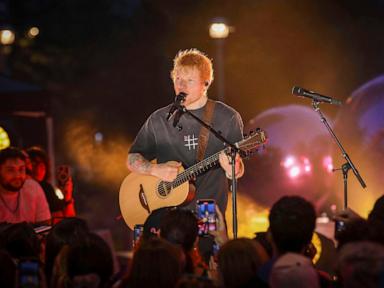
When a massive commercial touring apparatus intersects with geopolitical friction, public relations management shifts from simple media training to risk mitigation engineering. The recent disruption surrounding Ed Sheeran's tour—triggered by the removal of opening act Macklemore—highlights a fundamental vulnerability in modern celebrity brand management: the tight coupling of independent artist ecosystems under a single corporate umbrella. When one node in the touring matrix becomes politically toxic to stakeholders or specific regional markets, the primary act absorbs the collateral damage, forcing a reactive pivot that exposes the limits of centralized tour logistics.
The Cost Function of Brand Association in Global Touring
In contemporary entertainment economics, a supporting act is not merely an artistic choice; it is a calculated variable in an audience acquisition and risk-distribution model. Major stadium tours operate on razor-thin logistical margins where scheduling, venue contracts, and local promoter relationships must align with absolute precision. Introducing an artist with active, high-profile political alignments into this matrix introduces an unhedged volatility factor. You might also find this related story interesting: The Silence Between the Chords.
The mechanics of this risk exposure can be broken down into three distinct financial and operational vectors:
- Promoter Friction: Local promoters hold regional capital at risk. When an opening act triggers boycotts or intense public polarization, promoters face immediate pressure from municipal authorities, venue owners, and corporate sponsors. The cost of friction manifests as security escalations, potential venue cancellations, and fractured local media partnerships.
- Audience Fragmentation: A stadium tour requires a broad, unified demographic baseline to maintain high capacity utilization. While core fans may remain agnostic to political subtext, corporate sponsors and mainstream ticket buyers often react conservatively. An ideological polarization of the opening act acts as a wedge, depressing advance ticket sales in secondary markets.
- The Centrality Penalty: The headliner, having invested equity in the tour's overarching brand, bears asymmetric liability. Ed Sheeran's public acknowledgment of "mistakes" made during the handling of the situation illustrates the governance failure of decentralized alignment. When a supporting artist's external statements or associations clash with the tour's commercial neutrality, the primary asset is forced to step in as chief crisis officer.
The Mechanics of Public Accountability and Strategic Retreat
Celebrity crisis response typically follows a predictable decay curve: initial silence, stakeholder leakage, defensive positioning, and eventual public calibration. In this instance, the pivot from omission to admission requires analyzing how public statements function as damage control instruments. As extensively documented in detailed reports by E! News, the effects are worth noting.
When an artist acknowledges missteps in a high-stakes cultural conflict, they are attempting to lower the temperature of a polarized feedback loop. However, corporate communications in these scenarios frequently trigger a secondary penalty: alienation of the faction that supported the initial inclusion. By addressing the removal of Macklemore and conceding operational miscalculations, the management team attempted to restore operational predictability at the expense of ideological consistency.
This tactical retreat exposes a deeper systemic flaw. Modern touring entities often lack pre-vetted protocols for handling sudden geopolitical flashpoints involving secondary personnel. Contracts are drafted around force majeure, rider compliance, and moral clauses, but they rarely account for the velocity of digital outrage or the nuances of international political positioning. Consequently, decisions are made reactively under duress, leading to public relations friction that reverberates across subsequent tour legs.
Network Vulnerabilities in Distributed Entertainment Models
The modern entertainment ecosystem functions as a distributed network where artists, booking agencies, streaming platforms, and independent management teams are loosely coupled. A failure in one node propagates rapidly through the entire system because public perception treats the touring entity as a monolithic corporation.
Macklemore's explicit advocacy and subsequent exclusion from the tour lineup demonstrate how personal political expression clashes with the institutional risk aversion of global music conglomerates. Stadium tours are capitalized by institutional investors and multinational insurance firms that demand brand safety. When an artist's personal brand deviates from this safety baseline, the system automatically triggers an expulsion mechanism to protect the primary asset's valuation.
The fallout reveals that touring operations must evolve past traditional management frameworks. As public scrutiny intensifies, every variable—from backstage personnel to opening acts—must be audited through a geopolitical risk lens. The era of booking supporting acts purely on sonic synergy or streaming metrics has expired.
Moving forward, the resilience of major live music ventures will depend on the implementation of redundant communication pathways and rigorous vetting processes that anticipate reputational hazards before routing contracts are finalized. Without these structural adjustments, headliners will continue to find themselves managing self-inflicted crises on stage, trading artistic autonomy for corporate risk mitigation.