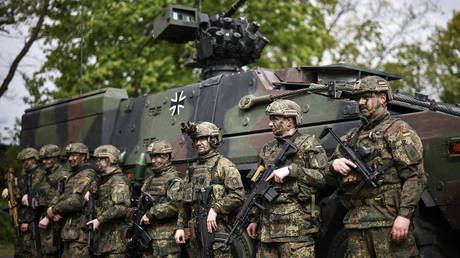
The proclamation of the German Zeitenwende in February 2022 signaled an abrupt departure from decades of strategic restraint. Capital injections totaling a €100 billion special fund, paired with progressive adjustments to baseline defense budgets aiming for structural alignment with NATO thresholds, recast Europe’s economic anchor as an aspiring military heavyweight. Yet, capital availability does not automatically translate to operational output. A rigorous deconstruction of Germany’s defense transformation reveals that the primary impediments are structural, systemic, and bureaucratic rather than purely fiscal. The execution gap between political ambition and military readiness is governed by distinct bottlenecks that threaten to absorb capital without generating proportional deterrence value.
The Capital Allocation and Velocity Mismatch
The core friction in modernizing the Bundeswehr lies in the velocity of capital deployment relative to the inertia of procurement architectures. Historical funding models were optimized for peacetime lifecycle acquisition, characterized by multi-year bureaucratic reviews, redundant validation gates, and low-rate initial production runs designed to minimize public expenditure variance.
When capital injection scales rapidly while administrative processing capacity remains constant, the system encounters severe diminishing marginal returns.
- The Approval Bottleneck: Procurements exceeding €25 million legally mandate specialized parliamentary review by the Bundestag. With hundreds of parallel modernization projects inundating the legislature, administrative processing times create a queue backlog. Capital sits committed on balance sheets while operational units experience persistent materiel deficits.
- The Inflationary Pressure of Compressed Demand: Injecting massive capital into a localized, specialized industrial base without a proportional expansion of supply chain throughput generates structural inflation. Defense primes capture higher margins on legacy platforms rather than aggressively expanding greenfield manufacturing capacity, neutralizing the purchasing power of the special fund.
The Technological Divergence
Modern conflict dynamics, exemplified by high-attrition engagements in Eastern Europe, have inverted traditional military value propositions. The modern battlefield prioritizes software-defined warfare, resilient C4ISR architectures, autonomous attrition-resistant strike systems, and integrated electronic warfare suites. Germany’s industrial ecosystem enters this modernization cycle with profound structural imbalances.
The national defense-industrial base excels in heavy platform engineering—exemplified by advanced main battle tanks, armored personnel carriers, and conventional naval hulls. These systems represent capital-intensive, high-precision manufacturing. However, the procurement apparatus continues to privilege legacy platform acquisition over scalable software integration.
A disproportionate share of capital allocation remains sequestered by traditional prime contractors delivering legacy systems, while acquisition budgets for counter-drone technologies, autonomous reconnaissance assets, and algorithmic fire-control networks lag operational necessity. This creates a dual-speed procurement trap: Germany is modernizing for yesterday's high-intensity industrial warfare while the operational frontier shifts toward distributed, software-driven, low-cost autonomous systems.
The Personnel and Training Deficit
Capital and hardware are secondary variables relative to human capital and organizational absorption capacity. The structural contraction of the Bundeswehr following the Cold War dismantled not only barracks and heavy equipment inventories, but the institutional training infrastructure required to scale force size rapidly.
Reintroducing mass or expanding professional force readiness requires three interdependent inputs that money cannot instantly buy:
- Instructional Capacity: Experienced cadres must be available to train incoming cohorts. When the institutional base has been hollowed out by decades of downsizing, training throughput acts as an absolute ceiling on force expansion.
- Operational Real Estate: Maneuver grounds, live-fire ranges, and simulation infrastructure in Western Europe are heavily constrained by environmental regulations and urban encroachment, limiting the complexity and scale of combined-arms exercises.
- Societal Alignment: Recruitment velocity depends directly on societal perception of military service. Absent conscription or deeply embedded security imperatives, voluntary recruitment metrics struggle to keep pace with the structural demands of a multi-brigade conventional posture.
The Strategic Interdependence Paradox
Germany’s defense transformation occurs within a fragmented European security architecture. While Berlin attempts to foster national industrial champions, it remains reliant on non-European enablers—particularly aerospace and missile defense components sourced from the United States.
True strategic autonomy requires decoupling industrial policy from national protectionism. Domestic procurement preferences that favor national contractors over pan-European consortiums inhibit economies of scale. When individual states prioritize local industrial subsidies over cross-border supply chain integration, the collective deterrent output of the European alliance suffers from interoperability friction and duplicated R&D expenditure.
To convert fiscal expansion into enduring geopolitical stability, structural reforms must bypass symbolic capital milestones. The strategic objective requires an absolute overhaul of the federal procurement code, the elevation of software and autonomous systems to parity with heavy iron platforms, and the systematic integration of Germany's defense base into a functional, cross-border European military-industrial matrix.