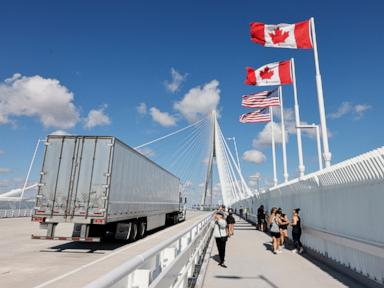
The breakdown of bilateral trade arrangements between the United States and Canada marks the transition from regional integration to managed economic fragmentation. When the United States invoked Section 338 of the Tariff Act of 1930 to impose fifty percent duties on roughly twenty billion dollars of Canadian exports, the mechanism bypassed standard trade agreement dispute channels. In response, Ottawa operationalized counter-tariffs valued at twenty-seven billion dollars across more than seven hundred product categories, utilizing variable rates of fifteen, twenty-five, and fifty percent.
Understanding this dynamic requires analyzing the cost structures of cross-border manufacturing. Modern supply chains do not operate on finished-goods logic; they rely on intermediate inputs crossing borders multiple times. When tariffs target these structural linkages, the friction compounds across every tier of production.
The Asymmetric Exposure Vector
The friction between Washington and Ottawa stems from a fundamental divergence in import composition. The aggregate trade deficit figures frequently cited in political discourse obscure the functional nature of the goods moving across the border.
The primary exposure variables are defined by distinct economic characteristics:
- Input Reliance: Over two-thirds of Canadian exports entering the United States function as intermediate components rather than finished retail items. These inputs feed directly into American automotive assembly, aerospace production, and metal fabrication plants.
- Finished Goods Targeting: Canada's retaliatory surtaxes are deliberately calibrated to hit consumer goods, agricultural equipment, and industrial machinery originating in politically sensitive U.S. districts, particularly targeting states with high electoral volatility.
- Sovereign Resource Interdependence: Critical minerals, energy grids, and primary aluminum remain central to the bargaining matrix, meaning that restrictions on one side create immediate pricing anomalies in downstream domestic markets on the other.
When the U.S. administration applied maximum Section 338 penalties to motor vehicles, dairy, and structural metals, the pricing model for integrated North American manufacturing broke. The policy assumption that duties act as a pure shield for domestic labor ignores the cost penalties inflicted on domestic firms that rely on Canadian steel, aluminum, and specialized sub-components.
The Mechanics of Retaliatory Surtaxes
Canada's response strategy abandoned incremental diplomacy in favor of synchronized matching. By implementing dollar-for-dollar surtaxes on targeted Harmonized System codes, Ottawa shifted the financial burden onto specific nodes within American export supply chains.
The structural cost function of this escalation operates through three distinct vectors:
- Administrative Friction: Every tariff classification change forces firms to audit bills of lading, prove country-of-origin compliance under legacy trade frameworks, and absorb compliance overhead. This administrative drag exists independently of the tariff rate itself.
- Substitution Delays: Industrial buyers cannot instantly switch component suppliers. Foundry tooling, electronic specification standards, and chemical formulations require months or years of validation. A fifty percent tariff acts as an immediate capital tax during this transition window.
- Margin Compression: Downstream distributors face a choice between absorbing the tariff tax to preserve market share or passing the price increase downstream, which triggers demand destruction in consumer markets.
Industries that depend on seamless cross-border logistics are forced to redesign their geographic footprint. Small and medium-sized enterprises, which lack the balance-sheet depth to maintain redundant inventory buffers, absorb the highest operational strain.
Strategic Forecast and Long-Term Market Realignment
The breakdown in institutional trust between Ottawa and Washington signals a permanent baseline shift for North American commerce. Even if temporary administrative pauses occur, corporate planners are no longer pricing future capital expenditures on the assumption of a frictionless border.
Firms are executing structural hedges to isolate themselves from ongoing policy volatility:
- Localization of Tier-Two Suppliers: Manufacturers are accelerating efforts to source raw inputs domestically or from non-U.S. and non-Canadian jurisdictions to decouple from bilateral tariff risks.
- Redistribution of Logistical Flows: Export-oriented entities are re-routing finished goods toward European and Asia-Pacific markets to mitigate exposure to North American trade turbulence.
- Contractual Risk-Shifting: Supply agreements are incorporating dynamic tariff-surcharge clauses, shifting the financial liability of regulatory changes directly onto end-purchasers.
The continuation of this trade friction ensures that redundancy will permanently replace optimization as the primary metric for supply chain design. Efficiency has been subordinated to jurisdictional security, altering the cost structure of North American manufacturing for the foreseeable future.