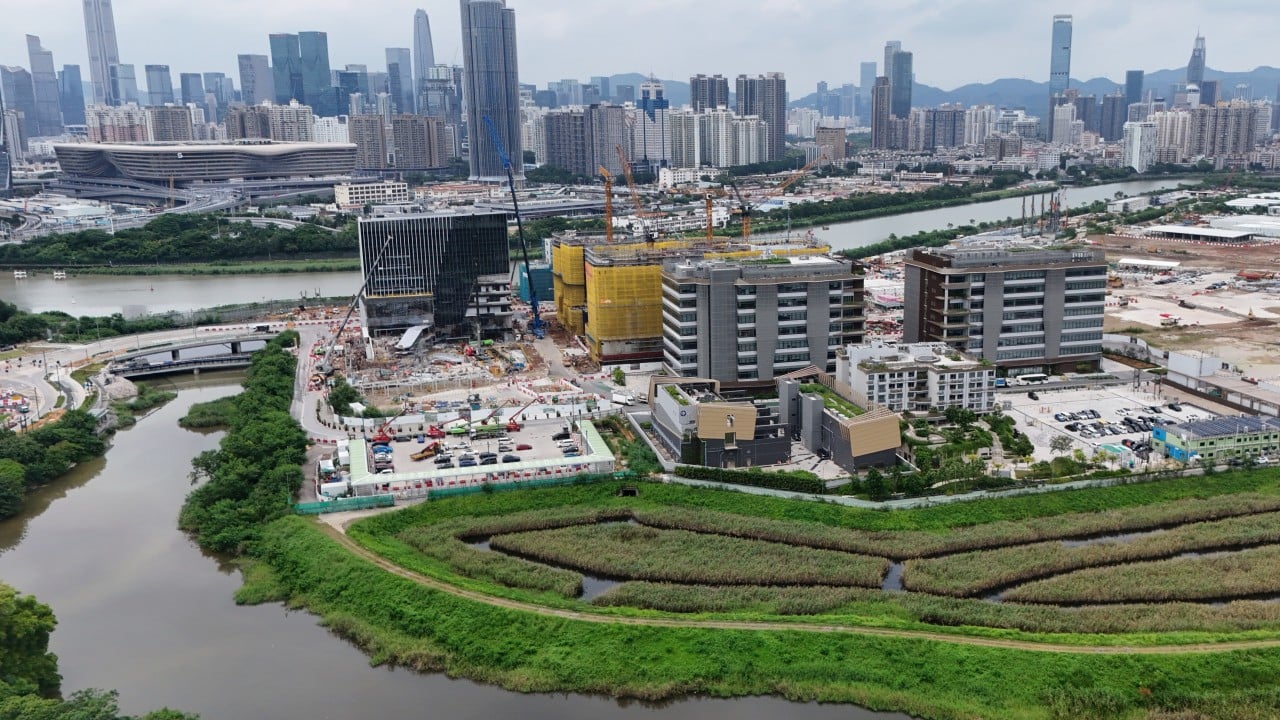
The economic architecture of cross-border industrial zones relies on minimizing friction between capital allocation, real estate supply, and technical infrastructure. Hong Kong's push to transform the Northern Metropolis into an artificial intelligence and microelectronics cluster represents a structural shift from a service-driven economy to an advanced manufacturing and high-performance computing base. Evaluating the commercial bidding dynamics for these flagship technology parcels requires examining the underlying cost functions, capital expenditure commitments, and infrastructural dependencies that dictate private sector participation.
The bidding behavior of artificial intelligence and semiconductor firms is governed by a precise cost-benefit calculation. Industrial land in high-density urban cores cannot support the thermal and spatial loads required by modern server clusters or semiconductor pilot lines. Consequently, the Northern Metropolis project offers large tracts of greenfield and cleared land, specifically structured around a multi-tier spatial layout.
The economic viability of these bids depends on three primary variables:
- Capital Expenditure Thresholds: Bidders must commit massive upfront capital to physical infrastructure before realizing operational revenue. For instance, initial supercomputing data facility developments in the region demand multi-billion-dollar outlays over compressed three-year execution windows.
- Power Density and Grid Capacity: Artificial intelligence model training and advanced microelectronics fabrication require continuous, high-capacity electrical supplies. Bidders price their offers based on the certainty of power delivery and proximity to regional transmission grids.
- Cross-Border Integration Costs: The economic rationale for locating within the Northern Metropolis hinges on frictionless data and personnel flows with Shenzhen. Regulatory alignment directly reduces administrative overhead for cross-border tech operations.
The dual-envelope tender evaluation methodology utilized by authorities—weighting non-premium technical proposals significantly higher than raw financial land premiums—alters traditional real estate economics. Instead of maximizing short-term land revenue, the state optimizes for long-term technological capability and operational velocity. This framework filters out speculative land-bankers, ensuring that only entities with demonstrated operational capacity in data facility management or semiconductor production secure parcels.
The primary bottleneck for bidders is not land acquisition cost, but the temporal misalignment between construction timelines and technology lifecycles. Artificial intelligence hardware and semiconductor fabrication specifications evolve on 18-to-36-month cycles. Real estate development and site formation spanning a decade introduce severe obsolescence risk. Bidders must factor in the cost of retrofitting uncompleted facilities to meet unexpected shifts in thermal cooling requirements, such as the transition from air cooling to direct-to-chip liquid cooling for high-density graphic processing unit clusters.
Infrastructure providers form the foundational layer of this ecosystem. Telecommunications and power utilities must deploy specialized assets—such as low-latency fibre-optic backbones and dedicated high-voltage sub-stations—concurrently with real estate development. If utility deployment lags behind facility completion, the time-to-market for tenant AI firms extends, eroding the anticipated return on investment.
To optimize participation and ensure long-term economic yield, prospective industrial bidders must structure their capital deployment around modular facility designs. Rather than locking into static architectural blueprints, firms should utilize phased fit-outs that allow power and cooling capacities to scale incrementally alongside computational demand, insulating operations from rapid technological depreciation.