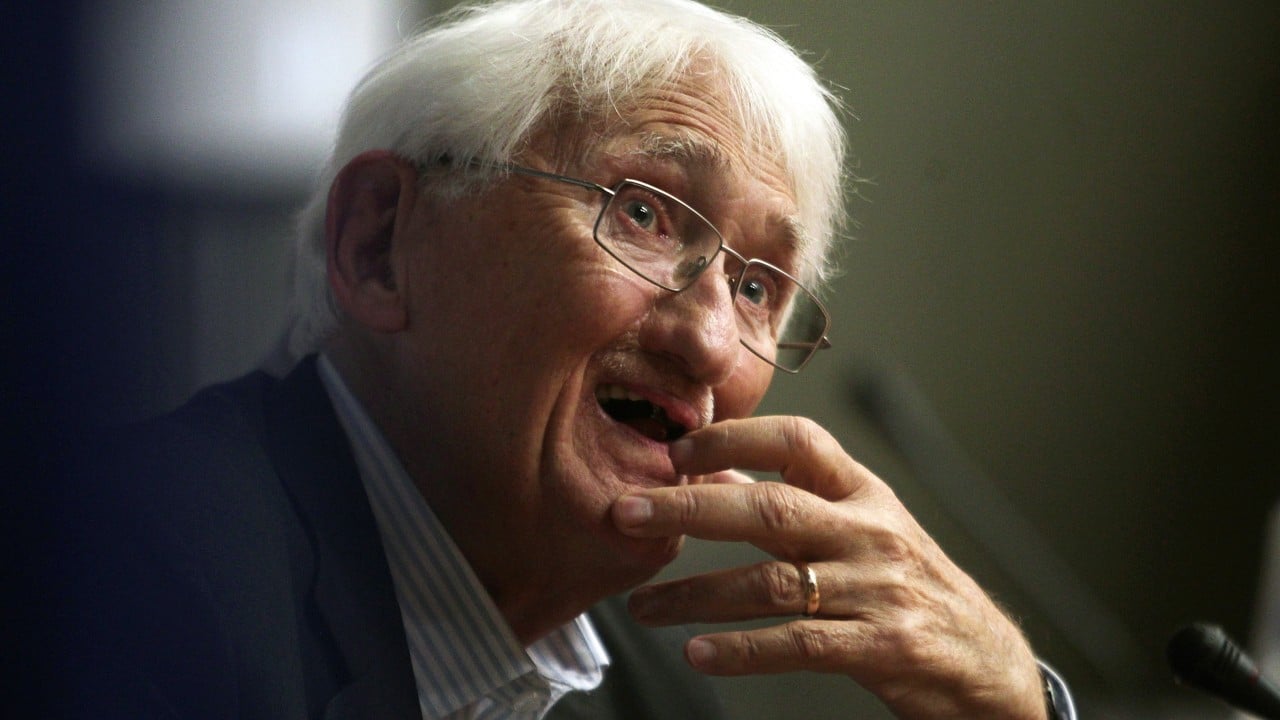
Jurgen Habermas’s death at 96 marks the conclusion of the most significant intellectual project in post-1945 Europe: the systematic reconstruction of German identity through the mechanics of communicative rationality rather than ethnic essentialism. While standard obituaries focus on his longevity or his role as a "public intellectual," a rigorous analysis reveals that Habermas’s true legacy is an operational blueprint for democratic stability in a post-metaphysical world. He provided the logical scaffolding that allowed the Federal Republic of Germany (FRG) to transition from a defeated, traumatized state to the institutional anchor of the European Union.
The Theory of Communicative Action: A Mechanism for Social Cohesion
Habermas’s primary contribution to social science—and the foundation of his political influence—is the shift from the "philosophy of the subject" to the "philosophy of language." He identified that social order is not maintained solely through the "system" (money and power) but through the "lifeworld" (shared meanings and communication).
In this framework, the stability of a democracy depends on the distinction between two types of rationality:
- Instrumental/Strategic Rationality: Action oriented toward success, where actors treat others as obstacles or tools to achieve a specific goal. This governs the market and the administrative state.
- Communicative Rationality: Action oriented toward mutual understanding, where actors seek a consensus based on the "unforced force of the better argument."
Habermas argued that modern crises emerge when the system "colonizes" the lifeworld. When the logic of the market or the state bureaucracy invades spheres of life that should be governed by discussion (such as education, family, and public debate), social alienation and political polarization occur. For Germany, this theory provided a path to re-legitimize the state by ensuring that power was tethered to a transparent, discursive process.
Constitutional Patriotism: Solving the Identity Deficit
The most critical strategic challenge for post-war Germany was the vacuum left by the collapse of nationalism. Habermas proposed "Constitutional Patriotism" (Verfassungspatriotismus) as the replacement for blood-and-soil identity. This was not a sentimental plea for "values" but a clinical solution to a specific political problem: How can a diverse, historically burdened population remain cohesive without relying on dangerous ethnic myths?
The mechanism of Constitutional Patriotism functions as follows:
- Decoupling Identity from Ethnos: Attachment is shifted from a shared history or race to the shared procedures of a democratic constitution.
- Universalist Orientation: The citizen's loyalty is to the principles of human rights and the rule of law, which are universal, rather than to a particular national culture.
- Reflexivity: The national identity becomes a project of continuous critique and debate rather than a static heritage.
This framework allowed the FRG to integrate millions of "guest workers" and later navigate the complexities of reunification. It transformed German identity into a legal-procedural commitment, making Germany the first "post-national" power.
The Structural Transformation of the Public Sphere
Habermas’s early work, The Structural Transformation of the Public Sphere, remains the definitive diagnostic tool for measuring the health of democratic discourse. He defined the "Ideal Speech Situation" as a space where:
- Every subject with the capacity to speak and act is allowed to take part in discourse.
- Everyone is allowed to question any assertion whatever.
- Everyone is allowed to introduce any assertion whatever into the discourse.
- No speaker may be prevented, by internal or external coercion, from exercising these rights.
The degradation of this sphere—what Habermas called its "re-feudalization"—occurs when private interests co-opt public debate through PR, advertising, and now, algorithmic manipulation. His analysis suggests that the current crisis of democracy is not a failure of "values" but a structural failure of the communication infrastructure. When the public sphere becomes a space for the manipulation of symbols rather than the exchange of arguments, the cognitive basis for democratic legitimacy dissolves.
The European Project and the Post-National Constellation
Habermas was the most persistent advocate for the deepening of the European Union, viewing it as the necessary response to the "Post-National Constellation." His logic was driven by a clear understanding of global capital:
- The Regulatory Gap: As capital became global, the nation-state lost its ability to regulate the economy and provide social security.
- The Supranational Solution: To regain democratic control over the economy, political institutions must scale up to match the reach of the market.
He critiqued the EU for its "democratic deficit," arguing that it functioned too much as an administrative "system" and not enough as a "lifeworld" project. He pushed for a European-wide public sphere where Greeks, Germans, and Poles would debate the same issues simultaneously, creating a "European people" through the act of communication rather than common ancestry.
Limitations and Critical Risks
A data-driven assessment of Habermas’s impact must acknowledge the "Habermas Paradox": His theory assumes a level of cognitive engagement and rational restraint that may be biologically or sociologically unsustainable in the digital age.
- The Information Asymmetry: Communicative action requires participants to have equal access to information. In a specialized, technocratic society, the complexity of issues (e.g., climate science, monetary policy) creates an inherent barrier to the "unforced force of the better argument."
- The Rise of Affect: Habermas largely ignored the role of emotion and "myth" in politics. The resurgence of populist movements suggests that rational-procedural identity (Constitutional Patriotism) is a "thin" identity that struggles to compete with the "thick" identity of ethnic or religious tribalism during periods of economic stress.
- Algorithmic Fragmentation: The "Public Sphere" has fragmented into echo chambers. The technological architecture of modern communication actively penalizes the consensus-seeking behavior that Habermas’s theory requires for legitimacy.
Strategic Shift: From Theory to Institutional Architecture
The passing of Habermas necessitates a shift from admiring his philosophy to operationalizing his insights within modern institutions. The defense of the "Habermasian project" requires three specific tactical moves for Western leaders:
- Infrastructure Protection: Treating the "Public Sphere" as critical national infrastructure. This means regulating social media algorithms not just for "content" but for "procedural health"—favoring discursive depth over engagement metrics.
- Procedural Legitimacy in Technocracy: Integrating "Citizens' Assemblies" into the legislative process to bridge the gap between administrative expert-rule and the lifeworld of the citizenry.
- The Post-National Defense: Recognizing that the retreat into the nation-state is a strategic error in the face of globalized threats. The Habermasian model suggests that sovereignty is not lost but recovered when moved to higher-order institutional frameworks capable of regulating global capital and environmental externalities.
The German "model" of the last 80 years is a live-test of Habermas’s hypothesis. Its current strain is not a failure of his logic, but a symptom of the system’s encroachment into the discursive spaces he sought to protect. The survival of the democratic experiment depends on the capacity to reconstruct these spaces of rational consensus against the twin pressures of technocratic automation and irrational populism.
Would you like me to analyze the specific impact of Habermas's theory on German legal precedents or its influence on modern EU regulatory frameworks?