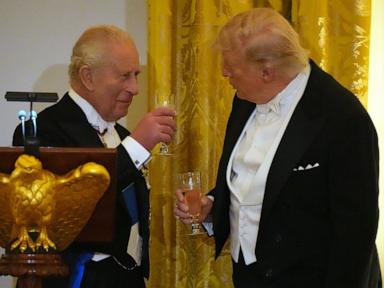
The sight of a British monarch standing in the White House to toast the 250th anniversary of the American Revolution is a historical irony that King Charles III did not let go to waste. As he addressed a room filled with American power players, he delivered a performance that was part diplomatic tightrope walk and part stand-up routine. He did what few expected: he turned a celebration of Britain’s greatest colonial failure into a masterclass in modern soft power.
By the time the dinner ended, the King had joked about the British burning the White House, teased the President about the origins of "football," and gifted Donald Trump a relic from a World War II submarine that happened to share the President’s name. This was not just a collection of quips. It was a calculated effort to stabilize a transatlantic partnership that has felt the strain of trade disputes and shifting military priorities.
The HMS Trump and the Art of the Personal Gift
The centerpiece of the evening was a heavy, polished brass bell. It wasn't just any maritime artifact; it was the original bell from the HMS Trump, a British submarine launched in 1944. The inscription—"Trump 1944"—was a stroke of genius in personal diplomacy.
In the world of high-level state visits, gifts are often generic or overly formal. Giving a sitting President a piece of history that literally bears his name is a move designed to bypass the bureaucratic layers of the State Department and speak directly to the man at the table. It served as a tangible reminder of the era when the U.K. and U.S. were inseparable in their combat objectives.
The choice of a submarine bell carries weight. Submarines are the silent service, operating beneath the surface to maintain global security. By presenting this specific item, Charles III signaled that even when the public rhetoric between London and Washington gets loud or discordant, the "underwater" structural alliance remains intact.
Weapons of Wit: Using History to Defuse Tension
Charles III has spent seven decades in the shadow of the most famous woman on earth, developing a dry, self-deprecating wit that he deployed with surgical precision. He addressed the "readjustments" to the East Wing—a reference to the President’s ambitious $400 million ballroom project—by reminding the audience that the British made their own "small attempt at real estate development" in 1814 when they set the building on fire.
This humor serves a dual purpose. First, it acknowledges the bloody and contentious history between the two nations, effectively saying that if they can move past the War of 1812, they can move past current disagreements over tariffs or NATO spending. Second, it humanizes a monarch who is often viewed through a lens of stiff traditionalism.
The most daring line of the night touched on the "Special Relationship" through a linguistic lens. "You recently commented, Mr. President, that if it were not for the United States, European countries would be speaking German," the King remarked, pausing for effect. "Dare I say that, if it wasn't for us, you'd be speaking French."
It was a bold move that drew genuine laughter from both sides of the aisle. By engaging in this kind of historical sparring, the King asserted British relevance without appearing defensive.
The Constitutional Tightrope
While the jokes landed, the King had to navigate a minefield of domestic and international politics. As a constitutional monarch, he cannot make policy, yet he is the ultimate representative of British interests. His visit coincided with the 250th anniversary of the Declaration of Independence—a celebration of the moment the American colonies rejected his ancestor, George III.
He handled this by describing the Revolution not as a rejection of Britishness, but as a "visionary act of self-determination" that perfected the shared heritage of liberty. It was a rhetorical pivot that allowed the U.K. to claim a piece of the American success story.
Security and Sympathy
The tone shifted when the King addressed the recent security incident near the Capitol. His expression of sympathy for the President and the First Lady was more than just a polite gesture. In the context of a state visit, it was a formal declaration of solidarity against political violence.
This was reinforced during his earlier address to Congress—only the second time a British monarch has done so. He achieved a rare feat in a polarized Washington: a standing ovation from both Democrats and Republicans. Trump himself later joked that the King managed to get the Democrats to stand, something he had struggled to do himself.
The Strategic Undercurrents of the Visit
Beyond the toasts and the gift-giving, the visit had a specific checklist of goals.
- Trade Relations: The inclusion of British roast beef at the Embassy garden party was a subtle nod to the recent lifting of U.S. tariffs on British agricultural products.
- Military Cooperation: Mentions of AUKUS and NATO were strategically placed to remind the American administration of the U.K.'s role as a primary security partner in both the Atlantic and the Pacific.
- Climate and Technology: While Charles III has historically been vocal about the environment, he moderated his tone to align with the current administration's focus on technological innovation and energy independence.
The King’s visit proved that the monarchy remains Britain’s most effective diplomatic tool. While prime ministers and presidents come and go, the Crown offers a sense of permanence. By the time Charles III left for New York to visit the September 11 Memorial, he had successfully reframed the U.K. not as a fading power, but as a steady, indispensable ally with a very long memory.
The HMS Trump bell now sits in the White House, a heavy piece of brass that says more about the future of the alliance than any joint communiqué ever could. It is a reminder that in the high-stakes world of geopolitics, sometimes the best way to move forward is to look back at what was shared in the depths of a global crisis.


